



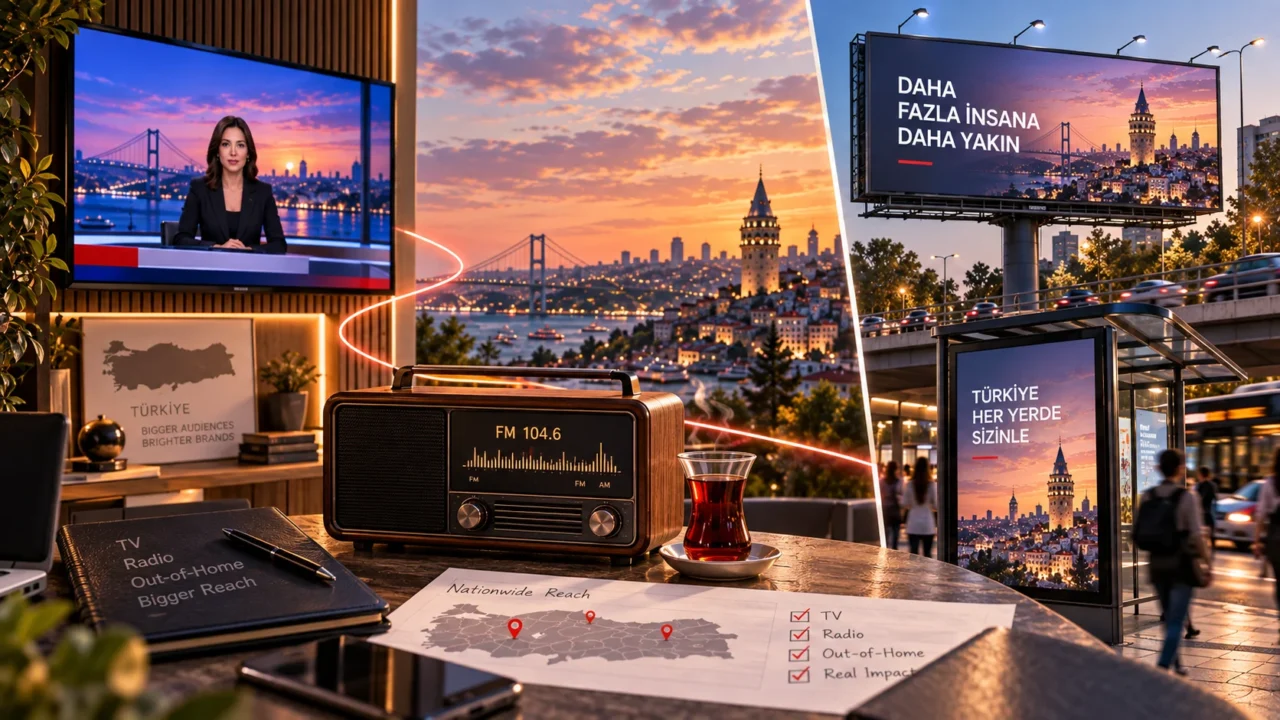
TV, Radio and Out-of-Home Media Buying in Turkey
Turkish media investment is overwhelmingly digital, but offline is not the rounding error most foreign brands assume. According to the Estimated Media and Advertising Investments Report prepared by Deloitte for Turkey’s advertising industry bodies, digital took 74.2 percent of media investment in 2024. Television followed at 18.3 percent with TRY 38.86 billion, out-of-home at 5.1 percent with TRY 10.94 billion, radio at 1.6 percent with TRY 3.3 billion, press at 0.8 percent and cinema at 0.1 percent.
So the question is not whether offline media matters in Turkey. It is whether it matters for your brand at your stage — and the honest answer for most foreign brands entering the market is not yet, with specific and identifiable exceptions.
Before any of that, one warning about the numbers themselves. Those figures are nominal Turkish lira in a high-inflation period, and the growth rates reported alongside them — television up 56.1 percent, out-of-home up 115.2 percent, radio up 100 percent year on year — are not real growth. Treat lira growth percentages in Turkish media reporting as inflation-inflated unless someone has explicitly adjusted them.
This guide covers what each offline medium is actually good for in Turkey, the RTÜK rules that constrain what you can broadcast, how offline is bought and measured here, and the specific circumstances in which a foreign brand should consider it.
Table of Contents
- The real media mix, and how to read it
- Television: what it is for
- The RTÜK rules you need before you buy
- Out-of-home: the strongest offline case
- Radio: small but underrated
- Cinema and retail media
- How offline is bought and measured
- When offline makes sense for a foreign brand
- When it does not
- Creative cannot be shipped in
- Integrating offline with digital
- Common mistakes
- Frequently asked questions
- Conclusion
The real media mix, and how to read it
The Estimated Media and Advertising Investments Report is the authoritative source here. It is produced by Deloitte on behalf of the Advertisers’ Association (RD), the Association of Advertisers (RVD), IAB Turkey, the Outdoor Advertisers’ Foundation (ARVAK), the National Radio Broadcasters’ Association (URYAD), the Mobile Marketing Association Turkey and TİAK, the television audience measurement body.
Its 2024 full-year edition, published in April 2025, reported total media and advertising investment of TRY 253.6 billion, of which TRY 213 billion was media investment and TRY 40.6 billion covered production, printing and advertiser service fees.
| Medium | Share of media investment (2024) | Volume (TRY) | Leading sectors |
|---|---|---|---|
| Digital | 74.2% | over 158 billion | — |
| Television | 18.3% | 38.86 billion | Food, home cleaning, cosmetics and personal care |
| Out-of-home | 5.1% | 10.94 billion | Entertainment/culture/sport 16%, cosmetics and personal care 14%, retail 11% |
| Radio | 1.6% | 3.3 billion | Finance, automotive, e-commerce, retail |
| Press | 0.8% | 1.64 billion | Finance 21%, then textile, holdings, e-commerce and retail |
| Cinema | 0.1% | 261.7 million | Finance, optics, watches and accessories |
Two things are worth noticing in that sector column, because they are more useful than the headline shares.
Television is dominated by FMCG. Food, home cleaning and personal care lead TV investment, which tells you what the medium is being used for: mass-reach brand building for low-consideration, high-frequency purchases sold through physical retail.
Out-of-home skews differently. Entertainment, culture and sport lead, followed by cosmetics and retail. That is a location and moment medium, not a mass-reach substitute for TV.
At the time of writing, the 2024 full-year report is the most recent annual edition published. Check for a newer edition before planning, since these are released annually in spring. And note the report’s own framing: these are estimates compiled from member agencies and sector bodies, not audited market totals.
For the digital side of the same picture, see our budget guide to digital marketing costs in Turkey.
Television: what it is for
Turkish television retains genuine cultural centrality, particularly around drama series, live football and news. For the right brand it delivers reach at a speed no digital channel matches.
The realistic use cases for a foreign brand are narrow but real:
- A national FMCG launch where you need broad awareness quickly and your product sits on shelves in Migros, BİM, A101 and Şok.
- Category creation, where you are explaining something Turkish consumers do not yet have a mental model for.
- Credibility building at scale for a brand nobody in Turkey has heard of — television presence still signals substance to a Turkish audience in a way digital does not.
- Sponsorship of a specific property — a series, a sports broadcast, a programme — which can be more efficient than spot buying and sits outside the standard advertising time limits described below.
What television is not, for a foreign brand entering Turkey, is a performance channel or a test. The minimum viable spend to achieve meaningful frequency across a national schedule is substantial, production costs sit on top, and the feedback loop is slow. If your Turkish business case is still unproven, television is the wrong place to prove it.
The RTÜK rules you need before you buy
Broadcast advertising in Turkey is governed by Law No. 6112 on the Establishment of Radio and Television Enterprises and Their Media Services, supervised by RTÜK, the Radio and Television Supreme Council. These rules constrain inventory and creative in ways that affect planning, not just compliance.
The 20 percent rule. Under Article 10 of Law No. 6112, excluding teleshopping, the proportion of all advertising broadcasts cannot exceed 20 percent of the broadcast between one hour mark and the next — in practice 12 minutes per hour. RTÜK enforces this actively, and its published decisions include penalties against broadcasters that exceeded it.
For an advertiser this matters as a supply constraint: premium inventory around high-rating programming is genuinely scarce, and pricing reflects that.
What sits outside the 20 percent. Article 10 excludes programme sponsorship, the broadcaster’s own programme promotions and product placement from that ratio. Programme promos are separately capped at 5 percent, or three minutes per hour. This is why sponsorship and product placement are structurally attractive in Turkish television — they access attention that the advertising cap does not ration.
Advertising must be clearly distinguishable. Law No. 6112 requires that advertising and teleshopping be arranged so they are clearly recognisable through an audio and/or visual warning and easily distinguishable from other elements of the programme service. Band advertising — the overlay format defined in RTÜK’s implementing regulation — is subject to the same identification requirements.
Product placement has its own restriction. RTÜK’s guidance states that band advertising for the placed product cannot be run during the product placement itself.
Health claims are tightly policed. RTÜK states that in commercial communication broadcasts, food supplements, herbal products, various devices and any other product cannot be presented with health claims in a way that causes them to be perceived as medicine. If your category is anywhere near this territory, get the script cleared before production, not after — a point that connects to the regulatory picture in our guide to healthcare and wellness marketing in Turkey.
One clarification worth stating: RTÜK governs the broadcast. The Advertising Board under the Ministry of Trade separately governs the content of commercial advertising under consumer protection law. A television commercial is subject to both regimes, and clearing one does not clear the other.
Out-of-home: the strongest offline case
For most foreign brands, out-of-home is the offline medium that actually deserves consideration first — not television.
The reasons are structural. It can be bought city by city or district by district, which suits a brand launching in İstanbul before committing nationally. It requires no broadcast clearance process. Production costs are far lower than a television commercial. And digital out-of-home inventory — LED screens, shopping centre, airport and point-of-sale screens, as the industry reporting categorises it — allows creative changes without reprinting.
The sector data supports the case: out-of-home took 5.1 percent of media investment in 2024 at TRY 10.94 billion, and was among the fastest-growing media in nominal terms. The leading investing sectors — entertainment, culture and sport at 16 percent, cosmetics and personal care at 14 percent, retail at 11 percent — indicate what it is used for: presence in high-footfall urban environments, close to consumption moments.
Practical planning points for Turkey specifically:
- İstanbul dominates but is not uniform. The city’s districts differ enormously in demographics and income. A blanket İstanbul buy wastes a large share of impressions for most brands.
- Transit inventory is significant. Metro, metrobus and airport environments deliver long dwell times with captive attention.
- Shopping centres are a distinct channel. Turkish AVM culture means mall screens reach shoppers close to purchase, particularly for cosmetics, fashion and electronics.
- Local permissions apply. Outdoor advertising is subject to municipal regulation, which is one reason this is bought through specialist operators rather than directly.
Radio: small but underrated
Radio took 1.6 percent of Turkish media investment in 2024 at TRY 3.3 billion. That small share understates its usefulness for specific objectives.
The sectors investing most in Turkish radio — finance, automotive, e-commerce and retail — point to what it does well. İstanbul and Ankara have severe traffic congestion and long commutes, which produces a large, regular in-car audience. For a brand whose message is simple and whose call to action is memorable, drive-time radio delivers frequency cheaply.
Three honest caveats. Radio cannot demonstrate a product, so it suits brands where the proposition is verbal rather than visual. Attribution is poor, so it works best as a frequency layer supporting a campaign measured elsewhere. And it demands genuinely Turkish scripting — a translated radio script is immediately audible as translated, more so than in any other medium.
The same audio production considerations covered in our guide to video marketing and content production in Turkey apply here, with the added constraint that voice is carrying all of it.
Cinema and retail media
Cinema took 0.1 percent of media investment in 2024, at TRY 261.7 million, with finance, optics and watches and accessories leading. It is a niche buy, appropriate for brands targeting a young urban audience with strong visual creative and no need for national reach.
More interesting for most foreign brands is retail media, which industry reporting identified as a rising trend in Turkey as it has been globally. Retail media — advertising inventory sold by retailers and marketplaces against their own shopper audiences — sits somewhere between offline and digital and is closer to where a consumer brand’s incremental budget usually performs best. It is not covered in the offline categories above, and it is developing quickly enough that anything written about it dates fast.
How offline is bought and measured
Offline media in Turkey is bought through media agencies holding relationships with broadcasters and outdoor operators, not through self-serve platforms. There is no equivalent of opening an account and uploading a creative.
Television measurement runs through TİAK, the television audience measurement company, which is also one of the bodies behind the investment report. TİAK data is the currency for television planning and post-buy evaluation in Turkey, and a media agency’s access to and competence with it is a reasonable thing to assess when selecting a partner — alongside the criteria in our guide to choosing a digital marketing agency in Turkey.
Out-of-home measurement is weaker. Audience estimates for outdoor inventory are less standardised than broadcast ratings. Ask specifically what measurement is being offered before signing, and treat impression estimates as vendor claims rather than currency.
Rate cards are negotiable and opaque. Published rate cards are starting points. Actual pricing depends on volume, commitment, timing and relationship. A foreign brand buying its first Turkish schedule without local representation will not get the same terms as an established advertiser, and no public benchmark exists to tell you how far off you are.
Plan for the tax layer. Advertising payments in Turkey carry their own fiscal treatment that differs by who is paying and being paid. That belongs in the budget model alongside media cost.
When offline makes sense for a foreign brand
Five situations where the case is genuine:
- You are in physical retail distribution. If your product is on shelves in Turkish chains, offline reach supports sell-through in a way digital alone does not, and retailers themselves notice media support.
- You have already validated demand digitally. Offline makes sense as an amplification layer on top of proven digital performance, not as a first bet.
- Your category is low-consideration and mass-market. FMCG, beverages, household products — the categories that dominate Turkish TV investment for good reason.
- You are launching city-first. Out-of-home in a defined İstanbul catchment is a contained, measurable-ish way to build local presence.
- You have a genuine moment. A sponsorship, a seasonal peak, a retail activation — offline is strongest when it is tied to something specific rather than running as always-on presence. Turkey’s seasonal calendar is covered in our guide to the Ramadan and Black Friday marketing calendar for brands in Turkey.
When it does not
The cases against are equally clear, and more commonly applicable.
You are testing the market. Offline cannot be bought at test scale meaningfully, and the feedback loop is too slow to inform an entry decision.
You have no physical distribution. Driving mass awareness for a product people cannot easily buy converts poorly.
Your category is niche or B2B. Mass media wastes the overwhelming majority of its reach on audiences who will never buy.
Your Turkish digital foundations are incomplete. Offline drives search and direct traffic. If your Turkish site, checkout or marketplace presence is not ready, you are paying to send people to a dead end.
Your budget cannot sustain frequency. A single burst of television at low frequency is money spent for no durable effect. If you cannot fund repetition, do not start.
Creative cannot be shipped in
This is where foreign brands most often underestimate cost and timeline.
A global television commercial with a Turkish voiceover is identifiable as a foreign asset, and Turkish audiences read it as such. Casting, setting, humour, family portrayal and music all carry cultural specificity that dubbing does not resolve. Out-of-home has the same problem in compressed form: a headline that works in English frequently does not survive translation into the shorter, punchier register Turkish outdoor copy requires.
There is also a regulatory dimension. Creative produced for another market has not been cleared against Turkish broadcast rules or advertising content rules, and the comparative claims, health-adjacent language or promotional mechanics that were acceptable elsewhere may not be here.
The practical implication is that offline media budgets need a genuine local production line beside them — the kind of work covered by Medyae’s production capability alongside its digital services. Media buying itself is typically handled through specialist media agencies holding the broadcaster and outdoor operator relationships, so a foreign brand running offline in Turkey usually has both a production partner and a media buying partner rather than one supplier.
Integrating offline with digital
Offline in Turkey works best when it is planned as a driver of measurable digital activity rather than as a parallel brand exercise.
Expect a search response. Television and radio generate branded search. Ensure you own your brand terms in Google before the campaign runs, and watch branded search volume as a leading indicator — it is often the fastest available read on whether offline is working. Our guide to Google Ads and Meta Ads in Turkey covers the search side.
Use the same creative platform across channels. Fragmented messaging wastes the frequency offline buys you.
Consider digital video as a partial substitute. YouTube and connected TV deliver video reach in Turkey with better targeting and measurement than broadcast, at lower minimum commitment — see our guide to YouTube advertising in Turkey. For many foreign brands this is the right first step before broadcast, not an alternative to it.
Instrument the measurement before, not after. Baseline branded search, direct traffic and conversion rates ahead of the campaign, or you will have nothing to compare against. Getting the analytics foundation right is covered in our GA4 and marketing analytics setup guide for Turkey.
Common mistakes
Reading lira growth figures as real growth. Nominal increases in a high-inflation period overstate genuine expansion substantially.
Starting with television. For most foreign brands, out-of-home or digital video is the appropriate first offline step.
Dubbing global creative. Audiences recognise it, and it has not been cleared against Turkish rules.
Ignoring the sponsorship and product placement route. These sit outside the 20 percent advertising cap and can reach attention that spot buying cannot.
Treating RTÜK clearance as covering advertising content. Broadcast rules and consumer protection advertising rules are separate regimes.
Buying a blanket İstanbul outdoor package. District-level targeting matters in a city this varied.
Running offline before the digital funnel is ready. Awareness drives search; search needs somewhere to land.
Accepting outdoor impression estimates as measurement. Ask what the methodology is.
Frequently asked questions
How much of Turkish advertising spend goes to offline media?
According to the Estimated Media and Advertising Investments Report prepared by Deloitte for Turkey’s industry associations, digital took 74.2 percent of media investment in 2024. Television accounted for 18.3 percent, out-of-home 5.1 percent, radio 1.6 percent, press 0.8 percent and cinema 0.1 percent. Check for a more recent annual edition before planning.
How much advertising can Turkish television broadcast per hour?
Under Article 10 of Law No. 6112, excluding teleshopping, advertising cannot exceed 20 percent of the broadcast between one hour mark and the next — 12 minutes per hour. Programme sponsorship, the broadcaster’s own programme promotions and product placement are excluded from that ratio, and programme promotions are separately capped at 5 percent.
Should a foreign brand entering Turkey buy television advertising?
Usually not as a first step. Television suits mass-market, low-consideration categories with established physical distribution and a budget able to sustain frequency. For brands still validating Turkish demand, digital video and out-of-home offer reach at lower minimum commitment with faster feedback.
Which offline medium should a foreign brand consider first?
Out-of-home, in most cases. It can be bought city or district by district, needs no broadcast clearance, costs far less to produce for, and digital out-of-home inventory allows creative changes without reprinting — all of which suit a brand launching in İstanbul before committing nationally.
Can I use my global TV commercial in Turkey with a Turkish voiceover?
Technically yes, but it is rarely effective and carries regulatory risk. Casting, setting, humour and music read as foreign to Turkish audiences, and creative produced elsewhere has not been cleared against Turkish broadcast rules or advertising content rules. Budget for local production.
Who regulates television advertising in Turkey?
RTÜK, the Radio and Television Supreme Council, supervises broadcasting under Law No. 6112, including advertising duration, identification and product placement rules. Separately, the Advertising Board under the Ministry of Trade supervises the content of commercial advertising under consumer protection legislation. A commercial is subject to both.
Conclusion
Offline media in Turkey is a smaller share of investment than most foreign brands expect and a more regulated environment than they are prepared for. Digital took nearly three-quarters of media investment in 2024, and for a brand still establishing demand that concentration is a reasonable guide to where budget belongs.
Where offline earns its place is specific: physical retail distribution, mass-market categories, validated demand, city-level launches and genuine campaign moments. Out-of-home is the sensible entry point for most brands, television the commitment you make once the business case is proven, radio a cheap frequency layer for verbal propositions.
Whatever you buy, build in local creative production and clear the work against both RTÜK’s broadcast rules and Turkish advertising content rules before you produce it. The brands that struggle here are rarely the ones that spent too little. They are the ones that bought reach for a message that had not been made Turkish, pointing at a funnel that was not ready.