



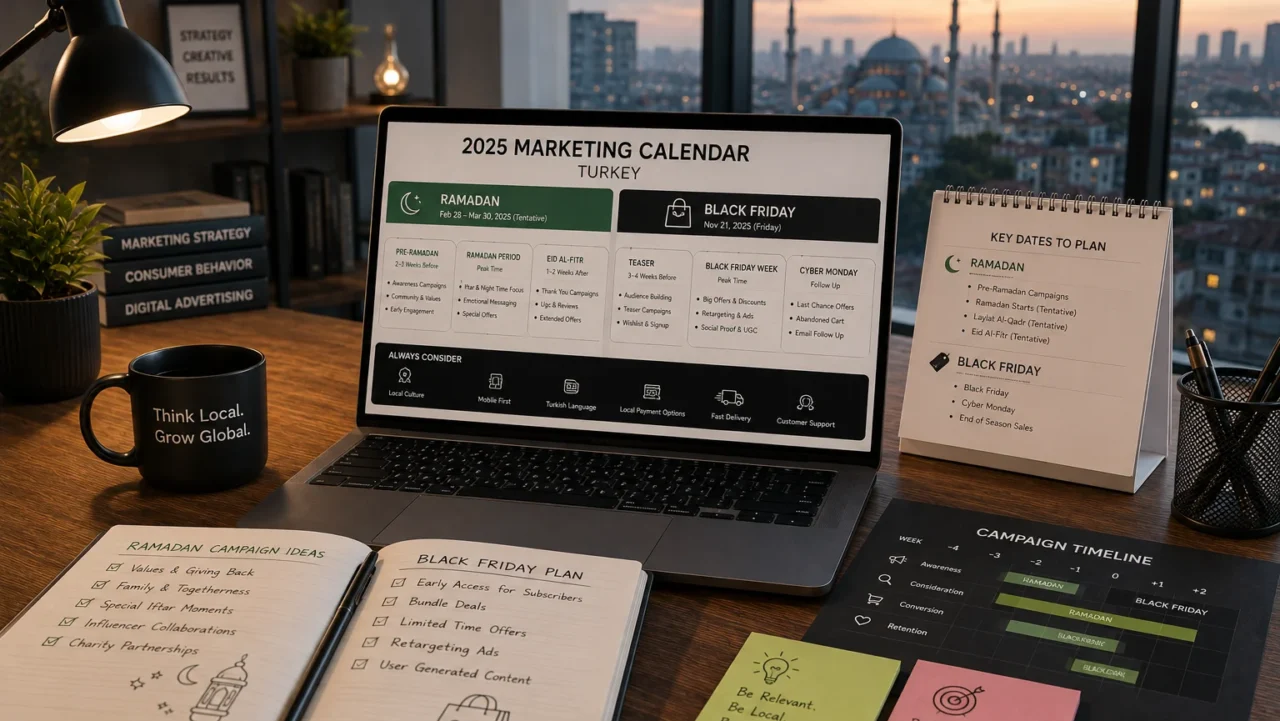
Ramadan and Black Friday Marketing Calendar for Brands in Turkey
A marketing calendar built around the Western retail year — a slow build to a Black Friday and Christmas peak — maps poorly onto Turkey. Turkey runs on two overlapping calendars: a Western-influenced retail calendar that includes Black Friday and 11.11, and a lunar Islamic calendar that governs Ramadan and Bayram, Turkey’s biggest annual consumer spending and gifting periods. A brand planning Turkey campaigns around only one of these two calendars is missing real, recurring demand. This guide covers how to build a genuinely integrated calendar, from channel-specific timing to regional and category differences to the measurement framework needed to prove seasonal spend is working.
Table of Contents
- Why Turkey’s Retail Calendar Doesn’t Match the West
- Ramadan and Bayram: What Actually Happens to Demand
- 11.11 and Black Friday in Turkey
- Building a Year-Round Campaign Framework
- Budget and Creative Timing
- Channel-Specific Timing Considerations
- Regional and Category Differences Within Turkey
- Other Dates Worth Tracking
- Measuring Seasonal Campaign Performance
- Common Mistakes
- Conclusion
- FAQ
Why Turkey’s Retail Calendar Doesn’t Match the West
Most global campaign calendars are built around a fixed Gregorian retail rhythm — back-to-school, Black Friday, the December holiday season. Turkey shares some of that rhythm, since Turkish e-commerce has absorbed Western sales events like Black Friday and 11.11 into its own calendar. But layered on top of that is Ramadan and the two Bayram holidays that follow the Islamic lunar calendar, which shifts roughly ten to eleven days earlier each Gregorian year. A campaign calendar copied directly from a Western template simply has no slot for the single biggest shift in Turkish consumer behavior each year.
This isn’t a minor scheduling quirk — it’s a structural feature of the market that a marketing team based in a Western headquarters can easily underestimate if the only reference point is a corporate global calendar template. A calendar built specifically for Turkey needs its own line items, not an adapted version of a calendar designed for a market that doesn’t observe Ramadan or Bayram at all.
Ramadan and Bayram: What Actually Happens to Demand
- Grocery, food, and gifting categories see a significant pre-Ramadan spending surge. Shopping activity concentrates heavily in the days before Ramadan begins, as households stock up for the month ahead — brands in food, home goods, and gifting categories should treat this lead-in window as a primary campaign period, not an afterthought.
- Daily shopping and browsing patterns shift during the month itself. Online activity tends to concentrate later in the evening during Ramadan, after the daily fast breaks, which has real implications for ad scheduling and social posting times.
- Eid al-Fitr (Ramazan Bayramı) drives a second spending peak centered on gifting, new clothing, and travel, as families gather and exchange gifts — fashion, travel, and confectionery categories see particularly strong demand around this period.
- Eid al-Adha (Kurban Bayramı) follows roughly two months later and carries its own, generally smaller, consumer spending pattern, with travel and family gathering as dominant themes.
- Messaging tone matters as much as timing. Campaigns that feel tone-deaf to the reflective, family-oriented spirit of the season — overly aggressive discount messaging with no cultural context — tend to underperform relative to campaigns that acknowledge the occasion authentically.
It’s worth noting that these two Bayram holidays function quite differently for brands. Eid al-Fitr, immediately following Ramadan, carries a strong gifting and renewal theme — new clothes, sweets, and family visits — and tends to reward fashion, confectionery, and home-goods campaigns that lean into that spirit. Eid al-Adha, by contrast, centers more on travel and family gathering than on gift purchasing, which means travel, hospitality, and food-delivery brands typically see stronger returns from this second holiday than gifting-oriented categories do.
11.11 and Black Friday in Turkey
- 11.11 (Singles’ Day) has been adopted enthusiastically by Turkish marketplaces, particularly Trendyol, functioning as a major discount event on par with markets where the tradition originated in East Asia.
- Black Friday has become a genuine, high-volume shopping event in Turkey, not a niche import — major retailers and marketplaces build significant campaigns around it, and consumer awareness of the event is now well established.
- These events reward early creative and inventory planning. Because both dates are fixed and heavily anticipated, competition for ad inventory and consumer attention peaks in the days immediately before and during the events — brands that finalize creative and promotions well in advance outperform those scrambling in the final week.
- Marketplace participation requirements often have lead time. Featured placement in major sales events on platforms like Trendyol typically requires meeting pricing and stock criteria set weeks in advance, not something arranged the week of the event.
The proximity between 11.11 and Black Friday, roughly two to three weeks apart depending on the exact year, creates a distinct planning challenge that doesn’t exist in markets that only observe one of the two events. Brands need to decide whether to run two genuinely distinct campaigns with fresh creative for each, or a single extended promotional window that spans both — the right choice depends heavily on category and inventory strategy, since running two full-intensity campaigns back to back can fatigue both budget and audience attention if not paced deliberately.
Building a Year-Round Campaign Framework
- Map both calendars together, not separately. Plot the lunar Ramadan and Bayram dates for the relevant campaign year alongside the fixed Gregorian retail dates in a single calendar, since the lunar shift means the relative spacing between events changes every year.
- Prioritize by category fit. Not every brand needs to activate around every period — a B2B software company gets little value from a Ramadan gifting push, while a fashion or food brand should treat it as a top-tier priority period.
- Build lead-in windows into the plan, not just the event day itself. The pre-Ramadan and pre-Bayram shopping surge, and the run-up to Black Friday and 11.11, are where much of the actual purchasing decision happens — campaigns launched only on the day itself arrive too late for a meaningful share of the audience.
- Leave room for a slower post-event period. Spending typically cools noticeably in the days immediately following a major event or holiday; budget and creative cadence should account for this rather than maintaining a flat spend level year-round.
A useful practical habit is building the calendar at least twelve to eighteen months out in advance, since Ramadan’s roughly ten-to-eleven-day annual shift means a date that fell in a slow retail month this year might land during back-to-school season or close to a fixed holiday next year. Building further out also gives creative and marketplace planning teams enough lead time to avoid the scramble that produces generic, last-minute campaigns.
Budget and Creative Timing
- Ad costs rise during peak competitive windows. CPCs and CPMs across Google, Meta, and marketplace advertising typically climb during Black Friday, 11.11, and the Bayram lead-in, as more advertisers compete for the same attention — budgeting for this increase in advance avoids being priced out mid-campaign.
- Creative needs a longer production lead time than the campaign itself suggests. Ramadan and Bayram-specific creative, in particular, benefits from being developed well ahead of the lunar date shift each year rather than repurposed last-minute from a generic template.
- Reserve some budget flexibility for the lunar calendar’s annual shift. Because Ramadan moves roughly ten to eleven days earlier each Gregorian year, a campaign plan that assumes the same calendar week annually will eventually collide with a different, less favorable part of the fixed retail calendar.
Channel-Specific Timing Considerations
Different channels respond to Turkey’s seasonal calendar in different ways, and a single blanket timing plan applied uniformly across paid search, social, and marketplace advertising tends to underperform a channel-aware one. Understanding these differences lets a media plan front-load budget where the demand signal actually starts, rather than moving every channel on the same schedule by default.
- Search demand shifts earlier than social engagement. Google search volume for gift and grocery-related terms typically begins rising in the days before Ramadan starts, while social engagement often peaks later, closer to the actual Bayram dates — this argues for staggering search and social budget increases rather than moving them in lockstep.
- Marketplace advertising follows the marketplace’s own promotional calendar. Platforms like Trendyol run their own internal campaign structures around 11.11 and Black Friday that don’t always align neatly with a brand’s independent paid social calendar, so marketplace ad timing needs to be planned against the platform’s own event schedule.
- Email and SMS remarketing have a narrower effective window during Ramadan. Given the shift toward evening browsing after the daily fast breaks, remarketing sends timed for typical daytime engagement windows land at a much lower-attention moment than the same message sent in the evening.
Regional and Category Differences Within Turkey
Treating Turkey as a single, uniform market during these seasonal windows misses meaningful variation — both in how strongly different regions respond to Ramadan and Bayram, and in how different product categories perform around Black Friday and 11.11. Brands that segment their calendar planning by region and category tend to allocate budget more efficiently than those running one identical national plan.
Observance intensity and shopping behavior around Ramadan can vary somewhat between major urban centers and more traditional regions, which has implications for both messaging tone and channel mix — a campaign calibrated for one region’s sensibilities may need adjustment for another. Category performance also diverges sharply around the fixed retail dates: electronics and home appliances tend to dominate Black Friday and 11.11 volume, while fashion and beauty see comparatively stronger lift around the Bayram gifting window. A brand operating across multiple categories or targeting a national audience benefits from building this variation into the calendar rather than applying one national plan uniformly.
Other Dates Worth Tracking
Beyond the two major calendars, several other dates carry real commercial weight in Turkey and are easy to miss if the campaign calendar only covers Ramadan, Bayram, Black Friday, and 11.11. None of these individually match the scale of the major events, but together they represent a meaningful share of annual seasonal opportunity that a narrowly focused calendar leaves unaddressed.
- New Year’s Eve (Yılbaşı) functions as a genuine gifting and celebration occasion in Turkey, distinct from its more muted treatment in some other markets, with strong demand in food, home goods, and gifting categories in the final days of December.
- Mother’s Day and Father’s Day follow international dates and drive meaningful gifting-category demand, particularly in flowers, jewelry, and personal care.
- Back-to-school season concentrates in late August and early September ahead of the academic year, with strong demand in stationery, electronics, and apparel categories.
None of these rival Ramadan, Bayram, or Black Friday in scale, but for brands in relevant categories, leaving them off the calendar entirely means missing smaller, but still meaningful, recurring demand windows.
Measuring Seasonal Campaign Performance
A seasonal calendar is only useful if its performance can actually be measured and compared year over year, and this is where many otherwise well-planned calendars fall short — spend increases during peak windows without a clear framework for judging whether that spend produced proportionally better results.
The most useful comparison isn’t peak-period performance against a flat annual average, since that comparison will almost always favor the peak period and tells a brand little about efficiency. A more informative benchmark compares this year’s peak-period cost-per-acquisition and return on ad spend against the same peak period the previous year, adjusted for the lunar calendar shift — this isolates whether the campaign itself improved, rather than simply reflecting the general lift that any campaign gets during a high-demand window. Tracking this comparison consistently, year after year, is what eventually turns a seasonal calendar from an educated guess into a genuinely data-informed plan.
Common Mistakes
- Copying a Western retail calendar without adding Ramadan and Bayram. This is the single most common gap, and it means missing the largest annual consumer spending shift in the Turkish market.
- Treating Ramadan purely as a discount opportunity. Messaging that ignores the cultural and reflective tone of the season tends to underperform against campaigns that strike a more authentic, less purely transactional note.
- Failing to track the lunar date shift year over year. A calendar built once and reused without adjustment eventually falls out of sync with the actual dates.
- Launching Black Friday or 11.11 creative too close to the date. Given how much of the buying decision happens in the lead-in window, late creative misses a meaningful share of the available demand.
- Applying one national calendar uniformly across all regions and categories. Ignoring regional observance differences and category-specific timing patterns leaves performance on the table that a more tailored, segmented plan would otherwise capture.
- Measuring peak performance against a flat annual average. This comparison flatters almost any seasonal campaign by default and obscures whether the campaign genuinely improved year over year or simply rode the natural seasonal lift.
Conclusion
Six points are worth carrying into a Turkey seasonal marketing calendar. Together, they shift the planning process from a single national timeline copied from a Western template into a genuinely layered calendar that reflects how demand actually moves across regions, categories, and channels throughout the year:
- Turkey runs on two overlapping calendars — a Western-influenced retail calendar and a lunar Islamic calendar — and a genuinely complete campaign plan needs to account for both, not just the one that’s easier to copy from a global template.
- Ramadan and Bayram drive the single largest annual consumer spending shift in the market, with distinct pre-event, during-event, and post-event demand patterns that a static campaign plan tends to miss.
- 11.11 and Black Friday are genuine, high-volume events in Turkey, not niche imports, and reward early creative development and marketplace participation planning well ahead of the actual dates.
- Lead-in windows matter more than the event day itself for both calendars — campaigns that launch only on the day arrive too late for a meaningful share of the audience, whose purchasing decisions were already made days earlier.
- Different channels and regions respond to the calendar differently, and a single uniform timing plan applied across search, social, and marketplace channels leaves performance on the table.
- Measurement needs to compare peak periods year over year, adjusted for the annual lunar calendar shift, rather than against a flat annual average, to tell whether a campaign genuinely improved.
If you’re building a Turkey campaign calendar and want the timing coordinated across paid, social, and marketplace channels, our Paid Advertising in Turkey guide covers channel-specific planning in more depth, and our Social Media Marketing in Turkey guide covers how organic and paid content should work together around key dates throughout the year.
FAQ
Why do Ramadan and Bayram dates change every year?
They follow the Islamic lunar calendar, which is shorter than the Gregorian solar calendar, causing these dates to shift roughly ten to eleven days earlier each Gregorian year. This means a campaign calendar needs to be checked and adjusted annually rather than reused from the previous year.
Which types of brands benefit most from a Ramadan campaign?
Food and grocery, fashion, home goods, and gifting-oriented categories typically see the strongest lift, given the gifting and family gathering traditions around Ramadan and Bayram. B2B and highly transactional categories generally see less direct benefit from Ramadan-specific campaigns.
Is Black Friday a real shopping event in Turkey, or mostly marketing hype?
It’s a genuine, high-volume shopping event with strong consumer awareness and significant retailer participation, comparable in scale to how it’s treated in many Western markets rather than a minor imported novelty.
Do Eid al-Fitr and Eid al-Adha require the same campaign approach?
Not quite — Eid al-Fitr leans more heavily toward gifting, new clothing, and confectionery, while Eid al-Adha centers more on travel and family gathering than on purchasing. Fashion and gifting brands typically see stronger returns around Eid al-Fitr, while travel and hospitality brands often do better around Eid al-Adha instead.
Should 11.11 and Black Friday be run as one combined campaign or two separate ones?
Both approaches can work, but the right choice depends heavily on category and inventory strategy. Running two full-intensity campaigns back to back risks fatiguing both budget and audience attention, so the pacing between the two events needs to be deliberate rather than defaulted into without a plan.
How far in advance should Ramadan or Black Friday campaigns realistically be planned?
Creative and marketplace participation planning typically benefit from starting several weeks ahead of the event, since ad costs and competition for attention both rise sharply in the immediate lead-in window, and marketplace featured placements often require meeting criteria set well in advance of the actual sale date.
Do all marketing channels need to ramp up at the same time before a peak period?
No — search demand for seasonal terms often rises earlier than social engagement does, and marketplace advertising follows the platform’s own promotional calendar rather than a brand’s independent timeline, so staggering the ramp-up by channel usually outperforms moving every channel in lockstep with each other.
Does Ramadan campaign performance vary by region within Turkey itself?
Observance intensity and shopping behavior can differ somewhat between major urban centers and more traditional regions, which has real implications for messaging tone and channel mix. A national campaign benefits from accounting for this variation rather than applying one single calibration everywhere across the country.
Are there other Turkey-specific dates worth adding to a full seasonal calendar?
New Year’s Eve, Mother’s and Father’s Day, and back-to-school season all carry real, category-specific demand, even though none individually rival Ramadan, Bayram, or Black Friday in overall scale. Brands in relevant categories still benefit meaningfully from including them in the plan.
What’s the right way to measure whether a seasonal marketing campaign actually performed well?
Comparing this year’s peak-period cost-per-acquisition and return on ad spend against the same peak period last year, adjusted for the lunar calendar shift, gives a far more accurate read than simply comparing peak performance to a flat annual average across the year.