



Trade and Shopper Marketing in Turkey: Winning Shelf, Terms and Conversion
Two facts decide trade marketing in Turkey. No single retailer gives you national coverage, and Turkish law limits what a retailer may charge you for shelf. Organised food retail is fragmented and discount-led: according to Euromonitor data published in the USDA’s 2026 Retail Foods Annual report for Türkiye, BİM led the organised food retail market at 18.4% at the end of 2025, followed by Migros at 9.2%, A101 at 7.8%, ŞOK at 6.0% and CarrefourSA at 1.8%. And Law 6585 on the Regulation of Retail Trade prohibits chains from demanding premiums for store opening, renovation or credit card participation, while allowing advertising, announcement and shelf allocation premiums only where the type and rate are written into the contract.
So a foreign brand cannot buy its way to distribution with one national deal, and cannot be charged for shelf in whatever form a buyer proposes. This article covers the channel map, the listing decision, the statutory trade-terms framework, the promotion rules that catch foreign brands out, and how to measure whether any of it worked.
Table of Contents
- What trade marketing and shopper marketing mean in the Turkish context
- The channel map: who you actually have to win
- Why no single retailer gives you national coverage
- The A101–CarrefourSA consolidation and what it changes for suppliers
- Distributor or direct listing
- What a Turkish retailer may charge you, and what it may not
- Payment terms and the thirty-day rule
- Promotion mechanics and the ten-day reference price rule
- What you cannot control: the retailer’s price
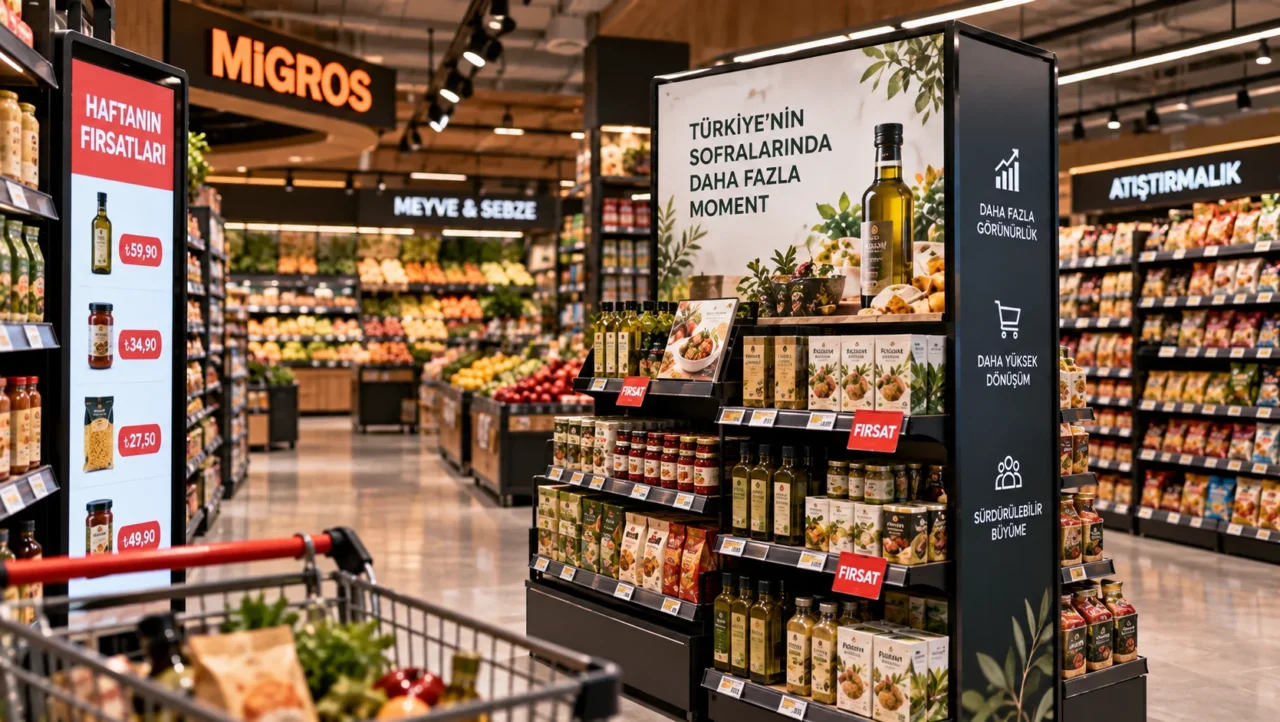
- Shelf, planogram and secondary display
- Private label as competitor and as option
- Measuring sell-out, not just sell-in
- Frequently asked questions
What trade marketing and shopper marketing mean in the Turkish context
Trade marketing is what you do with the retailer; shopper marketing is what you do to the person standing in front of the shelf. Trade marketing covers listing negotiations, trade terms, promotional calendars, distribution targets and the category argument you make to buyers. Shopper marketing covers pack visibility, shelf position, secondary displays, price-pack architecture and the mechanics that convert a shopper who had not planned to buy you.
In Turkey the two are harder to separate than in markets with concentrated retail, because the same negotiation that secures a listing often also determines your facings, promotional slots and display access.
Both are distinct from two adjacent disciplines this article does not repeat. Retailer-owned digital advertising inventory — sponsored placements on retailer apps and sites, and in-store screens sold as media — has its own economics, covered in our guide to retail media networks in Turkey. Funding arrangements where a local partner spends your money on marketing under agreed rules are covered in co-op marketing with Turkish distributors and dealers. Trade marketing is the layer underneath both: whether your product is physically present, at what price, in what position, under what terms.
The channel map: who you actually have to win
Turkish retail is not one channel with one set of rules. Each of the following requires a different commercial case, a different pack format and often a different price point.
| Channel | Examples | What it rewards | What it demands from a supplier |
|---|---|---|---|
| Hard discount | BİM, A101, ŞOK | Low price, limited assortment, high rotation | Very sharp cost, reliable volume supply, narrow SKU count, possible private label competition |
| National supermarket and hypermarket | Migros, CarrefourSA | Range, category depth, promotions, loyalty data | Full trade terms negotiation, promotional calendar, category argument |
| Regional and local chains | City and regional operators | Local relevance, flexibility, faster decisions | Regional distributor coverage; fragmented account management |
| Traditional trade | Neighbourhood grocers, kiosks | Impulse, single-serve, proximity | Distributor route-to-market; small packs; cash-and-carry presence |
| Specialist non-food | Gratis, Watsons (beauty); Teknosa, MediaMarkt, Vatan (electronics); Koçtaş, Bauhaus (DIY) | Category expertise, staff recommendation, demonstration | Training, merchandising investment, in-store staff programmes |
| Quick commerce and online grocery | Getir, Migros Hemen and comparable services | Convenience baskets, immediacy | Content quality, limited-range selection, different pack economics |
| Marketplaces | Trendyol, Hepsiburada, Amazon.com.tr | Search visibility, reviews, price competitiveness | A separate commercial model closer to e-commerce than trade marketing |
The practical consequence is that “we are launching in Turkey” is not a plan. A plan names the channels you will be in during year one, the pack formats each requires, and the margin you can sustain in each. Brands that treat discount and supermarket channels as one negotiation usually find that the cost structure a discounter accepts destroys the margin they need in the specialist channel.
Why no single retailer gives you national coverage
Using the Euromonitor figures in the USDA’s 2026 Retail Foods Annual report for Türkiye, the five largest organised food retailers together accounted for roughly 43% of the organised food retail market at the end of 2025 — BİM 18.4%, Migros 9.2%, A101 7.8%, ŞOK 6.0% and CarrefourSA 1.8%. Even the market leader sits below a fifth of organised retail, and organised retail is itself only part of total grocery sales, with traditional and local trade continuing to account for a substantial share.
Three consequences follow directly.
Distribution is built, not bought. Winning one national chain does not give you meaningful household reach. Reaching most Turkish shoppers requires several chains plus a distributor network covering regional chains and traditional trade.
Your buyer has less leverage than in concentrated markets — and so do you. No single chain can make your Turkish business, which protects you from over-dependence, but equally none has to care much about your brand if your category argument is thin.
Execution cost exceeds shelf-space cost. The expensive part is not the listing fee but the field force, merchandising visits, regional distributor margins and account management across many counterparties. Budget for the coverage model, not just the trade spend.
If you are still deciding whether the volume justifies that structure, our guide to sizing and validating the Turkish market before you enter sets out how to test demand before committing to a distribution build.
The A101–CarrefourSA consolidation and what it changes for suppliers
In April 2026 Yeni Mağazacılık, the company behind A101, agreed to acquire 89.28% of CarrefourSA — Sabancı Holding’s 57.12% stake and Carrefour Nederland BV’s 32.16% stake — at a company valuation of USD 325 million, with the final share value subject to net debt and working capital adjustment at closing. On 6 August 2026 the Turkish Competition Board (Rekabet Kurulu) approved the transaction conditionally.
The conditions matter to any supplier planning channel coverage:
- 48 stores to be divested — 10 A101 stores and 38 CarrefourSA stores.
- Operational independence — CarrefourSA must maintain an organisational structure and management separate from A101.
- Employment commitments — total employment to be preserved and increased for three years after the acquisition.
- A supplier support programme — support for at least 75 SMEs and local producers annually, including marketing, digital communications and analytics assistance.
- A local products umbrella brand — an umbrella brand strategy to raise the visibility of regional and domestic agricultural products.
The Board stated the commitments are binding and enforceable with daily administrative fines for breach. For a foreign supplier, operational independence is the condition to plan around: for now you negotiate with A101 and CarrefourSA as separate counterparties with separate assortments, not as one merged account. Verify any assumption of consolidated buying with each account rather than building a plan on it.
Distributor or direct listing
Most foreign brands entering Turkish physical retail choose between importing through a distributor and listing directly with chains. The decision usually comes down to volume, category and how much control you need over shelf execution.
| Through a distributor or importer | Direct listing with chains | |
|---|---|---|
| Speed to shelf | Faster — existing buyer relationships and logistics | Slower — you build each relationship |
| Coverage of traditional and regional trade | Realistic | Very difficult without a field force |
| Margin retained | Lower — distributor margin and trade terms both apply | Higher per unit |
| Control over shelf execution | Indirect; depends on contractual merchandising obligations | Direct, if you fund the field capability |
| Access to sell-out data | Depends entirely on what the contract requires the distributor to report | Depends on each retailer’s data sharing |
| Who carries regulatory responsibility | Often the importer, depending on product category and contract | Needs explicit allocation |
| Best fit | Market entry, broad distribution ambitions, categories needing traditional trade | Established volume, few key accounts, premium positioning needing controlled execution |
A hybrid is common and usually sensible: direct relationships with the two or three chains that matter most to your category, and a distributor for regional chains and traditional trade. Whichever you choose, define merchandising obligations and reporting requirements in the contract rather than in a slide deck — a distributor with no contractual merchandising duty delivers stock, not execution.
What a Turkish retailer may charge you, and what it may not
This is the part most foreign brands do not know, and it is directly useful at the negotiating table. Law 6585 on the Regulation of Retail Trade sets statutory limits on the fees chains may demand from suppliers.
Article 6(1) prohibits large stores, chain stores and affiliated retailers from demanding any premium or fee under names such as store opening, renovation or credit card participation.
Article 6(2) permits premiums for advertising, announcement or shelf allocation services only where the type and rate of the premium are specified in the contract, and requires that the shelf be made available during the contract period.
Read those together and the practical rule is clear. A buyer may legitimately ask you to pay for advertising, announcements or shelf allocation, provided it is contractually specified and the shelf is actually delivered for the contract term. A buyer may not present a store opening or refurbishment contribution as a condition of listing. If a demand does not fit a contractually specified category, it is not a trade term you have to accept as normal practice.
The framework exists because of documented practice. In its February 2011 preliminary report on fast-moving consumer goods retailing, the Turkish Competition Authority found major chains charging listing fees, shelf fees, display area fees and promotional participation fees, averaging 12.5% of national chain revenues against 5.5% for regional and local retailers, on a rising trend. Treat those 2011 figures as context for why the 2015 statute was written, not as a benchmark for modelling today’s trade spend.
Payment terms and the thirty-day rule
Article 7 of Law 6585 requires payments between producers or suppliers and retailers to be made on the date specified in the contract. For fast-moving goods that spoil quickly, the payment term may not exceed thirty days from the delivery date where the creditor is a small business and the debtor is a large-scale enterprise. Matters not regulated by the article fall under Article 1530 of the Turkish Commercial Code.
Two implications for a foreign supplier. First, the thirty-day protection is conditional — it depends on product perishability and on the relative size of the parties, so a large foreign supplier should not assume it applies to its own invoices. Second, because most terms are whatever the contract says, payment timing is a negotiated commercial variable in Turkey rather than a market standard. Model working capital on the terms you actually sign, and treat extended terms as a cost with a number attached rather than a concession without one.
Promotion mechanics and the ten-day reference price rule
If you run a discount in Turkey, the pre-discount reference price you show must be the lowest price applied to consumers in the preceding ten days. The Price Tag Regulation (Fiyat Etiketi Yönetmeliği) was amended by a regulation published in the Official Gazette on 11 October 2025, which shortened that lookback period from thirty days to ten. For goods that spoil quickly, such as fruit and vegetables, and for services, the price immediately before the discount may be used instead.
This changes promotional planning specifically: a high list price set briefly before a promotion no longer supports a deep advertised discount, because the reference is the lowest price actually charged in the window, not the shelf price the day before. Where you control the end price, your calendar has to respect the window; where the retailer controls it, your promotional support has to be designed so the retailer can comply.
Law 6585 adds two further constraints. Article 9 limits campaign duration in defined situations: campaigns connected with store opening, closure or relocation may not exceed three months, liquidation campaigns may not exceed six months, and discounts without definite start and end dates are prohibited. Article 10 covers continuous discounted sales — year-round sale of end-of-series, seasonal, excess export or defective goods at reduced prices — and requires easily visible and readable signage identifying that sales type.
Your in-store creative and claims are also subject to Turkey’s advertising rules under the Consumer Protection Law and the Advertising Board’s practice. Price and discount claims are actively enforced, so promotional artwork and shelf talkers belong in the same compliance review as your advertising.
What you cannot control: the retailer’s price
Under Law 4054 on the Protection of Competition, fixing or setting minimum resale prices is prohibited. You may communicate a recommended retail price and you may set a maximum price, but a recommendation has to be genuinely a recommendation — not enforced through pressure, withheld support or the threat of delisting.
This has real consequences for trade marketing in a market with sharp price competition between discounters and supermarkets. Your product can appear at materially different prices across chains in the same city, and you cannot legally compel alignment. The levers that remain are legitimate and should be designed in from the start: differentiated pack sizes and formats by channel, so you are not comparing like with like; channel-specific assortment; promotional funding tied to agreed mechanics rather than to an end price you dictate; and a price-pack architecture that gives each channel a defensible entry point. Build the architecture rather than attempting to police the price.
Shelf, planogram and secondary display
A listing is permission to be on the shelf. It is not a guarantee of position, facings or stock, and the gap between the two is where most foreign brands lose their Turkish launch.
What to specify and then verify:
- Facings and block. How many facings, in which shelf position, and whether your SKUs sit as a block or dispersed across the category. A dispersed range reads as unrelated products rather than a brand.
- Planogram compliance. Agreeing a planogram and auditing it are different activities. Without field verification you are paying for a position you may not have.
- Secondary display. End-of-aisle, floor and checkout positions are usually separately negotiated and priced, and belong in the contract as a specified advertising or shelf allocation service under Article 6(2) rather than as an informal favour.
- Out-of-stock discipline. Availability failures are routine in fragmented distribution and invisible unless measured. An empty shelf converts your trade investment into a competitor’s sale.
- Turkish-language pack and shelf communication. Pack copy, claims and shelf material must work for a Turkish shopper rather than read as translated export packaging. Mandatory labelling requirements also apply by category and should be confirmed before production.
For categories where the shopper decides at the shelf — food, beverage, confectionery, beauty, household — this execution layer determines the return on everything upstream. Category-specific considerations are covered in our guide to food, beverage and FMCG marketing in Turkey.
Private label as competitor and as option
Turkish discounters built their position on tightly controlled assortments with a heavy private label component, which creates a specific strategic question for a foreign brand: are you competing with the retailer’s own label, supplying it, or both.
Each answer carries a different risk. Competing means justifying a price gap to a shopper who is actively trading down, which needs a genuine product or brand reason rather than a packaging claim. Supplying delivers volume quickly, but it strengthens the competitor to your own brand on the same shelf and gives the retailer visibility of your cost base, weakening your next branded negotiation. Doing both needs clear separation of commercial teams.
Do not rely on historical private label penetration figures here. The Competition Authority’s 2011 report put private label at only 8% of Turkish sales against much higher European levels, but that is a fifteen-year-old snapshot taken before the discount channel’s growth. If private label share is load-bearing in your business case, buy current category-level data.
Measuring sell-out, not just sell-in
Sell-in tells you what you shipped. Only sell-out tells you whether shoppers bought you. Foreign brands routinely report Turkish performance on shipments to a distributor, which measures the distributor’s stocking decision rather than consumer demand, and conceals both over-stocking and availability failures.
Four things worth building into the plan from the start:
- Contractual reporting from distributors. Specify the data, granularity and frequency — by SKU, by account, ideally by store — in the distribution agreement. Retrofitting it later is a renegotiation.
- Retailer data where it exists. Access to sell-out or loyalty-derived data varies by chain and is usually commercial, so ask what exists and what it costs during the listing negotiation, when you have leverage. Retailer loyalty programmes are the usual source; our overview of customer loyalty and retention programs in Turkey covers how those schemes work locally.
- Independent field audit. Periodic store checks on availability, facings, planogram compliance and pricing — the only way to verify you received what you paid for.
- Syndicated panel data where the category justifies it. Expensive, and worth it when you need share rather than your own volume.
Any shopper-level or loyalty-derived personal data you receive brings obligations under Law 6698 on the Protection of Personal Data. Agree roles and legal basis with the retailer or distributor before data starts flowing.
Frequently asked questions
Can a Turkish supermarket charge a foreign brand a listing fee?
It depends what the fee is for. Under Article 6 of Law 6585, chains may not demand premiums under names such as store opening, renovation or credit card participation. They may charge premiums for advertising, announcement or shelf allocation services where the type and rate are specified in the contract and the shelf is made available for the contract period. The test is whether the charge corresponds to a contractually specified service.
Do I need a Turkish distributor to sell in Turkish supermarkets?
Not necessarily — direct listings with chains are possible. But reaching regional chains and traditional trade realistically requires a distributor or your own field force, and most entering brands use a hybrid: direct with the two or three chains that matter most, distributor for the rest.
Which Turkish grocery retailer has the largest market share?
Euromonitor data published in the USDA’s 2026 Retail Foods Annual report for Türkiye put BİM at 18.4% of the organised food retail market at the end of 2025, ahead of Migros at 9.2%, A101 at 7.8%, ŞOK at 6.0% and CarrefourSA at 1.8%. No retailer approaches a majority, so national coverage requires several accounts.
How long can a promotional campaign run in Turkey?
Article 9 of Law 6585 limits campaigns connected with store opening, closure or relocation to three months and liquidation campaigns to six months, and prohibits discounts without definite start and end dates. Separately, the pre-discount reference price shown must be the lowest price charged in the preceding ten days, following the Price Tag Regulation amendment published on 11 October 2025.
Can I set the price my Turkish retailers sell at?
No. Fixing or setting minimum resale prices is prohibited under Law 4054. You may recommend a price and set a maximum, provided recommendations are not enforced through pressure or withheld support. Channel-specific pack sizes and assortment are the lawful way to manage price positioning.
Conclusion
Trade and shopper marketing in Turkey rewards brands that treat the market as several channels with different economics, and that know the statutory framework behind the trade-terms conversation. Fragmented organised retail means distribution is built account by account rather than bought in one deal. Law 6585 sets real limits on what a chain may charge you and when it must pay you. The ten-day reference price rule introduced in October 2025 constrains how promotions can be constructed. And competition law means the end price is never yours to dictate, which makes pack architecture the lever that works.
Operational discipline matters as much as the negotiation. Specify facings, planogram and display in the contract; audit them in the field; measure sell-out rather than sell-in; and get reporting obligations written into the distribution agreement before you sign rather than after a disappointing quarter.
Medyae works with foreign and international brands on the marketing side of Turkish market entry and growth — SEO, digital marketing, social media management, web and production — including the Turkish-language creative and shopper communication that supports a retail launch. For how channel decisions connect to the wider entry picture, our pillar guide to marketing in Turkey for foreign brands is the place to start.
This article is general information about the commercial and regulatory environment for retail trade and promotions in Turkey. It is not legal advice. Trade terms, labelling obligations, promotional compliance and competition law questions are fact-specific and should be reviewed by qualified Turkish counsel for your category and structure.