



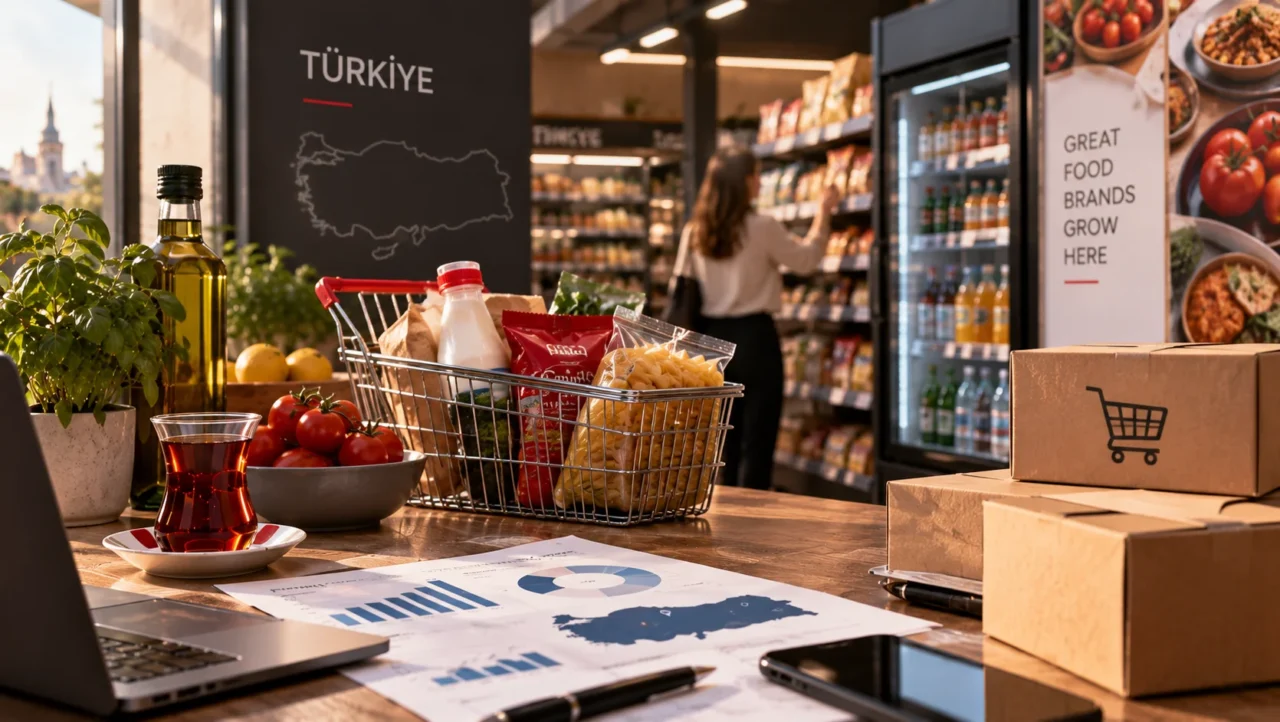
Food, Beverage and FMCG Marketing in Turkey
In Turkish FMCG, marketing is downstream of distribution, and distribution is downstream of regulation. A foreign food or beverage brand that starts with a campaign plan has usually skipped the two things that actually determine whether the campaign can work.
The first gate is regulatory. Food products placed on the Turkish market are subject to Ministry of Agriculture and Forestry registration or approval requirements, Turkish-language labelling under the Turkish Food Codex, and strict rules on what nutrition and health claims may appear in labelling, presentation and advertising. Those claim rules changed in 2023, and marketing copy written for another market will not automatically comply.
The second gate is shelf. Turkish grocery retail is concentrated among national chains and discount formats, and getting listed is a commercial negotiation with a specific legal constraint that surprises foreign suppliers: Turkish law restricts the fees retailers may demand from producers and suppliers. Under Law No. 6585, large stores and chain stores cannot require payments from producers or suppliers for things like store openings and renovations, turnover shortfalls, or bank and card participation — and unlawfully collected fees carry a penalty equal to the amount taken.
This guide covers both gates, the retail structure you are selling into, where FMCG advertising money actually goes in Turkey, and how the digital and creator layer supports a business that ultimately lives or dies on shelf.
Table of Contents
- Why FMCG marketing is a distribution problem first
- The retail structure you are selling into
- The listing-fee rule that changes negotiations
- Regulatory gate: registration and import
- Labelling in Turkish
- Nutrition and health claims
- Where FMCG advertising money actually goes
- The digital and creator layer
- Online grocery and quick commerce
- Price, promotion and private label
- Product adaptation and local taste
- Common mistakes
- Frequently asked questions
- Conclusion
Why FMCG marketing is a distribution problem first
FMCG differs from most categories covered in marketing guides because the purchase decision happens in front of a shelf, in seconds, at low value and high frequency. Three consequences shape everything else.
Availability beats persuasion. A brand a shopper cannot find does not get bought, however good the advertising. Marketing spend ahead of distribution is largely wasted, and retailers notice when it is the other way round — media support is part of what makes a listing worth keeping.
The retailer is a customer before the consumer is. Your first sales conversation in Turkey is with a buyer at a chain, not with a shopper. Category fit, margin, supply reliability and promotional plan matter more in that conversation than brand storytelling.
Repeat purchase is the business. Trial is comparatively cheap to buy through promotion; the question is whether the product earns a second purchase. That is a product and price question, and no campaign fixes a product Turkish consumers do not want to buy twice.
For the broader market context, see our guide to marketing in Turkey for foreign brands.
The retail structure you are selling into
Turkish grocery retail has modernised rapidly, and the structure a foreign supplier meets is concentrated and discount-led.
National chains and discount formats dominate modern trade. Turkey’s largest grocery networks operate at very large store counts, with hard-discount formats carrying a substantial share of everyday shopping. For a supplier, that means a small number of buying decisions control access to a large share of the market — and that those buyers are structurally focused on price and private label.
Traditional trade remains real. Neighbourhood grocers, local chains and regional players still matter, particularly outside the largest cities. They are harder to serve and lower volume per outlet, but they can be a route to presence while national listings are negotiated.
Marketplaces and online grocery are a parallel channel. They do not replace shelf for FMCG, but they provide a route to market that does not require a chain listing, and they generate consumer data you would otherwise never see. Our guides to e-commerce in Turkey and Hepsiburada and Amazon Turkey advertising cover the platform side.
One structural detail worth knowing: under Law No. 6585, large stores and chain stores selling fast-moving consumer goods must allocate shelf space equivalent to at least one percent of sales area to local products — geographically indicated products produced in the province, or products designated as local by provincial trade directorates. It is a small share, but it signals how deliberately Turkish retail regulation intervenes in shelf allocation.
The listing-fee rule that changes negotiations
This is the point most foreign FMCG teams have never encountered, because it has no equivalent in most Western markets.
Law No. 6585 on the Regulation of Retail Trade restricts what large stores, chain stores, dealer businesses and special-authorised businesses may charge producers and suppliers. The law prohibits demanding payments from producers or suppliers for matters such as store opening and renovation, turnover shortfall, and bank and credit card participation fees. The provisions were tightened by Law No. 7435 in January 2023.
The enforcement mechanism is unusually direct. For violations relating to unlawfully collected premiums and fees, the penalty is an administrative fine equal to the amount unlawfully collected, with other breaches attracting fixed fines.
Three practical implications for a foreign supplier:
- The “pay for shelf” playbook does not transfer cleanly. Budgeting a large listing fee as the price of entry, as you might elsewhere, may be budgeting for something the retailer is not permitted to charge in that form.
- Commercial terms shift to other levers. Negotiation concentrates on margin, promotional participation, payment terms and supply commitments rather than upfront fees.
- Get the agreement reviewed locally. Whether a particular charge is permitted is a legal question with financial consequences, and it should be assessed by Turkish counsel before signature rather than assumed either way.
This area is also moving. Reporting in 2026 indicated that the Ministry of Trade was preparing to revise the implementing regulation and rename it to cover the supply chain more broadly, extending its scope from retail relationships toward producers and suppliers. Confirm the current regulation before relying on any description of it, including this one.
Regulatory gate: registration and import
Food and beverage products are regulated by the Ministry of Agriculture and Forestry, and the framework is more demanding than the general consumer goods regime.
In outline, food businesses operating in Turkey are subject to registration or approval requirements depending on the activity, products placed on the market must comply with the Turkish Food Codex, and imported food is subject to control procedures at import. A foreign brand will therefore need a Turkish counterparty — an importer, distributor or its own entity — that holds the appropriate registrations and takes on the associated responsibilities.
The marketing-relevant point is timeline. Registration, import control, label approval and first shipment all precede any campaign, and each has its own lead time. A launch plan that assumes marketing and regulatory work run in parallel usually discovers they run in sequence.
Because requirements vary considerably by product type — dairy, meat, supplements, alcoholic beverages and products of animal origin each carry additional conditions — this is an area to scope with a Turkish regulatory consultant early rather than to generalise. Categories that touch health positioning carry further complexity, covered in our guide to healthcare and wellness marketing in Turkey.
Labelling in Turkish
Labelling is governed by the Turkish Food Codex Regulation on Food Labelling and Informing Consumers, published in the Official Gazette of 26 January 2017 (No. 29960, repeating issue).
For a foreign brand, three things matter commercially as well as legally.
Turkish-language information is required. This is not a sticker exercise to be solved at the last minute; it affects pack design, print runs and lead times.
The label is your primary marketing asset. In FMCG, the pack does more selling than the advertising. A label designed to satisfy a regulator rather than to communicate to a shopper wastes the most valuable surface you have.
Mandatory information constrains design. Ingredient lists, allergen indication, nutrition declaration, net quantity, date marking and the responsible business details all occupy space. Designing the Turkish pack from the regulatory requirements outward produces a better result than adapting a global pack inward.
Nutrition and health claims
This is where global FMCG marketing copy most often fails in Turkey, and the framework recently changed, so even relatively recent guidance may be out of date.
The Turkish Food Codex Regulation on Nutrition and Health Claims, published on 26 January 2017, established rules for nutrition and health claims used in labelling, presentation and advertising, with permitted health claims set out in annexes and an application procedure for adding new ones. It was prepared in line with EU Regulation (EC) No 1924/2006.
That regulation was repealed and replaced by the Turkish Food Codex Regulation on Nutrition Claims, published in the Official Gazette of 20 April 2023 (No. 32169). In the process, the health claim annexes — including the lists of permitted health claims, disease risk reduction claims, and claims relating to children’s development and health — were removed, and the new regulation addresses nutrition claims.
The practical consequence for a marketing team is that you cannot safely assume the claim position you researched a few years ago still applies, and you cannot assume an EU-approved health claim transfers automatically. Before producing packaging or campaign copy that makes any nutrition or health-related statement, confirm the current framework and the specific claim with a Turkish regulatory specialist and, where relevant, the Ministry.
Two further points hold regardless of which regulation is current. Claims are constrained across labelling, presentation and advertising — so a claim you cannot make on pack, you cannot make in a commercial either. And separately from food regulation, the Advertising Board under the Ministry of Trade supervises advertising content under consumer protection law, so a claim can be challenged as misleading advertising even where food rules are satisfied.
Where FMCG advertising money actually goes
Turkish FMCG advertising behaviour is measurable, and it points somewhere many foreign brands do not expect.
According to the Estimated Media and Advertising Investments Report prepared by Deloitte for Turkey’s advertising industry bodies, television accounted for TRY 38.86 billion of media investment in 2024, and the leading investing sectors in television were food, home cleaning, and cosmetics and personal care. Out-of-home, at TRY 10.94 billion, was led by entertainment, culture and sport, followed by cosmetics and personal care and then retail.
In other words, food is the single largest television advertising category in Turkey. That is not accidental. Mass-reach broadcast still matches the FMCG job — building broad awareness for low-consideration products sold through physical retail — better than precision digital channels do.
Two cautions. Those are nominal lira figures in a high-inflation period, so the growth rates reported alongside them substantially overstate real growth. And the fact that established FMCG players invest heavily in television does not mean a new foreign entrant should start there: television requires sustained frequency and national distribution to pay back. The offline picture, including the RTÜK rules that govern broadcast advertising, is covered separately in our guide to TV, radio and out-of-home media buying in Turkey.
The digital and creator layer
Digital’s role in Turkish FMCG is different from its role in considered-purchase categories. It rarely closes a sale directly; it builds the familiarity that makes a shopper reach for your pack rather than the one beside it.
Recipe and usage content works unusually well. Turkish food content has a large, engaged audience, and showing how a product is used in a Turkish kitchen solves a real problem for an unfamiliar imported product.
Creators carry disproportionate weight in food. Turkish food and lifestyle creators convert trial effectively, and the category supports both large-reach and micro-creator approaches. The commercial and compliance side is covered in our guide to influencer marketing in Turkey — and note that a creator describing your product’s nutritional benefits is making a claim in your advertising.
Short-form video suits demonstration. Preparation, texture and taste reactions translate well to the formats covered in our guides to TikTok marketing in Turkey and social media marketing in Turkey.
Seasonality is a bigger lever than in most markets. Ramadan in particular reshapes food consumption, shopping patterns and media consumption, and FMCG planning that ignores it misses the category’s largest annual opportunity. Our Ramadan and Black Friday marketing calendar for brands in Turkey covers the timing.
Producing food creative that looks appetising and locally credible is a specialist job, and it is the kind of work that sits with local production capability such as Medyae’s alongside social and creator management. The practical point is that translated global food creative — different portions, different table settings, different accompaniments — reads as foreign in a category where familiarity is the whole proposition. Our guide to video marketing and content production in Turkey covers what performs.
Online grocery and quick commerce
Online grocery and quick commerce have become a meaningful part of the Turkish FMCG picture rather than a novelty.
According to the Ministry of Trade’s 2025 e-commerce report, quick commerce grew substantially year on year and accounted for 8.5 percent of total e-commerce volume, with the food sector by a wide margin the largest category within it.
For a foreign FMCG brand, three implications:
- It is a listing decision, not a media decision. Presence on grocery and quick-commerce platforms requires the same kind of commercial negotiation as physical shelf.
- Search and category placement matter on these platforms in a way they do not in store, which makes product naming and category data genuinely important.
- The data is valuable. Online channels show you basket composition, repeat rates and price elasticity that physical retail sell-through never reveals — useful evidence for the next chain negotiation.
Price, promotion and private label
Turkish FMCG is a price-sensitive, promotion-heavy environment, and two forces make it harder for imported brands.
Private label is strong in discount retail. Retailer own-brands occupy substantial shelf space in the formats that dominate everyday shopping, and they compete directly on the price axis where an imported product is weakest.
Inflation reshapes shopper behaviour. Price sensitivity, pack-size trading and brand switching all intensify when real incomes are under pressure. A premium imported proposition has to justify itself against a cheaper local alternative every week, not once.
Two practical responses. First, be explicit about which shopper you are for — a genuinely differentiated imported product serving a defined segment is a more defensible position than competing on price against private label. Second, treat promotional pricing as a planned margin cost with a defined role, not an ongoing default, and note that Turkish rules on how discounts are presented and calculated apply to your campaigns as much as to any local retailer’s.
Product adaptation and local taste
The hardest question in Turkish FMCG entry is usually not marketing at all: does the product suit the market?
Turkey has a strong, confident domestic food culture and a large, capable domestic food industry — which means imported products compete against well-established local preferences rather than filling a gap. Sweetness levels, spice profiles, portion and pack sizes, and category conventions all differ from Western European norms in ways that affect repeat purchase rather than trial.
Pack size deserves particular attention. Household sizes, shopping frequency and price-point psychology in Turkey often favour different formats than a European range offers. Entering with a format designed for a different shopping pattern can cap a product’s performance regardless of marketing quality.
The useful discipline is to test repeat purchase, not just trial, before committing to a national listing — because a chain buyer’s decision to keep or delist you is made on rate of sale, not on campaign reach.
Common mistakes
Planning the campaign before distribution is secured. Marketing spend ahead of availability is largely wasted.
Budgeting large listing fees as the cost of entry. Turkish law restricts several categories of supplier payment, and unlawfully collected fees carry a penalty equal to the amount taken.
Assuming EU health claims transfer. The Turkish framework changed in 2023, and claims must be confirmed against the current regulation.
Treating labelling as a translation task. The Turkish pack is your main selling asset and should be designed, not adapted.
Letting creators make nutritional claims. Their words are claims in your advertising, and subject to the same constraints.
Ignoring Ramadan. It is the food category’s largest annual shift in consumption and media behaviour.
Entering with European pack formats. Size and format conventions affect repeat purchase.
Reading nominal lira category growth as real growth. Inflation inflates every FMCG figure quoted in lira.
Frequently asked questions
What does a foreign food brand need before selling in Turkey?
Food products are regulated by the Ministry of Agriculture and Forestry. In outline, food businesses are subject to registration or approval requirements, products must comply with the Turkish Food Codex, imported food is subject to control at import, and labelling must meet Turkish requirements. In practice a foreign brand needs a Turkish importer, distributor or entity holding the appropriate registrations. Requirements vary by product type, so scope them with a Turkish regulatory specialist early.
Can Turkish retailers charge listing fees to suppliers?
Not without limits. Law No. 6585 restricts payments that large stores and chain stores may demand from producers and suppliers, including charges relating to store opening and renovation, turnover shortfall, and bank and card participation. Penalties for unlawfully collected premiums and fees equal the amount collected. Have any supply agreement reviewed by Turkish counsel before signing.
Can I use my EU health claims on packaging in Turkey?
Not automatically. Turkey’s 2017 Regulation on Nutrition and Health Claims, which was aligned with EU Regulation 1924/2006, was repealed and replaced by the Regulation on Nutrition Claims published on 20 April 2023, and the health claim annexes were removed in that change. Confirm the current position and your specific claim with a Turkish regulatory specialist before producing packaging or copy.
Is television advertising necessary for FMCG in Turkey?
It is where established FMCG players concentrate: food was the leading television advertising sector in 2024, within TRY 38.86 billion of television media investment. But television requires sustained frequency and national distribution to pay back, so it is generally a scale decision rather than an entry decision for a new foreign brand.
How important is online grocery for FMCG brands in Turkey?
Growing and useful, though not a substitute for shelf. The Ministry of Trade reported quick commerce at 8.5 percent of total e-commerce volume in 2025, with food the largest category within it. Online channels also generate basket and repeat-purchase data that physical retail does not.
What is the biggest mistake foreign FMCG brands make in Turkey?
Treating it as a marketing problem. The binding constraints are regulatory approval, distribution and product fit with local taste and pack conventions. Campaigns amplify a product that is available and wanted; they cannot substitute for either.
Conclusion
Turkish FMCG is a large, modern and competitive market with a sophisticated retail structure and a domestic food industry that sets a high bar. For a foreign brand, that combination means the marketing question is almost never the first question.
Work the sequence in order: confirm the regulatory path and its timeline, settle the claims position against the current framework rather than an EU equivalent, design the Turkish pack from local requirements outward, secure distribution with an agreement reviewed against Turkish retail law, and test repeat purchase before committing to national scale. Then put media behind it — with the seasonal calendar, creator layer and content built for Turkish kitchens rather than adapted from a global asset library.
This article is general information based on published legislation and industry data as at the date shown. It is not legal or regulatory advice. Food regulation, retail trade rules and claim frameworks change, and the treatment of any specific product or agreement depends on its facts. Confirm your position with qualified Turkish regulatory and legal advisors before acting.