



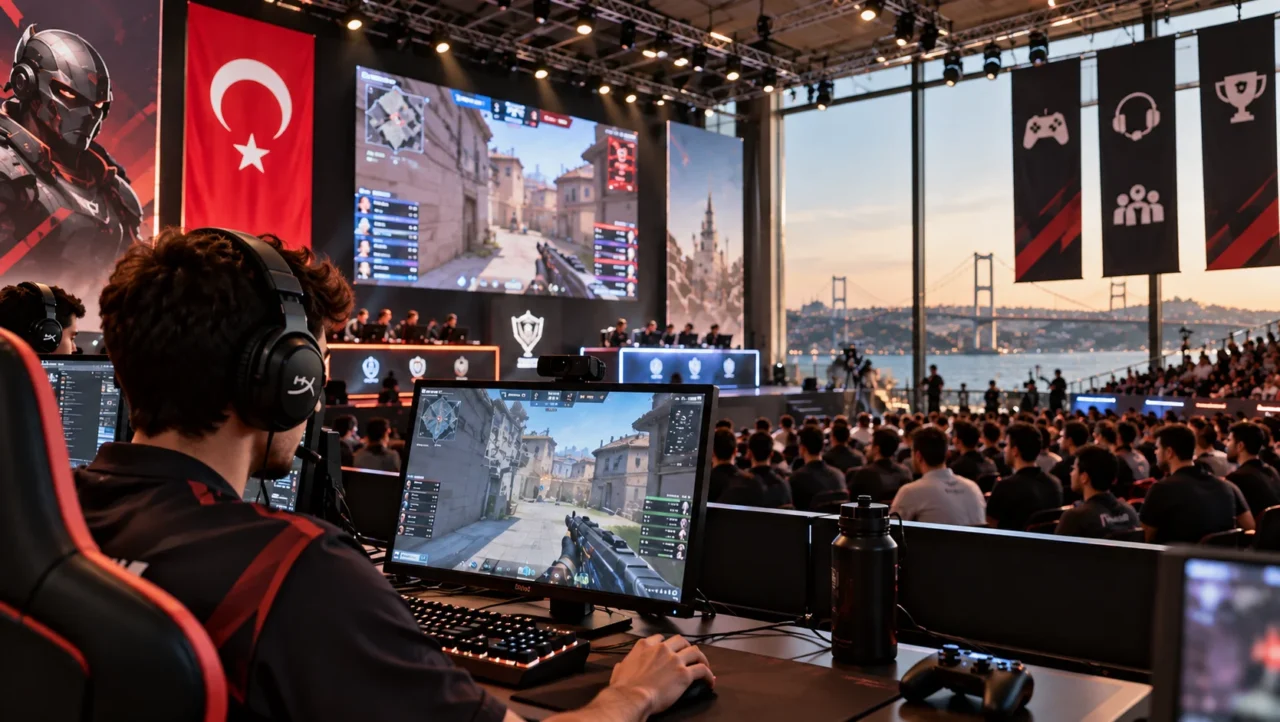
Gaming and Esports Marketing in Turkey
Turkey has one of the world’s largest gaming audiences and one of its smaller esports economies, and that gap is the commercial opportunity for a non-gaming brand.
The audience side is well evidenced. Analysis by mobile measurement firm Adjust placed Turkey eighth globally in mobile app downloads at the end of 2024, with 3.66 billion downloads, and noted that games from Turkish studios attract over 30 million local players. Turkish mobile game revenue was set to reach USD 427.5 million in 2025.
The esports economy is a different story. Market analysts characterise Turkish esports as growing slowly, constrained by limited sponsorship, an underdeveloped media rights market and low general consumer awareness — despite a strong domestic gaming culture and a young, connected population.
For a brand that does not make games, that combination reads as opportunity rather than warning. A large, engaged, young audience concentrated in an ecosystem that is under-monetised means sponsorship and creator inventory is available at prices that would be impossible in Western esports markets. And there is a specific structural reason the usual bidders are absent, which the section on betting below explains.
This guide covers who you actually reach, which channels exist, what gaming audiences reject, the platform access risk unique to Turkey, and how to measure any of it.
Table of Contents
- The audience, and why it is bigger than the market
- Who you are actually reaching
- The betting vacuum
- Streaming platforms and the access risk
- The channels available to a brand
- The local ecosystem you will work through
- What gaming audiences reject
- Creative that works in this category
- Disclosure and compliance
- Measuring gaming sponsorship
- Common mistakes
- A 90-day plan
- Frequently asked questions
- Conclusion
The audience, and why it is bigger than the market
Two different things are often conflated in discussions of Turkish gaming: the size of the player base and the size of the commercial market. They diverge sharply here.
On players and engagement, Turkey ranks among the world’s most active markets. Adjust’s analysis put Turkey eighth globally for mobile app downloads at the end of 2024, alongside 101.5 billion hours of total time spent in apps. Turkish mobile game installs grew 12 percent year on year in 2024 with sessions up 8 percent, and in the first half of 2025 installs rose 4 percent while sessions grew 12 percent — against global growth of 1 percent and 2 percent respectively.
On revenue, the picture is more modest. Turkish mobile game revenue was set to reach USD 427.5 million in 2025, and the esports segment specifically is described by market analysts as constrained by limited sponsorship deals, an undeveloped media rights market and low broad consumer awareness.
The implication for a non-gaming advertiser is direct. You are buying attention in a market where attention is abundant and the money chasing it is not. That is an unusual position, and it does not last indefinitely.
One caution on data. Much published Turkish gaming market sizing is expressed in lira, which inflation distorts, or in dollar terms that swing with the exchange rate. Treat any single market-size figure carefully and check what currency, year and scope it covers — the discipline set out in our budget guide to digital marketing costs in Turkey.
Who you are actually reaching
The stereotype of the gaming audience as teenage boys is outdated everywhere and particularly unhelpful in Turkey, where the ecosystem spans several distinct groups that rarely overlap.
Mobile casual players are the largest group by far, skew older and more female than any other segment, and are reached through the same social channels as general consumers rather than through gaming-specific media.
Competitive PC players cluster around a small number of titles with established Turkish scenes. This is the audience most people mean by “gamers”, and it is the one that responds to esports sponsorship.
Console players are a smaller, higher-spending segment, constrained by hardware and software pricing in lira.
Viewers who do not play much are a genuine and often-forgotten group. Streaming and gaming content is entertainment consumption in Turkey as much as participation, which widens the reachable audience considerably.
The practical consequence is that “we want to reach gamers in Turkey” is not a brief. Which of these four you mean determines the channel, the creative and the cost — and mobile casual players in particular are usually better reached through mainstream social channels, covered in our guide to social media marketing in Turkey, than through anything labelled esports.
The betting vacuum
This is the structural fact that makes Turkish gaming sponsorship unusually available, and it is specific to the market.
In most major esports markets, betting and gambling operators are among the largest sponsorship categories, funding teams, tournaments and streamers. In Turkey that funding layer is legally unavailable: under Law No. 7258, advertising unlicensed betting sites is a criminal offence, and only licensed operators may be promoted.
Two consequences follow.
Sponsorship inventory is less contested. Team shirt space, tournament naming, stream integrations and creator partnerships are not being bid up by a deep-pocketed category that dominates elsewhere. A consumer brand entering now faces less competition for the same attention.
Enforcement pressure shapes the ecosystem. The same legal environment that removes betting money also creates active enforcement around gambling content, which is what produced the platform episode described next. A brand sponsoring creators needs to understand that its partners operate in a space where gambling-adjacent content carries real regulatory consequence — and should include content standards in creator agreements accordingly.
The honest framing is that Turkey’s esports economy is under-monetised partly for reasons that will not change quickly. That is an advantage for a brand willing to enter, and a reason to expect the ecosystem to remain smaller than the audience implies.
Streaming platforms and the access risk
Live streaming is where gaming attention concentrates, and in Turkey it carries a risk foreign brands do not encounter in most markets.
In February 2024, Turkey’s National Lottery Administration obtained access blocks against both Kick and Twitch on gambling content grounds. Kick was blocked on 20 February and restored after announcing it would block casino content for Turkish users. Twitch was blocked on 23 February, with the block lifted on 29 February 2024.
Both platforms are accessible following those decisions, and this episode should be read as history rather than current status — verify the present position before planning, since it can change. But it establishes something a brand should plan around: streaming platform availability in Turkey is subject to regulatory action on gambling content, and a block can arrive without warning and last days.
Three practical responses:
- Do not build a Turkish campaign around a single streaming platform. Distribute across platforms and formats so a disruption is an inconvenience rather than a cancelled activation.
- Include continuity terms in sponsorship agreements. What happens to deliverables if the platform is inaccessible for a week during your campaign window is a question to settle in the contract.
- Set content standards with partners. Gambling-adjacent content is the trigger, and your brand appearing alongside it is both a brand safety and a regulatory question.
YouTube carries a large share of Turkish gaming content and is subject to a different regulatory posture, which makes it a useful hedge as well as a channel in its own right — see our guide to YouTube advertising in Turkey.
The channels available to a brand
The routes into Turkish gaming sit on a spectrum from cheap and testable to expensive and committing.
| Channel | What it buys | Best for |
|---|---|---|
| Creator partnerships | Direct access to an engaged audience with the creator’s credibility attached | Testing whether the audience responds at all |
| Team sponsorship | Season-long association, jersey and content presence, fan affinity | Sustained presence once the audience is validated |
| Tournament and league sponsorship | Broadcast presence and event association | Broad reach within the competitive audience |
| Event and festival presence | Physical activation, product trial, content capture | Categories where the product is experienced |
| In-game and platform advertising | Scale within mobile titles | Mass-market reach rather than gaming credibility |
| Owned community | Long-term relationship, low marginal cost | Brands willing to commit beyond a campaign |
For most foreign brands the sensible sequence is creator partnerships first, because they are the cheapest way to learn whether your category has any credibility with this audience, followed by team or tournament sponsorship if the answer is yes. The commercial mechanics of creator work in Turkey are covered in our guides to influencer marketing in Turkey and influencer marketing costs in Turkey.
The local ecosystem you will work through
Turkish esports is organised, and a foreign brand will generally reach it through intermediaries rather than directly.
Specialist local operators combine several functions that would be separate businesses in larger markets. Multiplayer, active since 2009, describes itself as organising, producing and broadcasting Turkey’s most popular national esports league championships, representing top gaming influencers and esports professionals through a talent management arm, and running the Chapter festival series bringing together technology, game and esports audiences.
The practical consequence is that a single counterparty may control league inventory, broadcast, creator representation and event access. That makes entry simpler and negotiation less transparent. Two protections are worth building in:
- Ask what is actually being sold. Where broadcast, team and creator inventory come from the same partner, establish which audiences overlap rather than accepting summed reach figures.
- Settle content rights and account ownership. Content produced through a sponsorship has value beyond the campaign, and the default position usually favours the partner.
Turkey’s game development industry is also a genuine ecosystem in its own right, with domestic studios building large local and international player bases. For brands whose product has any technology adjacency, that industry is a partnership surface as well as a competitive one.
What gaming audiences reject
Gaming audiences are unusually intolerant of brands that do not belong, and Turkish gaming communities are vocal. Four failure patterns recur.
Borrowed vocabulary used incorrectly. Using gaming terminology to signal belonging, and getting it slightly wrong, is worse than not using it at all. The audience notices immediately and the screenshots circulate.
Sponsorship without contribution. A logo on a jersey with no accompanying value — no support for the scene, no content, no fan benefit — reads as extraction. Brands that fund something the community actually wants earn a different reception.
Campaign-length commitment. Entering for one tournament and leaving is visible and remembered. This audience tracks who stayed.
Over-controlled creator content. A creator reading approved brand copy loses the credibility you paid for. The tension between brand safety and authenticity is real, and in this category the resolution should lean toward the creator’s voice within clear content boundaries.
Because community reaction here is public and fast, having a response process before you need one matters — see our guide to reputation and crisis management on social media in Turkey.
Creative that works in this category
Gaming creative rewards specificity and punishes generic brand messaging more than most categories.
Turkish, written by someone who plays. Gaming language in Turkish mixes Turkish and English terminology in patterns that are specific and unforgiving. This is not translation work, and it is not general copywriting either.
Long-form has a place. Unlike most digital categories, gaming audiences watch extended content willingly. A ten-minute integration inside a stream or video can outperform a thirty-second spot, which changes the production brief.
Product utility beats brand association. If your product genuinely helps — connectivity, hardware, energy, comfort, delivery during long sessions — demonstrate it. If it does not, association is what you are buying, and it should be priced accordingly.
Content quality is scrutinised. This audience consumes high production value daily and notices when a brand’s contribution looks cheap next to it.
Producing gaming-native content in Turkish generally means originating it locally rather than adapting a global asset, which is production and social work of the kind agencies with local capability, Medyae among them, handle alongside creator programmes. What performs in Turkish video more broadly is covered in our guide to video marketing and content production in Turkey, and the short-form layer in TikTok marketing in Turkey.
Disclosure and compliance
Three compliance layers apply to gaming and esports marketing in Turkey, and none of them is gaming-specific.
Influencer disclosure. Turkish rules on social media influencer advertising are prescriptive about the wording that must appear and where it must be visible, and the obligation is triggered by any benefit received — including gifted hardware or product, which is common in this category. Build label verification into content approval rather than assuming creators handle it.
Gambling and betting. Advertising unlicensed betting is a criminal offence under Law No. 7258. For a brand, the exposure is usually indirect: ensuring your sponsored creators and properties are not carrying gambling content alongside your brand.
Data protection. Community platforms, tournament registrations, prize draws and audience data all involve personal data processing subject to Turkish obligations regardless of where your company is established — see our guide to KVKK compliance for foreign brands.
Where your activation involves minors, which parts of the gaming audience will, additional care around data, prizes and content is warranted and should be reviewed with Turkish counsel.
Measuring gaming sponsorship
Sponsorship measurement is weak in this category everywhere, and weaker in an under-monetised market where inventory is sold without standardised audience currency.
Four disciplines help:
Do not accept summed reach. Where a partner controls league, team and creator inventory, aggregate audience figures double-count. Ask for platform-level data you can verify.
Define the objective before the buy. Awareness within a defined community, product trial, content generation and direct response are different objectives requiring different inventory. Sponsorship sold as all four is usually optimised for none.
Measure branded search and direct traffic. Gaming sponsorship generates search response, and branded search volume is often the fastest available read on whether an activation worked.
Track sentiment, not just reach. In a category where community reaction determines whether the association helps or harms, how the audience responded matters as much as how many saw it.
Getting the analytics foundation right for Turkey is a common failure point, covered in our GA4 and marketing analytics setup guide for Turkey.
Common mistakes
Briefing “gamers” as one audience. Mobile casual, competitive PC, console and viewers are different people reached differently.
Building a campaign on one streaming platform. Turkish access has been disrupted by regulatory action before.
Entering for a single tournament. The audience tracks who stays.
Over-scripting creator content. You are paying for credibility and then removing it.
Using gaming vocabulary you do not understand. Getting it slightly wrong is worse than not attempting it.
Accepting aggregate reach from a single-source partner. Overlapping audiences get counted twice.
Ignoring disclosure obligations on gifted hardware. In-kind benefit triggers the requirement.
Assuming esports means reaching all gamers. The largest audience segment is mobile casual and is not watching competitive broadcasts.
A 90-day plan
Weeks 1–4: define and observe. Decide which of the four audience segments you are actually targeting and why your category has any right to speak to it. Map the local ecosystem, including which partners control which inventory. Verify current platform access and regulatory status rather than relying on historical accounts.
Weeks 5–8: test with creators. Run a small creator programme with clear content standards and Turkish-language disclosure requirements written into the contract. Give creators latitude within boundaries. Measure branded search response and community sentiment alongside reach.
Weeks 9–12: decide on commitment. If the creator test shows the audience accepts your category, move to a season-long team or tournament association with continuity terms and content rights settled in the agreement. If it does not, that is a legitimate result — and cheaper to learn at creator scale than through a sponsorship contract.
Frequently asked questions
How large is Turkey’s gaming audience?
Large by global standards. Analysis by Adjust placed Turkey eighth worldwide in mobile app downloads at the end of 2024 with 3.66 billion downloads, alongside 101.5 billion hours of total time spent in apps, and noted that games from Turkish studios attract over 30 million local players. Turkish mobile game revenue was set to reach USD 427.5 million in 2025, which is modest relative to that audience size.
Is esports sponsorship worth it in Turkey?
It can be unusually good value, because the market is under-monetised. Analysts describe Turkish esports as constrained by limited sponsorship and an undeveloped media rights market, and betting operators — a dominant sponsorship category in many countries — are effectively excluded because advertising unlicensed betting is a criminal offence under Law No. 7258. That leaves inventory less contested than in Western markets.
Which platform should a brand use to reach Turkish gamers?
More than one. Turkish streaming access has been disrupted by regulatory action: in February 2024 both Kick and Twitch were blocked on gambling content grounds, with Kick restored after removing casino content and Twitch’s block lifted on 29 February 2024. Both are accessible following those decisions, but the episode is a reason to distribute activity across platforms and to include continuity terms in sponsorship agreements.
Do influencer disclosure rules apply to gaming creators in Turkey?
Yes, on the same basis as other categories. Turkish rules on influencer advertising are prescriptive about required wording and its visibility, and the obligation is triggered by any benefit received — including gifted hardware or product, which is routine in gaming. Build label verification into your approval process.
Can a non-gaming brand credibly market to gamers in Turkey?
Yes, with conditions. The audience rejects borrowed vocabulary used incorrectly, sponsorship with no contribution to the scene, and short-term entries. Brands that fund something the community values, commit beyond a single campaign, and let creators speak in their own voice within clear boundaries are received very differently.
What is the biggest mistake in Turkish gaming marketing?
Treating gamers as a single audience. Mobile casual players are the largest segment and skew older and more female than the stereotype suggests; competitive PC players are the esports audience; console players are smaller and higher-spending; and a substantial group watches gaming content without playing much. Each needs a different channel and a different brief.
Conclusion
Turkish gaming offers a foreign brand something rare: a very large, young, highly engaged audience in an ecosystem that has not been bid up, partly because the category that funds esports in most markets is legally excluded here.
The conditions attached are equally clear. Decide which audience you mean before briefing anything. Do not build on a single streaming platform, because access has been disrupted before. Test with creators before committing to sponsorship, because it is the cheapest way to learn whether your category is welcome. And commit beyond one campaign, because this audience notices who stays and who was passing through.
Brands that treat Turkish gaming as a cheap reach buy get the reach and none of the goodwill. Brands that contribute something the community wanted anyway tend to find the economics work better than anywhere comparable.