



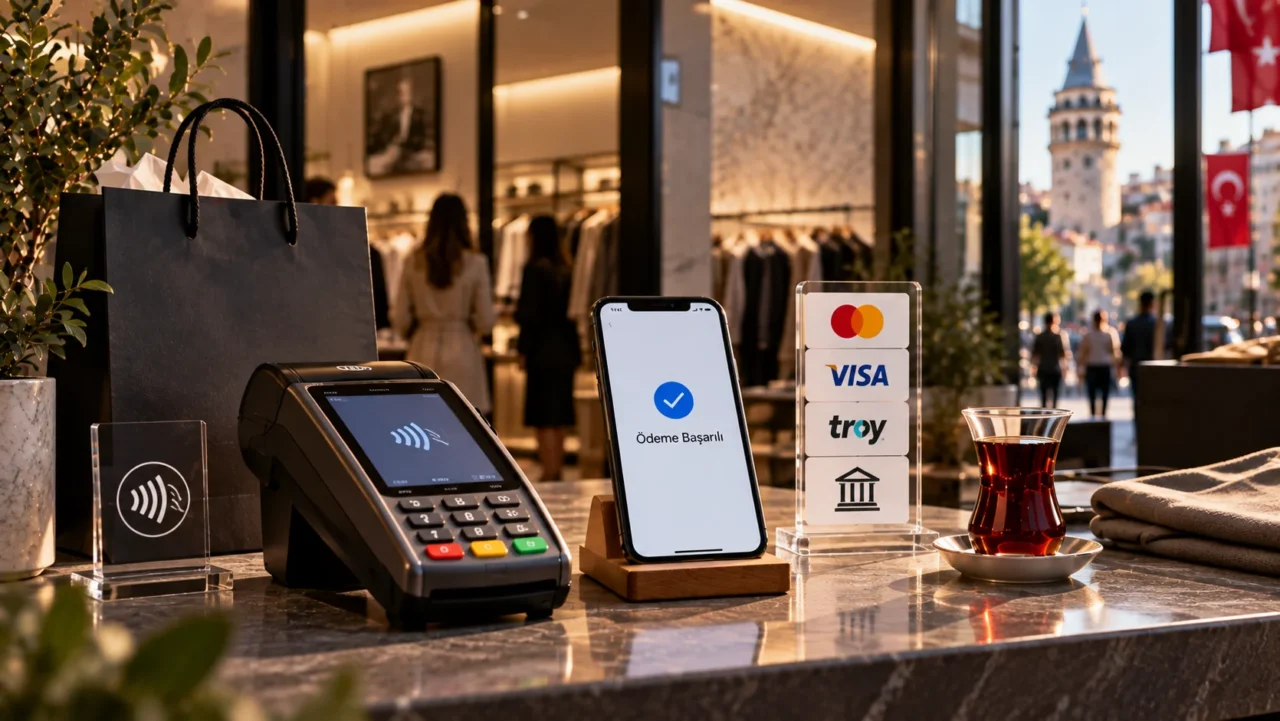
Payment Methods and Checkout Localization for Turkey
Three things decide whether a foreign brand can take money from Turkish customers smoothly, and most international teams get at least one of them wrong.
First, Turkish online spending is card-led and credit-card-heavy, and installment payment — taksit — is a structural expectation rather than a promotional extra. Second, the number of installments you may offer is not your decision: Turkey’s banking regulator caps installment terms by product category, and those caps change. Third, payment institutions and electronic money institutions must hold an operating licence from the Central Bank of the Republic of Turkey — alongside banks and PTT, which are also authorised to provide payment services — and using an unauthorised intermediary carries risk not only for the provider but potentially for its customers.
This guide covers what the payment data shows, how installment caps work, who is legally permitted to process Turkish payments, the realistic routes for a foreign merchant, and how to present payment options at checkout so that Turkish shoppers recognise them. It focuses on payment infrastructure and rules; broader checkout conversion tactics are covered in our separate guide to conversion rate optimization for e-commerce in Turkey.
Table of Contents
- What the payment data shows
- Why installments are structural in Turkey
- Installment caps: the rule most foreign brands miss
- Who is allowed to process payments
- Routes to accept Turkish payments as a foreign brand
- Debit cards, bank transfer and instant payments
- Cash on delivery
- Digital wallets, and what to check first
- 3D Secure and authorisation
- Presenting payment options the Turkish way
- Currency and price presentation
- Common mistakes
- Frequently asked questions
- Conclusion
What the payment data shows
The authoritative source for Turkish card data is BKM, the Interbank Card Center, which publishes monthly statistics on card payments across the banking system.
Its December 2025 figures show online card payments reaching TRY 760.4 billion in the month, up 46 percent year on year and representing roughly a third of all card payment value. In November 2025, online card payments totalled TRY 710.7 billion, making up 32 percent of card payment value — but only 15 percent of card transaction count, at 254.2 million transactions.
That gap between value share and count share is the most useful number in the dataset for an e-commerce team. Online card transactions are far fewer than in-store ones but much larger on average, which is exactly the environment in which installment payment matters most.
The card base itself is large and credit-heavy. As of September 2025, Turkey had 139.1 million credit cards, 217.2 million debit cards and 106.4 million prepaid cards. In June 2025, credit cards accounted for TRY 1.61 trillion of TRY 1.91 trillion in total card payments.
Two cautions on reading these figures. They are nominal lira values in a high-inflation period, so the year-on-year growth rates overstate real growth considerably. And they measure card payments only — bank transfers, cash on delivery and some wallet flows sit outside them. Check BKM’s latest monthly release rather than relying on the figures here, since they update every month.
For the wider e-commerce picture, see our guide to e-commerce in Turkey.
Why installments are structural in Turkey
In most Western markets, paying in installments at checkout is a financing product layered on top of payment — a buy-now-pay-later provider, a separate credit decision, a separate brand in the checkout. In Turkey it is built into the credit card itself. The card issuer splits the purchase into monthly installments, and the shopper expects to choose the number of installments at checkout the way a European shopper chooses a delivery slot.
Three consequences for a foreign merchant.
Absence reads as a defect. For higher-value purchases, a checkout without installment options does not look neutral to a Turkish shopper — it looks like a store that has not set up properly for the market.
The price the shopper compares is often the monthly figure. In categories where installments are common, shoppers evaluate affordability per month. Product pages that show only a total price leave the calculation to the customer.
Installments are also a promotional lever. Turkish retailers routinely run campaigns around installment terms — additional installments, interest-free installments with particular card programmes — particularly around key sales periods. That makes installment presentation part of your campaign calendar, not only your checkout. The seasonal context is covered in our Ramadan and Black Friday marketing calendar for brands in Turkey.
Installment caps: the rule most foreign brands miss
This is the single most important regulatory point for a merchant, and it is almost entirely absent from English-language guidance.
Installment terms on credit cards are not set by the merchant or even freely by the bank. They are capped by BDDK, the Banking Regulation and Supervision Agency, under the Regulation on Bank Cards and Credit Cards, and the caps vary by product category.
The categories and limits are set through BDDK board decisions and are revised periodically. Some examples illustrate how the mechanism works:
- General purchases on individual credit cards have been subject to a general ceiling, with shorter caps in specific categories.
- Jewellery (excluding bullion and minted gold) and furniture and electrical appliances had their installment periods shortened by a BDDK board decision of 1 July 2021 — to three months and nine months respectively.
- Mobile phones are among the most tightly restricted categories, and the rules differ sharply between new and refurbished devices. For new (non-refurbished) phones, credit card installments are not permitted. For phones qualifying as refurbished products, credit card installments of up to 12 months apply without a price threshold, provided the sale is made through an authorised seller or refurbishment centre. Do not confuse these with consumer loan rules: BDDK board decision No. 11022 of 5 December 2024 changed the maturity limits on consumer loans used to buy phones, which is a separate financing product from credit card installments.
Those examples are dated deliberately. The thresholds are expressed in nominal lira, which inflation erodes, and BDDK revises them. Do not build a product page or a campaign on any installment figure you read in an article — including this one. Confirm the current cap for your specific category with your payment provider or acquiring bank before launch, and again before each major campaign.
The practical implication is straightforward but frequently missed: a foreign brand cannot simply advertise “12 installments” across its catalogue because that is what its competitors appear to offer. What is permissible depends on what is being sold. A campaign promising installment terms that the category does not allow is both a checkout failure and an advertising accuracy problem.
Who is allowed to process payments
Turkish payment services are regulated under Law No. 6493 on Payment and Securities Settlement Systems, Payment Services and Electronic Money Institutions. Payment institutions and electronic money institutions must obtain an operating licence from the Central Bank of the Republic of Turkey (TCMB), with implementation detailed in the Regulation on Payment Services and Electronic Money Issuance that entered into force on 1 December 2021.
Two facts from TCMB’s own guidance matter directly to a merchant choosing a provider.
TCMB publishes the list. The Central Bank publishes the payment institutions and electronic money institutions authorised to operate, along with the scope of each licence. Some licences are limited — TCMB notes that institutions licensed only under Article 12(1)(c) of Law No. 6493 are restricted to accepting payment instruments. A provider being licensed does not mean it is licensed for everything you need.
Unlicensed payment services are a criminal matter. TCMB states that providing payment services other than through banks, PTT and the payment and electronic money institutions it lists is an offence under Law No. 6493, and warns that those receiving services from unlicensed providers may themselves become subject to investigations related to illegal activity and suffer significant losses.
That warning is the reason this belongs in a marketing guide rather than only a legal one. Foreign brands often reach Turkish payments through an intermediary recommended by a local partner, a platform or a reseller. Check the provider against TCMB’s published list, and check that its licence scope covers the service you are buying, before any money moves.
Routes to accept Turkish payments as a foreign brand
There are four realistic routes, and they differ mostly in how much installment capability and local card acceptance they give you.
| Route | What you get | Main trade-off |
|---|---|---|
| Turkish entity with local acquiring | Full local card acceptance and installment capability, lira settlement | Requires a Turkish company and the obligations that come with it |
| Licensed local payment institution | Local acceptance and installments through an intermediary | Onboarding requirements vary; verify licence and scope |
| International PSP with Turkish capability | Faster setup from abroad, sometimes with local methods | Installment support and local card performance vary by provider |
| Marketplace or partner as merchant of record | The platform’s payment infrastructure, installments included | You do not own the checkout, the customer relationship or the payment data |
Onboarding requirements for non-resident merchants differ by provider and change over time, so treat this as a question to put to specific providers rather than a settled barrier.
Two questions to ask any provider directly. Does it support Turkish installment presentation natively, with the correct category caps applied? And what is its authorisation performance on Turkish-issued cards? A provider that routes Turkish cards as cross-border transactions can see materially worse approval rates than one processing them domestically — which shows up as lost orders rather than as a line item.
If you sell through a marketplace, the platform handles consumer payment and installments for you; the trade-off is set out in our guide to Hepsiburada and Amazon Turkey advertising.
Debit cards, bank transfer and instant payments
Credit cards dominate online value, but they are not the whole picture.
Debit cards are numerous — 217.2 million as of September 2025 — and growing in use. Supporting them is standard, but they do not carry installments, so they serve a different shopper and basket.
Bank transfer (havale and EFT) remains a recognised payment option in Turkish e-commerce, particularly for higher-value orders and among shoppers who prefer not to enter card details. It introduces reconciliation work and a delay between order and payment confirmation, but omitting it removes an option some customers look for.
FAST, the instant payment system operated by TCMB, enables near-real-time transfers between participating institutions and has changed the practical speed of transfer-based payment. Whether it is useful to you depends on your provider’s integration.
Turkey also has a domestic card scheme, TROY, operated by BKM. Confirm that your provider accepts it rather than assuming international scheme acceptance covers every Turkish card.
Cash on delivery
Cash on delivery (kapıda ödeme) persists in Turkish e-commerce, typically where trust in a seller has not yet been established or for first orders with an unfamiliar brand.
For a foreign brand, this is a trust signal as much as a payment method. A shopper who has never bought from you and cannot see a Turkish address may prefer to pay on arrival. Offering it can lower the barrier to a first purchase.
The costs are real: carrier fees, cash handling, and higher refusal and return rates when the customer can decline at the door. Many merchants offer it selectively — with a surcharge, below a value threshold, or only in some regions. Model it against your actual refusal rate rather than enabling it by default or excluding it on principle.
Digital wallets, and what to check first
Digital wallets have a presence in Turkish e-commerce, both domestic wallets and the global device wallets.
The Turkish wallet landscape has been subject to regulatory change and enforcement, and its composition shifts. Rather than naming specific providers here, the recommendation is procedural: before integrating any wallet, confirm the operator appears on TCMB’s published list of licensed payment or electronic money institutions, and that its licence scope covers what it is offering you. The same check described above applies — a wallet is a payment service provider, and the same rules govern it.
3D Secure and authorisation
Turkish online card payments rely heavily on 3D Secure authentication, typically completed through an SMS code or the issuing bank’s app. Turkish shoppers are accustomed to it and do not regard it as friction in the way some Western shoppers do.
For a foreign merchant, the operational risks lie elsewhere:
- The authentication step must work on mobile. A 3D Secure redirect that breaks on a mobile browser or in an in-app webview loses the order at the final step.
- The authentication page should be in Turkish. An unexpected foreign-language step at the moment of payment is a trust problem.
- Decline reasons need monitoring. Rising declines on Turkish cards often indicate routing or configuration problems rather than customer fraud.
Presenting payment options the Turkish way
Having the right methods available is half the job. Presenting them in a form Turkish shoppers recognise is the other half.
Show installment options on the product page, not only at checkout. Shoppers want to know the monthly figure before committing to the basket. An installment table or a “from X per month” line on the product page answers the question where it is asked.
Show installments per card programme where applicable. Turkish shoppers often compare which bank’s card gives the best terms. Checkouts that display available installments by card programme match this behaviour.
Use Turkish payment vocabulary. Taksit, peşin fiyatına taksit, havale/EFT, kapıda ödeme — the terms shoppers look for should appear as they would on a Turkish site, not as translated English labels. This is a specific application of the principle in our guide to website localization for Turkey.
Make the total cost clear. Where installments carry a cost, show it plainly. Advertising and price presentation in Turkey are subject to consumer protection rules, and misleading installment presentation creates exposure beyond a lost sale.
Display payment security signals the market recognises. Familiar card scheme logos, the 3D Secure indicator and a visible Turkish contact point reduce hesitation for a brand the shopper has not bought from before.
Implementing this properly is web and software work as much as payment work — installment tables, card-programme logic, mobile-safe authentication flows and Turkish-language payment pages all sit in the storefront. That is the kind of build that falls within web design and software capability such as Medyae’s, alongside the payment provider’s own integration.
Currency and price presentation
Price in Turkish lira, VAT-inclusive, for Turkish customers. A checkout that shows a foreign currency or converts at the payment step introduces uncertainty about what the shopper will actually be charged — and in a market where exchange rates move, that uncertainty is a reason not to buy.
In an inflationary environment, lira pricing also needs a review cadence. A price set once drifts in real terms, and installment thresholds that depend on a product’s lira price — as several BDDK caps do — can change which installment terms apply to your product as its price moves. That interaction is easy to miss and worth checking whenever prices change.
Where data from checkout is involved — card data aside, which your provider handles — Turkish data protection obligations apply to customer information you collect, covered in our guide to KVKK compliance for foreign brands.
Common mistakes
Launching without installments. For higher-value categories, their absence reads as an incomplete store.
Advertising installment terms the category does not allow. BDDK caps installments by category; check before you promise.
Using figures from an article as current caps. Thresholds are in nominal lira and revised periodically.
Not checking the provider against TCMB’s list. Licence status and licence scope both matter.
Processing Turkish cards as cross-border. Approval rates can suffer, and you will see it as lost orders.
Showing installments only at checkout. Turkish shoppers evaluate the monthly figure on the product page.
Translating payment labels. Use the terms Turkish shoppers already recognise.
Ignoring the interaction between price changes and installment thresholds. A repricing can change which terms apply.
Frequently asked questions
What is the most common way to pay online in Turkey?
Cards, and particularly credit cards. BKM data for November 2025 shows online card payments at TRY 710.7 billion, 32 percent of all card payment value but only 15 percent of transaction count, indicating much larger average online baskets. Credit cards accounted for TRY 1.61 trillion of TRY 1.91 trillion in total card payments in June 2025. Debit cards, bank transfer and cash on delivery are also used.
Can I offer 12 installments on everything I sell in Turkey?
Not necessarily. BDDK caps credit card installment terms by product category under the Regulation on Bank Cards and Credit Cards, and some categories — jewellery, furniture and electrical appliances, and mobile phones among them — have shorter caps or specific restrictions. The caps are revised periodically, so confirm the current limit for your category with your provider before launch.
Does a payment provider in Turkey need a licence?
Yes. Under Law No. 6493, payment institutions and electronic money institutions must be licensed by the Central Bank of the Republic of Turkey, which publishes the list of authorised institutions and the scope of each licence. TCMB warns that providing payment services without authorisation is an offence and that customers of unlicensed providers may themselves be drawn into investigations.
Can a foreign company accept Turkish card payments without a Turkish entity?
Often yes, depending on the route. Licensed local payment institutions, international providers with Turkish capability and marketplaces acting as merchant of record can all enable Turkish payments without a local company, though installment support and approval rates vary. A Turkish entity with local acquiring gives the fullest capability. Requirements differ by provider, so confirm them directly.
Should I offer cash on delivery in Turkey?
It can lower the barrier to a first purchase from an unfamiliar brand, but it carries carrier fees and higher refusal and return rates. Many merchants offer it selectively — with a surcharge, below a value threshold, or in specific regions. Model it against your own refusal rates.
Do Turkish shoppers object to 3D Secure?
Generally not; it is standard in Turkish online card payments. The risks are technical — authentication flows that break on mobile or in in-app browsers, or authentication pages not in Turkish.
Conclusion
Payment is where Turkey diverges most sharply from the markets foreign e-commerce teams are used to, and most of the divergence is structural rather than cosmetic. Credit cards carry installments natively, shoppers compare monthly figures before totals, the installment terms you may offer are capped by category and revised by the regulator, and the provider you choose must hold the right licence from the Central Bank.
Get those four things right and the rest — debit cards, transfers, cash on delivery, wallets, 3D Secure — becomes implementation detail. Get them wrong and no amount of checkout optimisation downstream will recover the orders, because the problem sits in what you are able to offer rather than in how you present it.
Choose a licensed provider whose scope fits your needs, confirm the current installment caps for your categories, show the monthly figure where the shopper looks for it, and price in lira with a review cadence. Then turn to the conversion work.
This article is general information based on published regulation and official statistics as at the date shown. It is not legal or financial advice. Installment caps, licensing requirements and payment regulation change, and the treatment of any specific arrangement depends on its facts. Confirm your position with your payment provider and qualified Turkish advisors before acting.