



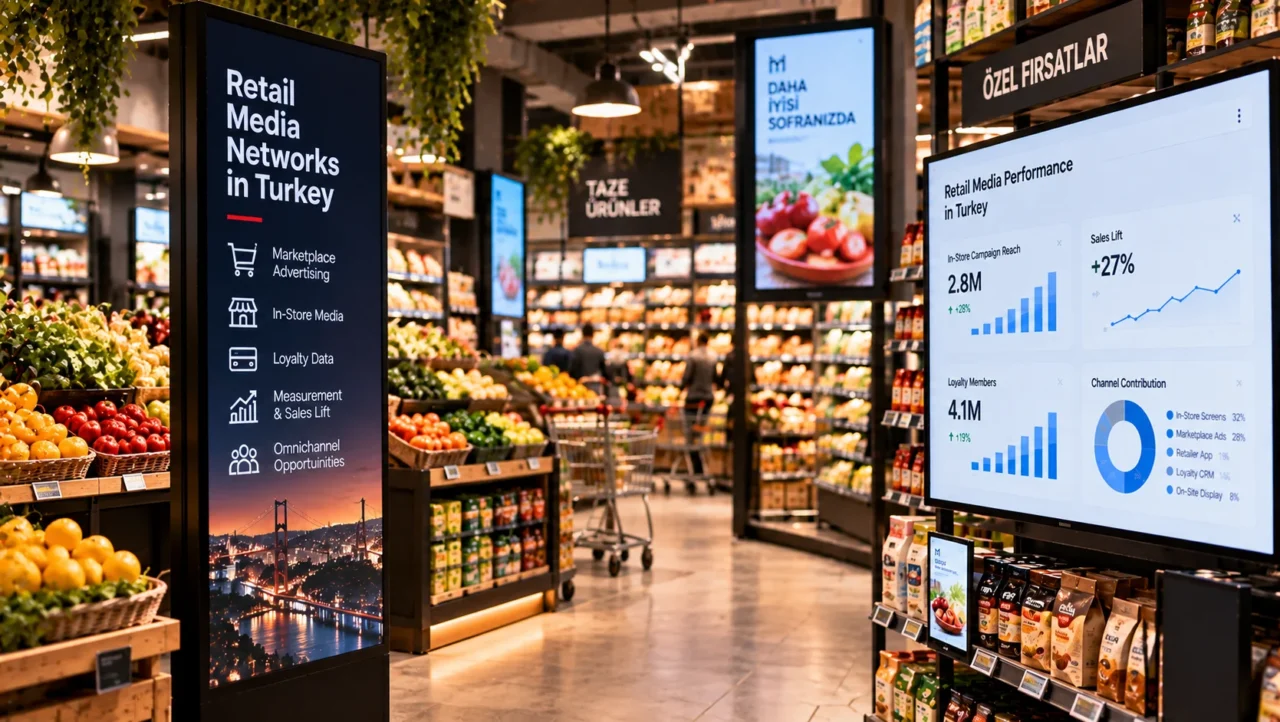
Retail Media Networks in Turkey
Foreign brands in Turkey generally know half of retail media and have never heard of the other half. The half they know is marketplace advertising — sponsored products on Trendyol or Hepsiburada. The half they do not know is the grocery and physical retail side, which runs on loyalty card data and reaches shoppers at the shelf as well as on the screen.
That second half is further developed in Turkey than most international teams assume. Migros established Mimeda in 2021, described as Turkey’s first retail media company, operating more than fifteen marketing and communication channels including in-store digital screens, entrance sensors, checkout areas, online retail placements, personalised ad spaces and the retailer’s own in-store television. CarrefourSA launched its own retail media platform developed from the start of 2024, followed by a sponsored product and display advertising platform built with agency and technology partners.
The number that explains why this works sits in CarrefourSA’s own announcement: the retailer stated that 75 percent of its total turnover comes from transactions using a loyalty card. Three quarters of sales tied to an identified customer is a data position no general advertising platform in Turkey can match.
This guide covers the three inventory layers, who you actually buy from, what the measurement promise is worth, and where retail media belongs in a foreign brand’s Turkish plan.
Table of Contents
- What retail media actually is
- The three inventory layers
- The Turkish landscape
- Why loyalty penetration is the proposition
- The data argument under KVKK
- Who you actually buy from
- What you can buy
- Measurement: the promise and the catch
- Trade marketing becomes a media line
- Where it fits in a Turkish plan
- Common mistakes
- A 90-day plan
- Frequently asked questions
- Conclusion
What retail media actually is
Retail media is advertising inventory owned and sold by a retailer, targeted using that retailer’s own purchase data, and measured against sales in that retailer’s own environment.
Three features distinguish it from everything else in a media plan.
The targeting data is purchase history, not inferred interest. A general advertising platform knows what you clicked. A retailer knows what you bought, how often, at what price and what you switched to.
The advertising sits at the point of decision. Not adjacent to content, but inside the environment where the purchase happens — a search results page, a category listing, a shelf-edge screen.
Measurement closes the loop. Because the retailer sees both the exposure and the transaction, sales attribution is direct rather than modelled — with important caveats covered below.
For a foreign brand, the practical distinction to hold onto is this: marketplace advertising is one expression of retail media, not the whole category. If your Turkish plan contains sponsored products on a marketplace and nothing else, you are using the part of this channel that is easiest to buy and missing the part built on the strongest data.
The marketplace layer specifically is covered in our guide to Hepsiburada and Amazon Turkey advertising, and the separate comparison-platform layer in our guide to Akakçe and Cimri.
The three inventory layers
Retail media inventory divides into three layers with different mechanics, different costs and different buyers inside your organisation.
| Layer | What it is | Typical formats | Who usually owns the budget |
|---|---|---|---|
| Onsite | The retailer’s own website and app | Sponsored products, category banners, search placements | Digital or e-commerce |
| Offsite | Advertising elsewhere, targeted with the retailer’s data | Social, display, video, email to loyalty members | Media or brand |
| In-store | Physical store environment, digitised | Digital screens, checkout area, shelf-edge, in-store TV and audio | Trade marketing |
Mimeda’s channel description illustrates how far the in-store layer has developed in Turkey: in-store digital screens, entrance sensors, checkout areas, online retail spaces, personalised advertising spaces and the retailer’s own in-store television channel among more than fifteen channels.
The organisational point matters as much as the technical one. In most foreign brands these three layers sit with three different teams and three different budgets — which is why retail media proposals frequently stall. Deciding who owns the channel before the first conversation with a retailer saves months.
The Turkish landscape
Turkey’s retail media providers fall into two groups, and foreign brands are usually familiar with only the first.
Marketplaces. Trendyol, Hepsiburada, Amazon Turkey and other platforms operate sponsored product and display advertising systems for sellers. These are the easiest to access, because you can usually self-serve once you hold a seller account.
Grocery and physical retailers. Migros, through Mimeda established in 2021, and CarrefourSA, through a platform developed from early 2024 and a sponsored product and display offering launched with agency and technology partners later that year. Industry reporting describes other large Turkish grocery and discount chains as active or developing in this space.
Two cautions before planning around any specific provider.
Corporate structures change. The Turkish retail sector has been through ownership and consolidation activity, and at least one of the retailers above has been subject to a transfer process reported in 2026. Confirm the current corporate position and whether the retail media offering continues in the same form before building a plan around it.
Capability claims need checking. Retail media is a fashionable term, and the gap between a retailer announcing a platform and a retailer able to deliver measurable targeted campaigns at scale can be substantial. Ask what is actually live, what data is actually available for targeting, and what reporting you will actually receive.
Why loyalty penetration is the proposition
The single most important number in evaluating a grocery retail media network is what share of its transactions are linked to an identified customer. Everything else depends on it.
CarrefourSA’s announcement of its retail media platform stated that 75 percent of the retailer’s total turnover comes from loyalty card transactions. Reporting on the Turkish retail media market has described the retailer as reaching close to 12.5 million card customers with around 300 million physical and digital visits a year.
Why this matters more than audience size:
- Identified transactions are what make targeting possible. A retailer with low loyalty penetration can tell you how many people walked past a screen. One with high penetration can tell you which households bought your category last month and did not buy your brand.
- It is also what makes measurement possible. Closed-loop sales attribution requires linking exposure to purchase, which requires an identified customer on both sides.
- It determines which audiences you can build. Category buyers, competitor buyers, lapsed buyers and new-to-category households are only addressable where the data exists.
The practical question to ask any Turkish retailer pitching retail media is therefore not “how many customers do you have” but “what share of your transactions are identified, and what can I target with that”. This connects directly to the loyalty programme mechanics covered in our guide to customer loyalty and retention programs in Turkey — the retailer’s loyalty programme is the asset the media business is built on.
The data argument under KVKK
Retail media is frequently sold as the answer to a privacy-constrained advertising environment, and in Turkey that argument has a specific form worth examining rather than accepting.
The case is real. Turkish rules require consent before non-essential cookies are set, and advertising cookies in particular cannot be operated on a legitimate interest basis — which constrains third-party tracking and shrinks addressable retargeting audiences. A retailer’s own purchase data, collected in a direct customer relationship, is a different kind of asset.
But three qualifications matter.
First-party does not mean unregulated. The retailer’s data is still personal data, subject to KVKK, and the Personal Data Protection Board has issued a principle decision addressing loyalty card programmes specifically, with expectations around consent management and verification architecture. The retailer’s compliance is the retailer’s responsibility, but a brand buying audiences built on that data has an interest in it being sound.
Ask what you actually receive. There is a large difference between a retailer targeting its own customers on your behalf and a retailer sharing customer data with you. The first is normal; the second raises controller and transfer questions that need legal review. Establish which arrangement you are in.
Offsite targeting involves transfers. Where a retailer activates its data on external platforms, data moves — and the cross-border element engages Turkish transfer rules amended in 2024.
The general framework is covered in our guide to KVKK compliance for foreign brands marketing in Turkey. The point here is that retail media reduces your dependence on third-party tracking; it does not move you outside the data protection regime.
Who you actually buy from
The Turkish retail media supply chain has more intermediaries than the marketplace layer suggests, and knowing who does what prevents paying twice.
The retailer owns the inventory and the data.
A technology platform often provides the advertising infrastructure. Turkish retail media deployments have been built with specialist local retail media technology providers alongside international agency groups.
A sales house or agency partner may manage the retailer’s media sales end to end — reporting on the Turkish market describes exactly this arrangement for at least one major retailer.
Your own agency plans and buys across networks.
Three practical implications:
- Ask who you are actually contracting with and where the margin sits. A chain of intermediaries between your budget and the inventory affects what reaches the media.
- Self-serve is uneven. Marketplace platforms generally offer self-service; grocery retail media is more often a managed, negotiated relationship with minimum commitments.
- Independence matters when choosing. A partner with a revenue-share relationship with a specific network is not a neutral adviser on which network to use.
What you can buy
Formats across Turkish retail media networks follow international patterns, with the in-store layer more developed than in some European markets.
Sponsored products. Keyword and category-targeted placement in the retailer’s search and browse. The entry point for most brands, and the format where performance is most directly measurable.
Display and category banners. Visibility within the retailer’s environment, suited to launches and seasonal pushes rather than always-on performance.
Audience activation offsite. The retailer’s segments used to target advertising on external platforms, which extends reach beyond the retailer’s own traffic.
Loyalty communications. Email, app and personalised offer placements reaching identified members, subject to the consent and commercial messaging rules that govern all Turkish direct communication.
In-store digital. Screens, checkout area placements and in-store channels — the layer that converts traditional trade marketing into measurable media.
On cost, there is no published Turkey-wide retail media rate card, pricing is negotiated and varies by retailer, category and commitment, and figures circulating online should not be treated as benchmarks. Establish your own through a test and model it against the channel cost picture in our budget guide to digital marketing costs in Turkey.
Measurement: the promise and the catch
Closed-loop measurement is retail media’s strongest selling point and the place where buyers most often accept more than the data supports.
The promise is genuine: because the retailer sees exposure and purchase, it can report sales attributed to the campaign rather than modelled estimates. Turkish retail media positioning explicitly emphasises real-time performance tracking and cost control.
Four catches to raise before signing.
Attributed is not incremental. A shopper who would have bought your product anyway, and who also saw your sponsored placement, appears in attributed sales. The question that matters commercially is how much of the attributed revenue would not have occurred otherwise — and answering it requires holdout testing, which most networks do not offer by default. Ask for it.
The retailer marks its own homework. Reporting comes from the party selling you the media. That is not a reason to distrust it, but it is a reason to validate against your own sell-out data where you can get it.
Attribution windows and models vary by network. Comparing ROAS figures across retailers without checking the window and the attribution logic compares different things.
The data stops at the retailer’s boundary. A retail media campaign that drives a purchase in a different store is invisible, which systematically understates brand effects.
The sensible position is to treat retail media reporting as strong evidence of in-retailer performance and weak evidence of total commercial impact. Getting your own measurement foundation right is covered in our GA4 and marketing analytics setup guide for Turkey.
Trade marketing becomes a media line
For brands selling through physical retail, retail media’s most consequential effect is organisational rather than technical.
Trade marketing spend — the budget historically allocated to in-store visibility, promotional support and retailer relationships — is being converted into measurable media. In-store screens and checkout placements deliver what shelf displays delivered, with reporting attached.
Three consequences for a foreign brand:
- Two budgets now compete for the same outcome. Trade marketing and digital media can buy the same in-store attention through different routes, and in most organisations nobody is comparing them.
- Retailer negotiations now include media. Listing discussions increasingly include advertising commitments, which changes what you are agreeing to. Note that Turkish retail law restricts certain payments retailers may demand from suppliers, so where media commitments are bundled into commercial terms, the arrangement is worth legal review — the framework is covered in our guide to food, beverage and FMCG marketing in Turkey.
- Measurement expectations rise. Once in-store activity is measurable, it becomes accountable — which is uncomfortable for activity that was previously justified by relationship.
Where a distributor or partner handles your Turkish retail relationship, the question of who funds and who controls retail media spend belongs in the same conversation as other channel economics, covered in our guide to co-op marketing with Turkish distributors and dealers.
Where it fits in a Turkish plan
Retail media is a conversion-proximate channel, which makes it complementary rather than substitutional.
It works best for brands already on shelf. Advertising inside a retailer where your product is not stocked, or is stocked in few stores, wastes the targeting advantage.
It does not create demand. It captures and redirects demand at the decision point. Brands with no awareness in Turkey still need upper-funnel work, and retail media performance will look poor if it is the only channel running.
Category matters. FMCG, beauty, electronics and household categories are the natural fit. Considered purchases with long research cycles are served less well.
It is strongest in competitive categories. Where the shopper is choosing between similar products at the shelf, being the one surfaced is worth a great deal. Where you are the only option, you are paying for a sale you would have had.
The wider e-commerce channel picture is covered in our guide to e-commerce in Turkey, and the category where this channel is most developed in our guide to fashion and apparel marketing in Turkey.
Planning across several networks with different data, formats and reporting standards is genuinely complex, and it sits between media buying and e-commerce operations rather than cleanly inside either. That combination is the kind of work agencies with both capabilities, Medyae among them, are structured to coordinate.
Common mistakes
Treating marketplace ads as the whole channel. The grocery and in-store layer runs on stronger data and is less contested by foreign brands.
Accepting attributed ROAS as incremental. Ask for holdout testing before accepting the headline number.
Comparing ROAS across networks without checking the model. Attribution windows and logic differ.
Buying before checking distribution. Advertising inside a retailer where you are weakly stocked wastes the advantage.
Assuming first-party data is outside KVKK. It is personal data, and loyalty programmes are specifically addressed by the Board.
Not establishing which arrangement you are in. Retailer targeting on your behalf and data sharing with you are different legally.
Letting trade marketing and media budgets buy the same thing separately. Nobody compares them unless someone is asked to.
Planning around a capability that was announced rather than delivered. Ask what is live now.
A 90-day plan
Weeks 1–4: map and qualify. List the retailers where your distribution is genuinely strong and ask each what retail media capability is live today, what share of transactions are identified, what audiences can be targeted and what reporting you receive. Decide internally who owns the channel and whether the budget comes from trade or media. Get the data arrangement reviewed legally.
Weeks 5–8: test narrow. Start with sponsored products on one or two networks where you are well stocked, on products where you are competitive. Negotiate holdout testing into the test if the network supports it. Keep each network’s results separate rather than blended.
Weeks 9–12: read incrementality, not attribution. Compare attributed sales against your own sell-out data. Assess whether in-store digital is replacing trade marketing spend or adding to it. Expand only where the incremental case holds, and establish your own cost benchmarks rather than importing any.
Frequently asked questions
What is retail media and how is it different from marketplace advertising?
Retail media is advertising inventory owned and sold by a retailer, targeted with that retailer’s own purchase data and measured against sales in its own environment. Marketplace advertising is one expression of it. The broader category also includes grocery and physical retailers’ onsite, offsite and in-store inventory, which is built on loyalty card data rather than marketplace browsing behaviour.
Does Turkey have retail media networks beyond marketplaces?
Yes. Migros established Mimeda in 2021, described as Turkey’s first retail media company, operating more than fifteen channels including in-store digital screens, entrance sensors, checkout areas, online retail placements and in-store television. CarrefourSA developed a retail media platform from early 2024 and launched sponsored product and display advertising with agency and technology partners. Confirm current corporate and capability positions before planning, as the sector has seen ownership activity.
Why does loyalty card penetration matter for retail media?
Because it determines what can be targeted and measured. CarrefourSA stated that 75 percent of its total turnover comes from loyalty card transactions. A high share of identified transactions is what allows a retailer to build audiences such as category buyers, competitor buyers and lapsed buyers, and to link advertising exposure to actual purchase.
Is retail media a way around Turkish cookie consent rules?
It reduces dependence on third-party tracking but does not remove you from the data protection regime. The retailer’s purchase data is still personal data under KVKK, loyalty card programmes are specifically addressed by the Personal Data Protection Board, and offsite activation involves data transfers. Establish whether the retailer is targeting on your behalf or sharing data with you, and have the arrangement reviewed.
Can I trust retail media ROAS figures?
Treat them as evidence of in-retailer performance, not total commercial impact. Attributed sales include purchases that would have happened anyway, reporting comes from the party selling you the media, attribution windows differ between networks, and sales in other retailers are invisible. Ask for holdout testing and validate against your own sell-out data.
Which brands should prioritise retail media in Turkey?
Brands already well distributed in the relevant retailer, in competitive categories where shoppers choose between similar products at the point of decision — FMCG, beauty, electronics and household goods in particular. It captures and redirects demand rather than creating it, so brands with no Turkish awareness still need upper-funnel activity alongside it.
Conclusion
Retail media is one of the few channels in Turkey where a foreign brand can be genuinely early. The marketplace layer is familiar and already contested. The grocery and in-store layer, built on loyalty data that in at least one case covers three quarters of transactions, is less understood by international advertisers and barely documented in English.
The discipline that makes it work is unglamorous. Buy where you are actually distributed. Ask what share of transactions are identified before you ask about audience size. Insist on incrementality rather than accepting attribution. Decide internally whether this money comes from trade marketing or media, because otherwise both will spend it. And treat first-party data as a better targeting asset, not as an exemption from the rules that govern it.
Do that and retail media becomes the most accountable line in a Turkish plan. Skip it and you will keep buying the attention of shoppers who are already standing in front of your competitor’s product.