



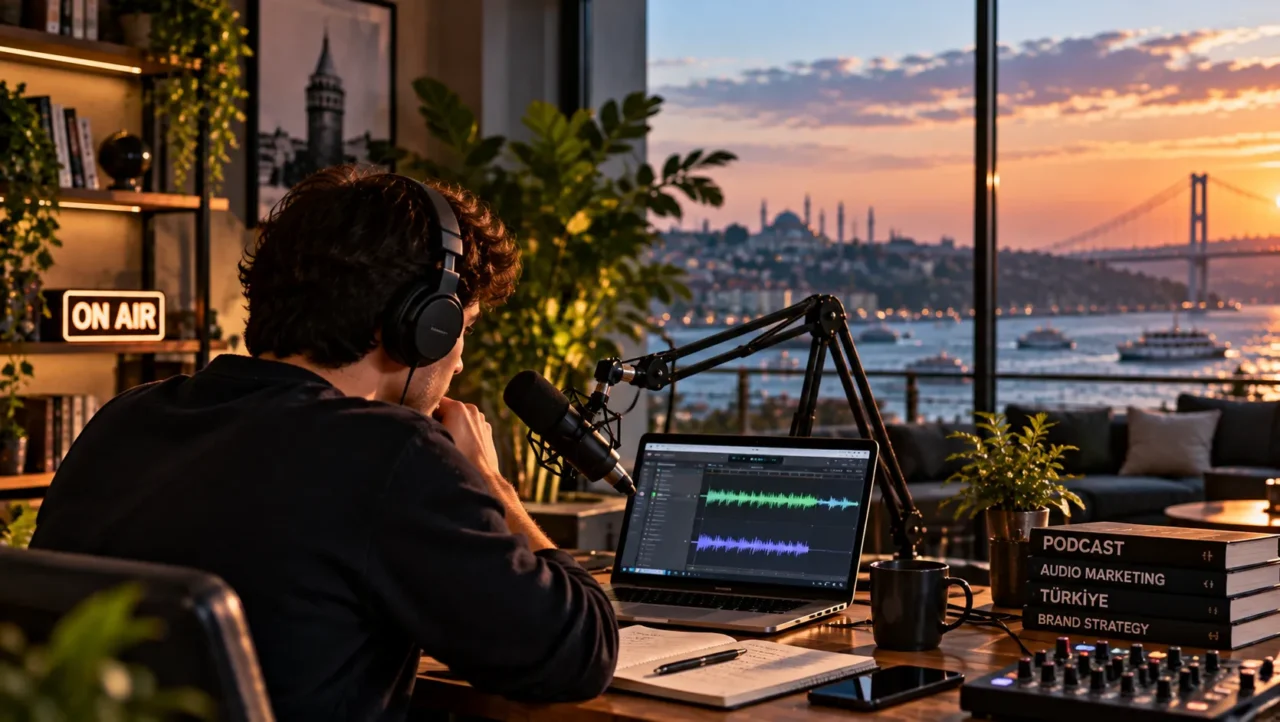
Podcast and Audio Marketing in Turkey: What Foreign Brands Need to Know
Start by accepting that nobody can tell you the size of Turkish podcast advertising, because the country’s authoritative advertising investment report does not measure it separately. The Media and Advertising Investments report published by Reklamcılar Derneği with Deloitte in April 2025 put total Turkish media and advertising investment for 2024 at TRY 253.6 billion, with digital at 74.6% and TRY 158.03 billion, and radio at roughly TRY 3.3 billion. Digital audio has no line of its own: it sits inside an “Other” category alongside email, connected TV and in-game sponsorships, which together came to around TRY 6.75 billion, about 4% of digital spend.
That tells you something useful. Audio in Turkey is a real but small channel, early enough that anyone quoting you a precise Turkish podcast ad spend figure is extrapolating. It also means the opportunity is priced like an emerging channel rather than a mature one. This article covers what the audience data actually supports, the platform and network map, ad formats and the disclosure rules that govern them, when RTÜK licensing becomes your problem, music rights, and how to measure any of it.
Table of Contents
- What the Turkish audio market actually looks like
- Who listens, and what the data does not say
- The platform and network map
- Ad formats and what each is good for
- Host-read advertising and the disclosure rules
- When RTÜK licensing becomes your problem
- Music rights in audio advertising
- Should you make a brand podcast?
- Language, voice and production
- Measuring audio in Turkey
- Frequently asked questions
What the Turkish audio market actually looks like
Turkish audio divides into three layers that behave differently commercially, and conflating them is the first planning error.
Licensed radio remains a measurable, bookable medium with established audience currency, and at roughly TRY 3.3 billion in 2024 it is many times the size of anything in digital audio. It doubled year on year in nominal terms, though with Turkish consumer prices rising at double digits over the same period, nominal growth across this whole report should be read as substantially less in real terms. The buying mechanics sit with traditional media planning, which our guide to TV, radio and out-of-home media buying in Turkey covers.
Music streaming is where most Turkish audio listening time sits, and where audio advertising inventory is most readily available at scale through the platforms’ own ad products.
Podcasting is the smallest and the most interesting, because engagement per listener is high and competition for attention is low. A peer-reviewed review of the Turkish podcast sector published in the Journal of Erciyes Communication in January 2026 reports Podcast Index listing over 20,000 Turkish podcast channels and over 400,000 episodes, with Listen Notes ranking Turkish fifteenth among podcast-producing languages at around 14,000 channels. Those are production counts rather than audience figures, and the review itself notes that podcast-specific revenue data for Turkey is limited.
Who listens, and what the data does not say
The most substantial representative study of Turkish podcast listening is now dated, and no foreign brand should plan from it without acknowledging that. Ipsos, working with Podbee Media, surveyed around 16,000 people aged 14 and over in research published in April 2021. Its findings:
- Awareness was 11% overall, rising to 16% among under-45s and 19% in Istanbul.
- Around 650,000 people knew what a podcast was and listened often; around 2 million listened occasionally; a further 4.5 million were aware but did not listen, giving roughly 5 million potential listeners.
- Active listeners skewed young, affluent and concentrated: 53% were under 25, 31% were in the high socio-economic group, and 43% lived in the Marmara region.
- Around half used Spotify, 14% listened daily, and three in four listened while doing something else.
- Motivation split between learning, cited by 43%, and entertainment, cited by 41%.
Treat the absolute numbers as a 2021 baseline, not a current measurement — the market has grown since, and the review cited above reports Spotify’s own 2024 figures showing listeners up 26% and listening hours up 15% year on year. What is more likely to have held is the shape: a young, urban, higher-SES, Marmara-weighted audience listening while doing something else.
One honest conflict worth knowing. The Ipsos work put Spotify at roughly half of listeners, while separate industry research cited in the same academic review reported 78.3% using YouTube. Both can be true at once, because many Turkish listeners consume podcasts as video on YouTube rather than through podcast apps. If your media plan assumes “podcast” means an audio app, it may be planning against the smaller half of the audience.
The platform and network map
The Turkish audio ecosystem has a local layer that global media plans usually miss entirely.
| Layer | Examples | What it matters for |
|---|---|---|
| Global podcast and music platforms | Spotify, Apple Podcasts, YouTube, SoundCloud | Scale distribution and platform-sold audio advertising inventory |
| Turkish audio aggregators | TRT Dinle, Karnaval, PowerApp | Local discovery, radio and podcast catalogues in one place |
| Radio-originated podcasts | NTV Radyo, Açık Radyo | Established editorial audiences migrating to on-demand |
| Production and distribution networks | Podbee Media, Podfresh, Poddict, TTWW Media, Digipeak, Sessanat | Host-read placement, production partners, advertiser–podcaster matching |
The practical point is that buying Turkish podcast advertising at any meaningful scale usually means working with a local network rather than a self-serve platform, because inventory is fragmented and the valuable placements are host-read rather than programmatic. Poddict operates as an advertiser-to-podcaster marketplace, which is the closest thing to a self-serve route. Entity names and market positions in this layer change, so confirm who is currently active before building a plan around a specific partner.
Ad formats and what each is good for
Audio advertising in Turkey uses the same formats as elsewhere, and the choice should follow the objective rather than the rate card.
Pre-roll, mid-roll and post-roll. Mid-roll is generally the most valuable position because the listener is committed to the episode. Typical durations run 15 to 60 seconds, and a reasonable discipline is keeping total advertising to a modest share of episode length — the academic review cites a recommended maximum of around 10%.
Programmatic audio on music streaming. This is where reach lives, bought through platform ad products with the targeting those platforms offer. It behaves like display: measurable, scalable, lower engagement per impression.
Sponsorship. Naming or “presented by” rights, guest appearances, special episodes and branded segments. In a market where podcast audiences are small but committed, sponsorship often outperforms spot advertising on cost per engaged listener.
Host-read endorsement. The highest-performing and highest-risk format, covered in its own section below because the compliance requirements are specific.
On pricing, be sceptical of any CPM quoted to you as a Turkish benchmark. The figures in circulation — a range of roughly USD 18 to 25 per thousand listens — are global reference points from industry sources, not measured Turkish rates, and Turkish podcast CPM data is not systematically published. Negotiate against your own cost per engaged listener rather than an imported benchmark.
Host-read advertising and the disclosure rules
Host-read audio advertising is subject to Turkey’s advertising disclosure rules, and the audio-only case has its own specific timing requirement. Under the Commercial Advertising and Unfair Commercial Practices Regulation, where the content is audio-only the disclosure must be made at the beginning of the broadcast and before the advertisement — not buried in a description, and not left to the end.
Two further points tighten this. The amendment published in the Official Gazette on 1 July 2026 ties the disclosure obligation to any benefit received, not to cash payment: payment, a discounted product or service, or event participation all trigger the requirement for a clear label such as “reklam” or “tanıtım”. And where a host advertises in an audio-only format, the disclosure cannot be satisfied by a visual label alone, because the listener never sees it.
Three operational consequences. Put the disclosure wording in the brief and in the contract, rather than leaving it to the host’s habit. Require a review of the recorded read before publication, since audio cannot be quietly edited after the fact the way a caption can. And if the podcast’s audience is substantially under 18, the child-directed advertising restrictions apply on top, including the prohibition on encouraging excessive consumption — and profiling-based targeted advertising to children is itself prohibited following the same July 2026 amendment.
When RTÜK licensing becomes your problem
This is the question foreign brands do not think to ask, and the answer depends on whether you are publishing content or operating a service.
The Regulation on the Provision of Radio, Television and On-Demand Broadcasts over the Internet was published in the Official Gazette on 1 August 2019, No. 30849, with Articles 10 and 11 taking effect on 1 September 2019. It brings internet delivery of radio, television and on-demand services within RTÜK’s licensing regime, and it treats content as on-demand where it is watched or listened to at a time chosen by the user and on the user’s personal request.
What falls in and out:
- In scope: media service providers delivering broadcast services over the internet, with named examples at the time including Karnaval — notable because it is an audio service — alongside video platforms and television channels, plus platform operators transmitting those services.
- Out of scope: personal communication services, platforms that are not dedicated to delivering broadcast services, and persons who merely provide hosting.
- Licence types included INTERNET-RD for radio, INTERNET-TV for television and INTERNET-İBYH for on-demand services, issued for ten years, and only joint-stock companies under the Turkish Commercial Code may hold them. Platform operators require a transmission authorisation.
The fee levels stated when the regulation was introduced were TRY 10,000 for an internet radio licence and TRY 100,000 each for internet television and on-demand licences, with an annual TRY 100,000 platform operator fee. RTÜK revises these annually, so those 2019 figures are certainly out of date and should not be used for budgeting.
The practical reading: distributing a brand podcast through Spotify, Apple Podcasts or YouTube is a materially different proposition from operating your own audio streaming service aimed at Turkey, and the hosting-only and non-dedicated-platform exclusions matter. If your plan involves running a branded audio service or an internet radio station rather than publishing episodes to third-party platforms, get a Turkish legal view on licensing before launch, not after.
Music rights in audio advertising
Music in an audio advertisement needs rights cleared across several separate layers, and Turkish collective management is organised along those lines rather than offering one blanket permission.
A track breaks into lyrics (söz), composition (beste), sound recording (fonogram) and performance (yorum). MESAM and MSG administer rights in lyrics and composition; MÜYAP administers phonogram rights; MÜYORBİR administers performance rights. In practice the lyric and composition rights often sit with the composer or a publisher, while recording and performance rights sit with the performer or label.
Two points for a foreign brand. First, a licence that covers playing music in a venue or on a station is not the same thing as permission to synchronise a recording into an advertisement, and whether and how a collecting society’s licence extends to advertising use is a question for a Turkish copyright lawyer rather than an assumption. Get written consent, which Turkish practice handles as a muvafakatname, covering the specific use. Second, the clean routes are commissioning original music or using properly licensed stock with the licence terms read — both avoid most of the clearance work, and a bespoke sonic identity is usually better brand strategy than a recognisable track anyway.
Should you make a brand podcast?
For most foreign brands entering Turkey, buying audio advertising is the better first move and making a podcast is the worse one. A brand podcast is a publishing commitment: a schedule, a format, a host, production capacity and a distribution plan, sustained long enough to build an audience from zero in a market where you may have little brand awareness to begin with.
The cases where it does work are specific. B2B categories with a genuinely informed point of view, where a small, senior audience is worth more than reach, and where the podcast functions as a credibility asset used in sales conversations rather than a reach channel. Categories where expertise is the product — professional services, health-adjacent subject matter handled carefully, and financial services and fintech, where sector advertising rules make explaining safer ground than claiming — where explaining is the marketing. And existing global shows with Turkish-language adaptation, where the format is already proven and the local investment is production rather than invention.
If you do commit, two local decisions matter more than the content plan. Produce in Turkish with a Turkish host rather than subtitling or dubbing a global show, because a dubbed podcast sounds dubbed and this audience is listening closely. And publish to YouTube as well as audio platforms, given the share of Turkish podcast consumption that happens as video — a decision that changes your production requirements from the first episode.
Language, voice and production
Audio removes every visual cue, which makes language and voice carry the whole impression — and makes the shortcuts more audible.
Script in Turkish, do not translate into it. A translated audio script retains the rhythm of the original language, and in a medium where the listener has nothing else to attend to, that rhythm is conspicuous. Turkish sentence structure places the verb late, which changes how a message builds and where the emphasis lands; a script written to an English cadence will land its point in the wrong place or run over the available seconds.
Cast for the audience, not for the brand guideline. Accent, age and register communicate immediately in audio. A global brand voice specification written around English-language delivery often does not transfer, and insisting on it produces a read that is technically compliant and locally wrong.
Mind the duration arithmetic. Turkish is frequently longer than English for the same content. A script that fits 30 seconds in English may not in Turkish, and the usual failure is a rushed read rather than a trimmed script. Brief for the Turkish duration from the start.
Produce locally where you can. Voice casting, direction and sound design done in Turkey by people who hear the language natively is the single highest-return production decision in this channel. The distinction between translating and localising is the same one covered in our guide to website localisation for Turkey beyond translation, and it is more exposed in audio than anywhere else.
Measuring audio in Turkey
Audio is the hardest major channel to attribute, and in Turkey the local measurement infrastructure for digital audio is thinner than for television or radio.
What works, in rough order of reliability. Promotional codes and dedicated URLs read by the host give you direct, if partial, attribution and are the standard answer for podcast advertising. Geo and time-based testing — running audio in some regions or periods and not others — measures incremental effect without needing user-level data, and Turkey’s regional variation makes it practical. Brand metric movement from survey measurement captures what audio does best, which is building familiarity rather than driving immediate action; the local considerations, including the socio-economic classification change, are covered in our guide to brand tracking and consumer research in Turkey. Platform-reported delivery gives you impressions and completion, not effect.
Set expectations before you buy. Audio will not produce the attribution detail a performance channel produces, and the consent position on tracking in Turkey constrains some of the identity-based approaches used elsewhere — the framework is in our guide to cookie consent and tracking compliance in Turkey. A realistic brief treats audio as an upper-funnel channel measured by brand movement and tested geographically, with codes as a directional signal rather than the verdict.
Frequently asked questions
How big is podcast advertising in Turkey?
No reliable figure exists, and that is itself the answer. The Reklamcılar Derneği and Deloitte Media and Advertising Investments report for 2024, published in April 2025, does not break out digital audio as a separate line — it sits within an “Other” category with email, connected TV and in-game sponsorships, totalling around TRY 6.75 billion, roughly 4% of digital spend. Radio, by contrast, was around TRY 3.3 billion. Anyone quoting a precise Turkish podcast ad spend figure is extrapolating.
Do I need an RTÜK licence to publish a podcast in Turkey?
Publishing episodes to third-party platforms is a different proposition from operating an audio service. The 2019 regulation on internet delivery of radio, television and on-demand broadcasts brings media service providers and platform operators within RTÜK’s licensing regime, and excludes personal communication services, platforms not dedicated to broadcast services, and hosting-only providers. Licences may only be held by joint-stock companies. If you plan to run a branded audio service or internet radio station targeting Turkey, take Turkish legal advice before launch.
How must a host-read podcast advertisement be disclosed in Turkey?
For audio-only content the disclosure must be made at the beginning of the broadcast and before the advertisement. Following the amendment published in the Official Gazette on 1 July 2026, the obligation is triggered by any benefit received — payment, a discounted product or service, or event participation — and requires a clear label such as “reklam” or “tanıtım”. A visual-only label cannot satisfy the requirement in audio-only content.
Which platform do Turkish podcast listeners actually use?
Both Spotify and YouTube matter, and the evidence conflicts in an informative way. Ipsos research published in April 2021 found around half of listeners using Spotify, while separate industry research cited in a 2026 academic review of the sector reported 78.3% using YouTube. Many Turkish listeners consume podcasts as video, so a plan that treats podcasting as audio-app-only may be addressing the smaller part of the audience.
Can I use a well-known song in a Turkish audio advertisement?
Only with the right permissions, and more than one is needed. Rights in lyrics and composition, the sound recording, and the performance are administered separately — MESAM and MSG for lyrics and composition, MÜYAP for phonograms, MÜYORBİR for performances — and a licence permitting music to be played is not the same as permission to synchronise a recording into an advertisement. Get written consent for the specific use, or commission original music.
Conclusion
Turkish audio is an early channel with an unusually engaged audience and very little competitive pressure on attention. The honest framing is that it is small: radio was around TRY 3.3 billion of a TRY 253.6 billion advertising market in 2024, and digital audio is not large enough to be measured separately in the national report. That is an argument for entering deliberately rather than either ignoring the channel or over-investing in it.
Four things decide whether it works. Plan against the audience’s shape — young, urban, higher-SES, Marmara-weighted, and consuming a great deal of podcast content as video on YouTube — rather than against 2021 absolute numbers. Put the audio-only disclosure requirement into the brief and the contract, because it must come at the beginning of the broadcast and before the advertisement. Clear music rights across all four layers or commission original music. And script in Turkish for Turkish duration, cast locally, and measure with codes, geo tests and brand movement rather than expecting performance-channel attribution.
Medyae works with foreign and international brands on the marketing side of entering and growing in Turkey — SEO, digital marketing, social media management, web and production — including the Turkish-language scripting, voice and production work that audio advertising depends on to sound local rather than translated. For how audio fits the wider channel picture, our pillar guide to marketing in Turkey for foreign brands is the place to start.
This article is general information about the commercial and regulatory environment for audio and podcast marketing in Turkey, and the figures cited carry the dates of the sources given. It is not legal advice. Broadcast licensing scope and fees, advertising disclosure obligations and music rights clearance are fact-specific and should be confirmed with qualified Turkish counsel for your activity.