



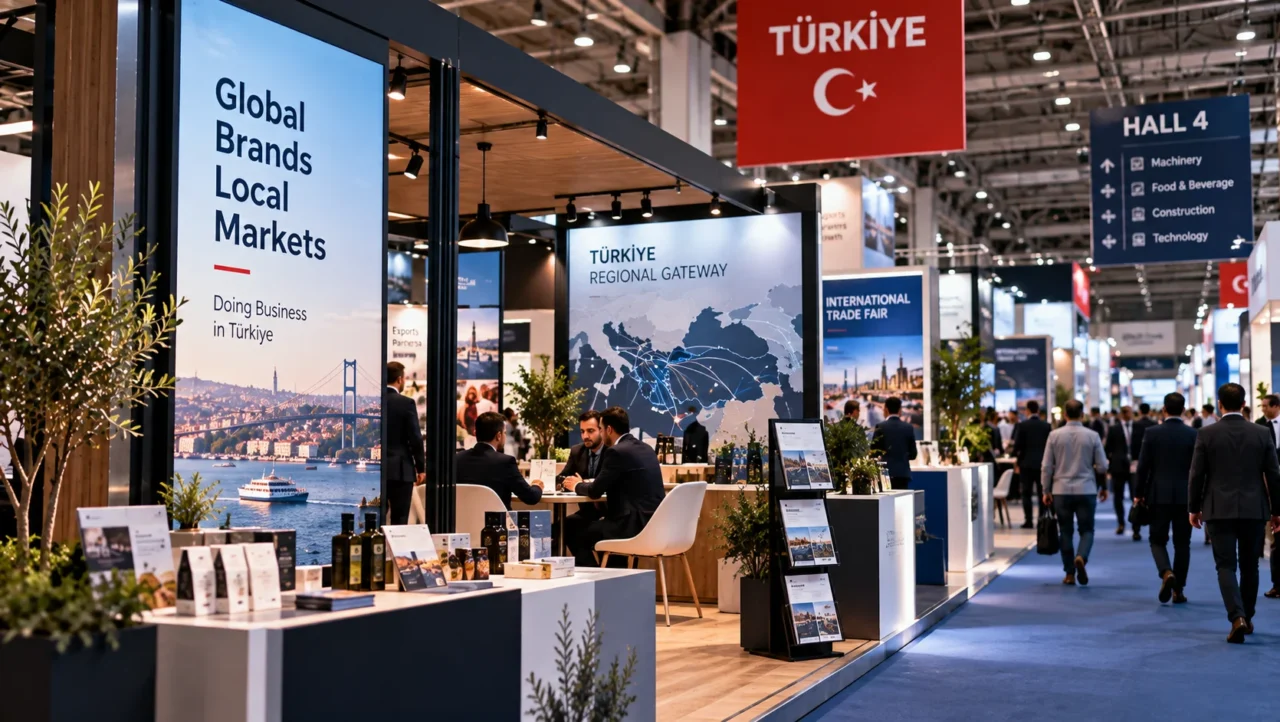
Exhibiting at Turkish Trade Fairs: What Foreign Brands Need to Know
Two checks decide whether a Turkish trade fair pays for itself, and both happen before you book. First, confirm the fair appears on the official annual fair calendar published by TOBB, the Union of Chambers and Commodity Exchanges of Türkiye: domestic fairs in Turkey are organised by companies holding a TOBB-issued fair organisation authorisation certificate, and TOBB can request the closure of events held without it. Second, plan your follow-up before you collect a single business card, because sending commercial email or SMS to Turkish contacts is governed by Law 6563 and the Message Management System (İleti Yönetim Sistemi, or İYS), under which consent that is not registered in İYS is treated as invalid.
Fairs remain one of the most efficient ways for a foreign brand to meet Turkish distributors, buyers and specifiers in a market where B2B relationships still form face to face. This article covers the regulatory framework, how to judge whether a fair is genuinely international, getting exhibits through customs, lead capture under KVKK, and who should hold the stand.
Table of Contents
- Why trade fairs still matter in Turkish B2B
- How the Turkish fair system is regulated
- How to tell whether a fair is genuinely international
- Choosing the right fair: venues and audiences
- What your exhibitor contract must contain
- Getting your exhibits into Turkey: ATA Carnet and temporary import
- Samples, giveaways and tasting product
- Stand staffing and language
- Lead capture and KVKK at the stand
- Follow-up: why İYS decides whether your leads are usable
- Who should hold the stand
- The marketing that happens around the fair
- Frequently asked questions
Why trade fairs still matter in Turkish B2B
In many categories a Turkish distributor, importer or industrial buyer will not commit to an unfamiliar foreign brand on the basis of email and a video call. Fairs compress into three or four days the relationship-building that would otherwise take several trips, and they put you in front of people who are hard to reach individually.
Three structural reasons they work here. Turkish B2B purchasing often involves several decision-makers inside the same family-owned or group-owned company, and a stand lets you meet them together rather than sequentially. Istanbul fairs draw regional visitors from the Middle East, the Balkans, the Caucasus and Central Asia, so one event can serve more than the Turkish market — the logic behind using Turkey as a regional hub for MENA and Central Asia. And for categories sold through distribution, a fair lets you compare several candidate partners in parallel rather than negotiating with whichever one found you first.
What fairs do not do is substitute for demand. A stand generates conversations; it does not create awareness among buyers who have never heard of you, nor replace the Turkish-language presence those buyers will check after meeting you.
How the Turkish fair system is regulated
Domestic fairs in Turkey operate under rules set and administered by TOBB. The framework is the Principles and Procedures on Holding Fairs in Turkey (Yurt İçinde Fuar Düzenlenmesine Dair Usul ve Esaslar), adopted by TOBB Board of Directors Decision No. 94 of 3 November 2014, effective 1 January 2015, and grounded in Law No. 5174 on Chambers and Commodity Exchanges.
- Organisers must be authorised. An organiser has to be a joint-stock or limited company holding a TOBB-issued domestic fair organisation authorisation certificate, subject to requirements including minimum paid-in capital, a sworn financial adviser’s report and a cash guarantee.
- Fairs run on a published calendar. Organisers apply through their local chamber or commodity exchange by 1 August of the preceding year, and later applications are rejected. TOBB publishes the main calendar in September of the preceding year, in the Trade Registry Gazette and on its website.
- TOBB supervises and sanctions. It assesses applications, oversees fairs, receives post-fair reports, and can impose warnings, forfeiture of the guarantee, exclusion from the calendar or cancellation of the certificate. It can also request closure of unauthorised events.
For an exhibitor the practical takeaway is to verify the fair appears on the current TOBB calendar before signing anything. An event outside the calendar is not necessarily fraudulent, but it sits outside the system that would give you recourse, and its organiser has no guarantee at risk.
How to tell whether a fair is genuinely international
“International” is a regulated description in Turkey, not a marketing adjective. Under Article 6 of the Principles and Procedures a fair may use the term only if the same organiser has held a fair with the same or a similar name or subject at least twice in the last five years, and at least one of the following is met:
- Foreign exhibitors, direct or through representatives, make up at least 15% of all exhibitors;
- Net stand area allocated to foreign exhibitors is at least 10% of the total; or
- Foreign visitors make up at least 2.5% of all visitors.
The classification must be documented in a report by a sworn financial adviser or an independent audit firm. Fairs carrying the UFI international label are exempt from that reporting requirement.
Read the thresholds before relying on the label. Because only one of the three has to be met, a fair can legitimately be called international on the strength of foreign exhibitors while attracting very few foreign visitors — which matters if your objective is to meet export buyers rather than be seen by Turkish ones. Ask the organiser which criterion the fair satisfies and ask to see the most recent audited participation report. A serious organiser will have it.
Choosing the right fair: venues and audiences
Turkey’s fair infrastructure is concentrated in Istanbul, with significant capacity in Izmir, Ankara and Antalya. The venue tells you something about an event’s scale and the audience it draws.
| Venue | Location | Typical profile |
|---|---|---|
| TÜYAP Fair, Convention and Congress Center | Beylikdüzü, Istanbul | Turkey’s largest fair complex; many major industrial and sector fairs, including Plast Eurasia İstanbul and Expomed Eurasia |
| İstanbul Fuar Merkezi / CNR Expo | Yeşilköy, Istanbul | Close to the airport; consumer and trade fairs across many sectors |
| Fuar İzmir | Gaziemir, İzmir | Aegean industrial base; regional and sector events |
| Antalya Expo Center | Antalya | Tourism, agriculture and events tied to the southern economy |
| ANFA Altınpark and other Ankara venues | Ankara | Public-sector adjacency, defence and institutional buyers |
Work backwards from who you need to meet rather than choosing by fair name. If your buyer is a retail chain category manager, the relevant event is the one that chain’s buyers attend, and the conversation that follows runs on the terms set out in our guide to trade and shopper marketing in Turkey. If your buyer is a factory engineer, it is the machinery or components fair in that vertical. Ask candidate partners which two fairs they actually attend; the answer is shorter than the calendar suggests.
If you have not established whether the Turkish opportunity justifies exhibiting at all, sizing and validating the Turkish market before you enter comes first. Attending one cycle as a visitor is an underrated and much cheaper way to answer the question.
What your exhibitor contract must contain
Under the Principles and Procedures the organiser must sign a participant rental contract (katılımcı kira sözleşmesi) with every exhibitor at every calendared fair, stating the stand or space allocated for a fixed period in exchange for rent, the participation fees and what they cover, the services provided as part of the fair, and each party’s mutual responsibilities.
Treat those four elements as a checklist. The disputes foreign exhibitors run into are almost always about what the fee covered.
- Stand position in writing. A hall name is not a position. Get the stand number and layout drawing attached to the contract.
- Included versus charged separately. Shell scheme, carpet, electrical connection and consumption, water, internet, furniture, cleaning, waste removal, badge scanners and exhibitor passes are commonly priced separately. Ask for the full price list, not the stand rate.
- Catalogue and promotional inclusions. Which listings, which languages, and the deadline for supplying copy.
- Stand construction rules. Height limits, rigging, approval deadlines for custom builds, and whether you must use nominated contractors.
- Cancellation and postponement. What happens to your payment if the event moves or you withdraw.
Get the contract in a language you can read, and do not rely on verbal assurances about position or inclusions. If a term matters, it belongs in the document the rules already require the organiser to give you.
Getting your exhibits into Turkey: ATA Carnet and temporary import
The normal route for demonstration equipment, display units and samples that will leave again is an ATA Carnet. According to the Ministry of Trade’s guidance on temporary importation, where a carnet issued under the applicable convention is presented with the relevant cover-page section endorsed by the exit country’s customs and is valid in the Turkish customs territory, the transaction proceeds without any other document or guarantee being required.
- Duration. Temporary importation is generally subject to a maximum of 24 months, with specific periods set by the relevant decision and regulation and extensions requested in writing before expiry. For goods moving under a carnet, the permitted stay follows the carnet’s own validity, and longer use requires a new carnet.
- Without a carnet. For temporary importation with full exemption outside the carnet route, a guarantee covering the import duties is required, with limited exceptions.
- Identity. Goods whose identity cannot be verified cannot use the regime, which is why serial numbers and detailed item lists matter on the carnet schedule.
Start this four to six weeks out, not in the final week. The carnet is issued in your own country through the issuing chamber there, and the schedule of goods has to match what actually travels. A mismatch between the carnet list and the crate contents is the most common reason exhibits sit in customs while the stand stands empty.
Samples, giveaways and tasting product
This detail catches foreign exhibitors out, and it follows from how the regime works: goods that are consumable in nature cannot use the temporary importation regime. Anything you intend to hand out, give away, taste, demonstrate destructively or leave behind is not coming back out of the country, so it cannot travel as a temporary import.
That covers food and drink for sampling, cosmetics testers, brochures and catalogues in quantity, branded giveaways, and consumables used up in demonstrations. These have to be imported properly, with duties and taxes paid and any category-specific requirements met — and food, cosmetics and medical categories carry their own requirements for placing product on the Turkish market that go well beyond customs clearance.
Two consequences. Build the cost of properly importing giveaway and sampling volumes into the budget rather than discovering it at the border. And consider producing brochures, catalogues and promotional items in Turkey instead, which avoids the customs question and usually produces better Turkish-language material than translating what you print at home.
Stand staffing and language
A stand staffed only by people who do not speak Turkish will have shorter conversations and fewer of them. Many Turkish B2B professionals in export-facing sectors speak good English, but the people who make introductions, qualify a casual visitor into a real prospect and handle the first commercial exchange are more effective in Turkish.
- At least one fluent Turkish speaker who understands the product, not a general interpreter. A translator who cannot answer a specification question loses the conversation.
- Your distributor’s staff on the stand, if you have a partner — they already know the visitors and the vocabulary.
- Turkish-language collateral and stand graphics, with English alongside. English-only graphics signal that you are visiting rather than entering.
- A named person for follow-up whose details are on what you hand out, so a lead has somewhere to go.
Confirm visa requirements for every travelling team member by nationality well in advance, and check with Turkish counsel whether any planned on-site activity — particularly stand construction or installation work performed by your own staff — raises work permit questions. These depend on nationality and the nature of the activity, so verify rather than assume.
Lead capture and KVKK at the stand
Every business card, badge scan and form you collect is personal data processed in Turkey, which brings Law 6698 on the Protection of Personal Data (KVKK) into scope from the first visitor.
Three things to settle before the doors open. Your legal basis and privacy notice: visitors must be informed who is processing their data, for what purposes, on what basis and to whom it may be transferred, which in practice means a clear notice at the point of collection — on the form, beside the scanner, on the prize-draw entry. Who the data is shared with: if leads go to your distributor, to a regional head office outside Turkey or into a global CRM, that transfer has to be addressed in the notice and have a proper basis. What you do with organiser-supplied badge data: a scanner provided by the organiser does not move the compliance obligation onto or away from you, so understand the arrangement rather than assuming it is handled.
Keep marketing consent separate from the business conversation. Collecting a card to send a quotation and collecting permission to add someone to a newsletter are different things, and bundling them produces consent you cannot rely on. The capture and record-keeping discipline is the same as described in our guide to cookie consent and tracking compliance in Turkey.
Follow-up: why İYS decides whether your leads are usable
A pile of business cards is commercially worthless if you cannot lawfully email or message the people on it. Commercial electronic messages in Turkey are governed by Law 6563 and the Regulation on Commercial Communication and Commercial Electronic Messages, which operates through İYS.
- Senders must register. Natural and legal persons wishing to send commercial electronic messages register with İYS (Article 5(2)), and messages may not be sent to recipients whose consent is not present in İYS (Article 5(3)).
- Consent taken outside İYS must be uploaded. Consents not obtained through İYS must be recorded there by the service provider within three business days (Article 7(11)), and consents not recorded in İYS are deemed invalid (Article 7(12)). The burden of proving consent obtained outside İYS lies with the service provider (Article 7(10)).
- Business recipients are treated differently but are not outside İYS. Prior consent is not required for recipients who are tacir (merchants) or esnaf (craftsmen) under Article 6(3), but once such a recipient exercises the right of refusal, messages may not be sent without consent. Article 6(6) requires that for these messages the recipients are recorded in İYS and that İYS is checked, before sending, for whether the recipient has exercised that right.
- Refusal must be honoured quickly. A recipient may refuse at any time without giving a reason (Article 9(1)), including through İYS (Article 9(7)). Refusals reaching the sender must be notified to İYS within three business days (Article 9(6)), and sending must stop within three business days of the refusal reaching the sender (Article 10(1)).
So the İYS workflow has to exist before the fair. Collect 300 cards on Thursday, start thinking about İYS the following month, and the three-business-day upload window for any consent taken on the stand has long closed. Decide in advance who registers with İYS — you, your Turkish entity or your distributor — and have the process for uploading consents and checking refusals running during the event itself.
Who should hold the stand
This decision affects cost, compliance and who owns the relationships afterwards, so make it deliberately rather than by default.
Your own stand gives you direct relationships, control of the brand presentation and leads that belong to you. It costs more, puts the customs, İYS and KVKK questions on you, and can unsettle an existing distributor who reads it as a step towards going direct.
Your distributor’s stand with your brand present is cheaper and faster and uses their language and relationships. It may also qualify for Turkish domestic fair support: KOSGEB operates support for SME participation in domestic fairs, aimed at SMEs registered in Turkey, and whether your Turkish entity or partner qualifies and on what terms should be confirmed with KOSGEB directly rather than assumed. The trade-off is that the leads, conversations and credit accrue to the distributor.
A joint presence — your brand and personnel on a stand the distributor holds — is the usual compromise. If you take it, agree in writing beforehand who owns the lead data, how it will be shared and on what basis, and who appears in the catalogue listing. Our guide to co-op marketing with Turkish distributors and dealers covers how to structure the funding and rules for shared activity of this kind.
The marketing that happens around the fair
The stand is three days. The return comes from the eight weeks either side of it, and this is where foreign brands most often underinvest.
Before. Build a Turkish-language landing page that your stand graphics, catalogue listing and outreach all point to — buyers who meet you will search for you that evening, and an English-only global site undoes part of what the stand achieved. Book meetings in advance with the partners and buyers you most want to see, because the best conversations at a fair are usually the scheduled ones.
During. Qualify and record rather than collecting indiscriminately. A short note on what each contact actually wants is worth more than a scan, and it is what makes the follow-up specific enough to get a reply.
After. Follow up within days while the conversation is remembered, through a channel you can lawfully use — for most newly collected contacts that means a direct reply to the conversation you had, with broader marketing messaging gated behind the İYS position. Then measure what the fair produced: qualified conversations, meetings booked, samples requested, partner candidates progressed. Badge scan counts are not a result.
Frequently asked questions
Do foreign companies need a Turkish entity to exhibit at a Turkish trade fair?
Exhibiting itself does not require a Turkish company — foreign exhibitors participate directly, and the rules explicitly contemplate them in the international-fair criteria. A Turkish entity may matter for other reasons, including İYS registration for marketing follow-up, importing sampling and giveaway stock, and support schemes aimed at SMEs registered in Turkey. Confirm your position with Turkish counsel.
How do I check whether a Turkish trade fair is legitimate?
Check whether it appears on the annual fair calendar published by TOBB, which issues domestic fair organisation authorisation certificates and publishes the main calendar in September of the preceding year. Organisers on the calendar hold a certificate and have a guarantee at risk; events outside it do not.
Can I use an ATA Carnet for goods I take to a Turkish fair?
Yes, for goods that will leave Turkey again. Where a valid carnet is presented with the required customs endorsement, the Ministry of Trade’s guidance states no other document or guarantee is required, and the permitted stay follows the carnet’s validity. Consumable goods cannot use the temporary importation regime at all, so samples, giveaways and tasting product must be imported properly with duties paid.
Can I email the leads I collect at a Turkish trade fair?
Only within the Law 6563 and İYS framework. Prior consent is not required for recipients who are merchants or craftsmen, but they must still be recorded in İYS and you must check İYS before sending to confirm they have not exercised the right of refusal. For other recipients consent is required, consent not registered in İYS is deemed invalid, and consent taken outside İYS has to be uploaded within three business days.
Conclusion
Turkish trade fairs work for foreign brands when they are treated as a commercial operation rather than a travel expense. The two checks that prevent most avoidable losses are confirming the fair is on the TOBB calendar before you commit, and standing up your İYS and KVKK workflow before you collect your first lead rather than after.
The rest is unglamorous and decisive. Read the participant contract for what the fee actually covers and get the stand position in writing. Run the ATA Carnet process weeks ahead and budget separately for importing anything you intend to give away or have tasted. Staff the stand with someone who speaks Turkish and understands the product. And decide deliberately whether the stand is yours, your distributor’s or shared, writing down who owns the leads.
Medyae works with foreign and international brands on the marketing side of entering and growing in Turkey — SEO, digital marketing, social media management, web and production — including the Turkish-language landing pages, campaign work and collateral a fair appearance depends on to convert. For how market entry decisions fit together, our pillar guide to marketing in Turkey for foreign brands is the place to start.
This article is general information about the regulatory and commercial environment for trade fair participation in Turkey. It is not legal, customs or tax advice. Participation contracts, customs treatment, data protection obligations, electronic marketing compliance, visa and work permit questions and support scheme eligibility are fact-specific and should be confirmed with qualified Turkish advisers and the relevant authorities.