



Campaign Landing Pages for Turkey: Forms, Consent and Conversion
The thing that usually breaks a foreign brand’s landing page in Turkey is not the design. It is the form. Two separate rules govern what happens when a Turkish visitor fills it in, and a page built for a Western market almost always fails both. Under Turkish data protection practice, the privacy notice and the explicit consent cannot be collected in the same act — the Personal Data Protection Board established this in its decision numbered 2018/90, dated 26 July 2018. Under the Regulation on Commercial Communication and Commercial Electronic Messages, a marketing permission that is never recorded in the İleti Yönetim Sistemi (İYS) is simply invalid: Article 7(12) states that consents not registered in İYS are deemed invalid.
The practical result is the worst possible outcome for a campaign. You pay for the click, the visitor converts, the lead lands in your CRM — and you are not lawfully able to email or message the person you just paid to acquire. This article covers what a Turkish campaign landing page has to do differently, how to structure the consent layer, the İYS step that sits behind it, and what actually moves conversion on these pages locally.
Table of Contents
- What changes on a landing page built for Turkey
- The form is the page
- Consent: three separate things, three separate boxes
- The İYS step most foreign brands miss
- Writing the page in Turkish
- Speed and mobile reality
- Trust on a page nobody has seen before
- What happens after submit
- Measuring landing pages when signal is partial
- Common mistakes
- Frequently asked questions
What changes on a landing page built for Turkey
A campaign landing page does one job: convert paid or referred traffic into an identifiable action. The job is the same in Turkey. Four inputs to it are not.
The consent layer is structurally different. In most European markets a single consent mechanism covers both the data processing and the marketing permission. In Turkey these sit in different instruments — Law No. 6698 on the Protection of Personal Data for the processing, and Law No. 6563 on the Regulation of Electronic Commerce with its implementing regulation for the commercial message permission — and they are administered differently. One of them routes through a national registry that has no equivalent in most of Europe.
The follow-up channel is often not email. A lead form in Turkey frequently converts into a WhatsApp conversation rather than an email sequence, which changes what you need to collect and which permission you need. That channel question is covered in our guide to WhatsApp Business marketing in Turkey.
The page is almost always read on a phone. DataReportal’s Digital 2026 Turkey report, published on 8 November 2025 with data mostly from October 2025, counts 77.5 million internet users in Turkey at 88.3% penetration, against 81.9 million cellular mobile connections equal to 93.3% of the population. A landing page that was designed at desktop width and checked on mobile afterwards is being built backwards for this market.
The form is the page
On a Turkish campaign landing page the form is not a component at the bottom. It is the thing the page exists to serve, and most of the measurable difference between a page that works and one that does not sits inside it.
Ask for less than you want. Every additional field costs completions, and in Turkey the costliest field is usually the phone number, because the visitor correctly assumes it will be used. If your sales process genuinely needs a phone number, earn it — explain in one line what will happen and when. If it does not, do not collect it, because an unused phone number is a data protection liability rather than an asset.
Match the field set to the offer. A price list download and a demo request are different transactions. Asking for company size and budget in exchange for a PDF reads as a tax rather than a trade.
Build the fields for Turkish input. Several details break imported forms. Turkish names carry characters — ç, ğ, ı, İ, ö, ş, ü — that some validation patterns reject outright, and a form that silently refuses a correctly spelled name loses the lead without telling anyone. Phone validation needs to accept the Turkish mobile format naturally rather than forcing an international prefix the visitor is not thinking in. Address fields built around a postcode-first model do not match how Turkish addresses are written, which runs il, ilçe, mahalle and then street.
Label in Turkish and label plainly. “Ad Soyad” is one field in practice; splitting it into first and last name is a translated-form signal. Placeholder-only labels disappear the moment someone types, which is harder on a phone than on a desktop.
Consent: three separate things, three separate boxes
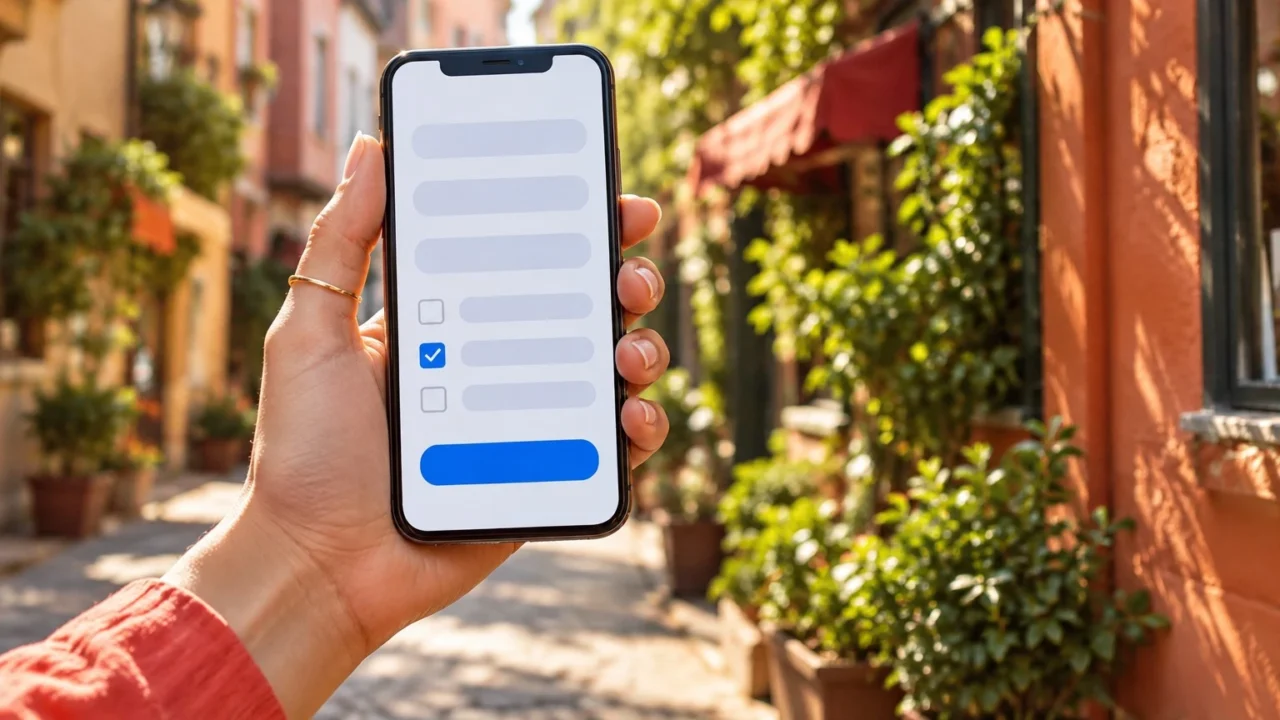
The single most common compliance failure on a foreign brand’s Turkish landing page is one checkbox doing three jobs. Turkish practice treats these as distinct, and bundling them does not simply look untidy — it undermines the validity of what you collected.
The three layers, and what each one is for:
| Layer | What it is | How it appears on the page |
|---|---|---|
| Aydınlatma (the privacy notice) | The controller’s duty to inform the person about the processing under Law No. 6698 | A notice that is presented and readable — not a permission the visitor grants |
| Açık rıza (explicit consent) | A lawful basis for processing where no other basis applies, such as transfer abroad | A separate, affirmative, unticked opt-in |
| Ticari elektronik ileti onayı | Permission to send commercial messages under Law No. 6563 and its regulation | A separate opt-in, by channel, that must then reach İYS |
Three points follow, and all three are regularly got wrong.
The notice and the consent are separate acts. In its decision numbered 2018/90 of 26 July 2018, the Personal Data Protection Board held that the obligation to inform and the taking of explicit consent must be carried out separately, and instructed the controller to separate the mechanism evidencing that the notice was read from the mechanism evidencing that consent was given. A single tick that says “I have read the privacy notice and consent to the processing of my data” is exactly the construction that decision addresses.
Consent cannot be the price of the service. The Board’s decision numbered 2023/1041 of 15 June 2023 examined a site where customers who declined consent to overseas transfer could still buy through customer service. The Board did not find the service conditional on consent — but it did find that the alternative route had been made almost impossible to notice, and ordered the controller to display that route clearly on its membership and sales screens. The lesson for a landing page is practical: if you offer an alternative to consenting, the alternative has to be visible, not technically present.
The marketing permission is per channel. An opt-in that says “I would like to receive communications” does not tell you whether you may send email, SMS or place a call, and those are managed separately downstream. Collect them as separate choices if you intend to use more than one.
Two further details that cost brands real leads. Pre-ticked boxes are not an affirmative choice and should not appear on the page at all. And the texts themselves have to be reachable without leaving the form — a modal or an expanding panel keeps the visitor on the page, where a link that navigates away on mobile frequently ends the session. The wider framework these sit in is set out in our guide to KVKK compliance for foreign brands marketing in Turkey, and the tracking-side equivalent in our guide to cookie consent and tracking compliance in Turkey.
The İYS step most foreign brands miss
Collecting a marketing opt-in on your form is not the end of the process in Turkey. It is the beginning of a three-business-day clock. This is the step that has no equivalent in most markets, and the one that most often turns a successful campaign into an unusable list.
İYS — the İleti Yönetim Sistemi — is the national registry for commercial electronic message permissions. Under the Regulation on Commercial Communication and Commercial Electronic Messages, the relevant obligations run as follows:
- Senders must be registered. Article 5(2) requires service providers who send commercial electronic messages to register with İYS.
- No İYS consent, no message. Article 5(3) bars sending commercial electronic messages to recipients for whom there is no consent recorded in İYS.
- Consents taken elsewhere must be uploaded within three business days. Article 7(11): consents not obtained through İYS are recorded in İYS by the service provider within three business days.
- Unregistered consents are invalid. Article 7(12): consents not recorded in İYS are deemed invalid.
- Opt-outs run on the same clock. Article 9 gives the recipient the right to refuse at any time without giving a reason, through the same channel the message arrived on, with the refusal option present in every message. Article 9(6) requires received refusals to be reported to İYS within three business days, and Article 10(1) requires sending to stop within three business days of the request.
Read together, these turn a form field into an operational requirement. A landing page that collects a marketing opt-in needs a path from the form submission into İYS that runs reliably within three business days — which in practice means an integration, not a monthly export someone remembers to upload. A campaign that runs for six weeks and uploads its consents afterwards has spent six weeks collecting permissions that were not valid when they were used.
Three consequences worth designing for before the campaign launches rather than after:
Decide where the consent record lives. Your form platform, your CRM and İYS all need to agree on who consented, to what channel, and when. The CRM and integration side of that is where our CRM and mobile application service sits.
Keep the evidence. You need to be able to show the circumstances in which a consent was given — which page, which wording, which date. A form platform that stores only the field values is not keeping a consent record.
Treat the opt-out as part of the build. Refusals arriving by any route have to reach İYS and stop the sending within three business days. A process that depends on one person checking an inbox does not meet that reliably.
If email is the channel you are building toward, the surrounding practice — platform choice, list quality, deliverability — is covered in our guide to email marketing in Turkey. This section is the permission layer that sits underneath it.
Writing the page in Turkish
Landing page copy is the part of a campaign most often handed to translation, and it is the part that tolerates it least.
Write from the brief, not from the English page. Turkish word order places the verb late, which means a headline translated clause by clause arrives at its point in the wrong position. Turkish also runs longer than English for the same content, so a headline that fit a two-line block in the original overflows it. Both problems are invisible in a translation document and obvious on the rendered page.
Make the offer concrete in the first screen. What the visitor gets, what it costs, and what happens next. A campaign page in a market where the brand is unknown cannot afford an abstract value proposition above the fold.
Match the page to the ad. Message mismatch between the creative and the landing page is expensive everywhere, and more so when the visitor has no prior relationship with the brand to fall back on. If your Meta campaigns run separate placements with different creative — and in Turkey they should, for the reasons set out in our guide to Meta Ads in Turkey — the landing experience has to follow rather than average them.
Keep the call to action a verb the visitor can picture. “Teklif alın” and “Demo talep edin” describe a transaction. “Gönder” on a submit button describes nothing.
Where the page sits in a wider localisation programme — URL structure, hreflang, the whole-site questions — is covered in our guide to website localization for Turkey.
Speed and mobile reality
A campaign landing page is loaded cold, on a phone, by someone who has just left a feed. Nothing about that is forgiving.
Build at phone width first. With 81.9 million cellular mobile connections in Turkey against a population measured by DataReportal at 93.3% coverage, designing at desktop width and adapting downward inverts the real usage pattern.
Watch what your own stack costs you. Tag managers, chat widgets, heatmap scripts, consent platforms and video embeds each add weight to a page whose entire value is realised in the first few seconds. A landing page carrying the full site tag load is usually carrying scripts that serve measurement rather than the visitor.
Test on the connection your visitors have, not the one your office has. The technical side of this — hosting, delivery, Core Web Vitals in a Turkish context — is covered in our guide to website performance and mobile experience for Turkish users, and the build side is where our web design and software service operates.
Trust on a page nobody has seen before
A Turkish visitor arriving from an ad for an unfamiliar foreign brand first decides whether this is a real company, and only then whether the offer is interesting. That trust burden is heavier than the same page carries at home.
What helps, in rough order of effect:
- A reachable Turkish identity. A Turkish phone number, a Turkish-language contact route and a named company. An international support address on a campaign page reads as distance.
- Specificity over claims. A named client, a concrete figure, a dated case — generic superlatives carry almost no weight with a visitor who has no reference point for the brand.
- Visible policy and legal texts. Not for the legal function alone; their absence is read as a signal.
- Local proof. Turkish-language reviews, Turkish customers, a Turkish address. Proof from other markets is weaker but not worthless.
- Clarity about what happens after submit. “We will call you within one business day” converts better than silence, because the visitor is already wondering.
If the page sells rather than captures a lead, the checkout-side equivalents — instalments, payment presentation, cart behaviour — sit in our guides to conversion rate optimization for e-commerce in Turkey and payment methods and checkout localization for Turkey. If the page sells online, the disclosure duties that come with distance selling are set out in our guide to e-commerce law and ETBİS compliance.
What happens after submit
Most landing page reviews stop at the submit button. In a lead generation campaign, a substantial share of the lost value sits after it.
Response time is a conversion variable, not an operational one. A lead generated by a campaign in Turkish working hours and contacted two days later by a European team has usually gone cold or gone elsewhere. If the campaign runs in Turkey, the follow-up has to run in Turkish and in the Turkish working day.
The thank-you state is wasted space in most builds. It is the one moment the visitor is certain to look at, and it can carry the next step, the expected timeline, or a second useful action.
Route by what the form actually told you. A form that captures segment information and then sends everything to one shared inbox has collected data it is not using and asked for fields it did not need.
Measuring landing pages when signal is partial
Landing page measurement in Turkey operates on incomplete data, and a plan that assumes otherwise will report confidently and wrongly.
Conversion tracking depends on consent. Visitors who decline tracking are still visitors and may still convert; they simply do not appear in the analytics view of that conversion. Platform-reported conversions and your own lead records will not agree, and the gap is not a bug to be fixed but a ratio to be monitored — a sudden change in it usually indicates a tracking problem rather than a performance one. The analytics configuration behind this is covered in our guide to GA4 and marketing analytics setup for Turkey.
Make the CRM the commercial source of truth. Decide in advance which number is the result and which is the optimisation input. A landing page judged on platform-reported conversions alone will be optimised toward the leads that are easiest to track rather than the ones worth having.
Medyae works with foreign and international brands on both halves of this — the page and form build, and the paid campaigns that feed them — through its web design and software and digital marketing services.
Common mistakes
- One checkbox covering notice, consent and marketing permission. The construction the Board’s 2018/90 decision addresses directly.
- Collecting marketing opt-ins with no İYS integration. Article 7(12) makes those permissions invalid, so the list cannot lawfully be used.
- Translating the page instead of writing it. Visible in the first headline.
- Follow-up in a European time zone. The lead is contacted after it has stopped caring.
- Optimising on form fills. It rewards the traffic that converts easily rather than the traffic that buys.
Frequently asked questions
Can one checkbox cover the privacy notice and marketing consent in Turkey?
No. In its decision numbered 2018/90 of 26 July 2018, the Personal Data Protection Board held that fulfilling the obligation to inform and obtaining explicit consent must be carried out separately, and instructed the controller to separate the mechanisms evidencing each. A combined “I have read and I consent” tick is the construction that decision addresses. Marketing permission under Law No. 6563 is a third, separate matter.
Do we have to register a landing page opt-in with İYS?
If it is a consent to receive commercial electronic messages, yes. Article 5(2) of the Regulation on Commercial Communication and Commercial Electronic Messages requires senders to register with İYS, Article 7(11) requires consents obtained outside İYS to be recorded there within three business days, and Article 7(12) provides that consents not recorded in İYS are deemed invalid. Build the integration before the campaign, not after it.
How long do we have to action an opt-out in Turkey?
Three business days. Article 9(6) of the regulation requires refusals received by the service provider to be reported to İYS within three business days, and Article 10(1) requires the sending of commercial electronic messages to stop within three business days of the refusal request. The refusal route must be free, accessible, and present in every commercial message.
Should a Turkish landing page ask for a phone number?
Only if the sales process will use it quickly and in Turkish. In Turkey a phone number on a form carries a real expectation of a call, which makes it the field that costs the most completions. If you collect it, say on the page what will happen and when — and if you will not call within a working day, consider whether a different channel such as WhatsApp fits the process better.
Can we reuse our European landing page template for Turkey?
The layout often survives; the form rarely does. The consent block has to be rebuilt around the Turkish three-layer structure, field validation has to accept Turkish characters and the local phone and address formats, the copy has to be written rather than translated, and the marketing opt-in needs a path into İYS. Treat it as a rebuild of the form inside an existing design rather than a translation of the page.
Conclusion
A campaign landing page for Turkey fails in a specific place, and it is almost never the one that gets reviewed. The design carries over. The form does not.
Four things decide whether the page produces usable leads. Separate the three consent layers — the privacy notice, explicit consent where it is needed, and the commercial message permission — because the Personal Data Protection Board’s 2018/90 decision treats the first two as separate acts and the third sits in a different law entirely. Build the path from the form into İYS before launch, because Article 7(12) makes an unregistered consent invalid and Articles 9 and 10 put opt-outs on a three-business-day clock. Write the page in Turkish from a brief and build it for a phone, in a market with 81.9 million cellular connections. And judge it on leads your CRM can qualify rather than on form fills your tag manager can count.
For how campaign pages fit the wider channel picture, our pillar guide to marketing in Turkey for foreign brands is the place to start.
This article is general information about landing page design, consent collection and commercial messaging in Turkey, and the decisions and provisions cited carry the dates and numbers given. It is not legal advice. Data protection obligations, consent validity and commercial electronic message requirements are fact-specific and should be confirmed with qualified Turkish counsel for your own forms and campaigns.