



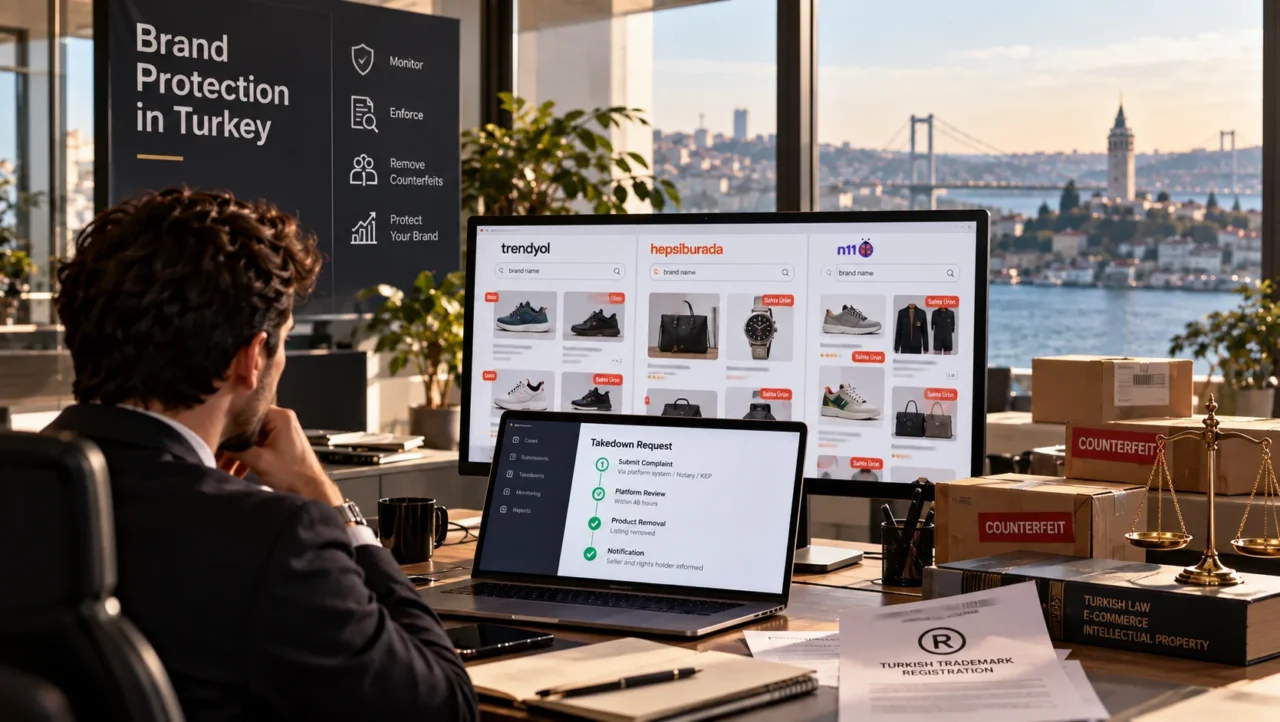
Brand Protection and Counterfeits on Turkish Marketplaces
Turkish law gives brand owners something most markets do not: a statutory takedown on marketplaces with a 48-hour deadline. Under Law No. 6563 and the implementing regulation published in the Official Gazette of 29 December 2022, an e-commerce intermediary service provider that receives a rights holder’s complaint supported by information and documents must remove the product without delay and within 48 hours at the latest, and notify both the seller and the rights holder.
That is a fast, cheap and genuinely effective mechanism. It is also one most foreign brands never use, for two reasons: they have not registered their trademark in Turkey, and they file through the wrong channel — the regulation contemplates complaints submitted through the platform’s internal communication system, a notary, or a registered electronic mail (KEP) address, not through a contact form or an email to support.
This guide covers what you will actually find when you look, why Turkish registration comes first, how the takedown procedure works in detail, the seller counter-notice that can undo it, the difference between counterfeits and grey-market goods, and the commercial responses that matter more than enforcement.
Table of Contents
- What you will actually find
- Registration comes first
- The 48-hour takedown mechanism
- What a valid complaint must contain
- The counter-notice that can undo it
- Counterfeit versus grey market
- Marketplace brand protection programmes
- Stopping goods before they arrive
- Monitoring: how to find it
- Commercial responses that matter more
- Who runs this, and what it costs
- Common mistakes
- A 90-day plan
- Frequently asked questions
- Conclusion
What you will actually find
Before any enforcement decision, run the audit. Search your brand and your three bestselling products on the major Turkish marketplaces and on price comparison platforms. Foreign brands are routinely surprised by what appears, and the findings fall into four categories that need different responses.
Outright counterfeits. Products bearing your marks that you did not make. The clearest case, and the one the statutory takedown was designed for.
Grey-market genuine goods. Authentic products imported and resold outside your distribution arrangements. Legally more complex, and commercially often the larger problem because the products work and the reviews are real.
Unauthorised sellers of genuine stock. Resellers who bought legitimately somewhere in the chain and list without your consent, frequently at prices that undercut your intended positioning.
Listing hijacks and brand misuse. Your brand name used in titles, keywords or store names by sellers offering something else entirely.
The audit is also the input to every other decision in this article. It tells you whether you have a legal problem, a distribution problem or a pricing problem — and those have different solutions. The commercial context is covered in our guides to e-commerce in Turkey, Hepsiburada and Amazon Turkey advertising and Akakçe and Cimri, where unauthorised listings are equally visible.
Registration comes first
Everything in this article depends on one thing: holding registered rights in Turkey.
Turkey operates a first-to-file trademark system administered by TÜRKPATENT, and the takedown procedure described below requires the complainant to prove ownership of the intellectual property right. A foreign brand relying on registrations held elsewhere has a materially weaker position, and in the worst case discovers that someone else has registered its mark in Turkey first.
Three practical points:
- Register before you launch, not after you find a problem. Enforcement is downstream of registration, and registration takes time.
- Register in the classes that match what you actually sell, and consider adjacent classes where counterfeiting is likely.
- Check first. A pre-launch search tells you whether your mark is available and whether someone has already filed it — which is a market entry question, not only a legal one.
This is work for a Turkish trademark attorney rather than a marketing team. The point for a marketing decision-maker is sequencing: brand protection capability is created at registration, and every month of delay is a month in which your only remedies are commercial.
The 48-hour takedown mechanism
This is the core tool, and it is worth understanding precisely because it is unusually fast.
Under Law No. 6563, an e-commerce intermediary service provider is not, as a general rule, held liable for unlawful content provided by the sellers on its platform. But on a rights holder’s complaint based on information and documents regarding an intellectual property infringement, the intermediary must remove the complained-of product from publication and notify both the seller and the rights holder.
The implementing regulation, published on 29 December 2022, sets the timing: the marketplace must remove the product without delay and within no more than 48 hours of receiving the complaint, and notify the parties.
Two further features:
Repeat complaints are filtered. The regulation provides that a marketplace will not process complaints about the same product and the same allegation unless new documents proving infringement are submitted. Getting the first complaint right matters.
Marketplaces publish their channels. Major Turkish platforms operate documented processes for this. Hepsiburada, for example, publishes a dedicated page setting out that rights holders should apply through a notary or KEP, publishes its KEP address for the purpose, and states that products removed on a valid complaint are republished within 24 hours at most where a seller’s objection clearly succeeds.
One note on the legal landscape: these provisions were challenged before the Council of State and the Constitutional Court in 2023. Confirm the current position with Turkish IP counsel rather than assuming the framework is static.
What a valid complaint must contain
The regulation specifies what a complaint has to include, and incomplete filings are the most common reason a takedown fails.
A complaint is submitted to the marketplace through its internal communication system, a notary, or KEP, and must set out the complainant’s identity and contact details, proof of ownership of the intellectual property right, identification of the product and listing complained of, and the grounds and evidence establishing that the product infringes the right.
The practical implications for a foreign brand:
- Use the prescribed channel. A support ticket or an email to a general address is not the procedure. KEP is a formal Turkish registered electronic mail system, which usually means your Turkish entity or your representative needs one.
- Evidence of ownership is a document, not an assertion. Have the Turkish registration certificate ready in the format the platform expects.
- Evidence of infringement must be specific to the listing. Screenshots with URLs, listing identifiers, images showing the differences from genuine product, and where possible a test purchase.
- Build a template and a file per product. This becomes a repeatable operation rather than a one-off legal exercise, and speed depends on having the documents assembled in advance.
The counter-notice that can undo it
The procedure is deliberately two-sided, and foreign brands are often unprepared for the second half.
A seller whose product has been removed can object, supported by information and documents showing the complaint was unfounded — and where the objection succeeds, the product is republished. The regulation contemplates the seller submitting invoices or equivalent documents capable of proving the product is genuine, together with contracts or other evidence tracing the goods back to the rights holder or to persons authorised by the rights holder to place them on the market.
This is where the counterfeit-versus-grey-market distinction becomes operational. A seller of genuine goods with a documented supply chain can often defeat a takedown, because the product is not counterfeit. Filing complaints indiscriminately against genuine-goods resellers therefore tends to produce republished listings, wasted effort, and a weaker position on the complaints that actually matter.
Two disciplines follow. Verify before filing — a test purchase resolves most ambiguity. And triage: reserve the statutory takedown for genuine counterfeits and clear brand misuse, and address authorised-reseller issues through distribution agreements instead.
Counterfeit versus grey market
These are different problems with different remedies, and conflating them is the most common strategic error.
| Counterfeit | Grey market | |
|---|---|---|
| What it is | Fake product bearing your marks | Genuine product sold outside your distribution |
| Primary harm | Quality failures attributed to you, safety risk, brand damage | Price erosion, channel conflict, unsupported customers |
| Takedown prospects | Strong where infringement is evidenced | Weaker; seller may document genuine supply |
| Better remedy | Statutory takedown, platform programmes, enforcement | Distribution control, contractual terms, pricing strategy |
Whether a particular parallel import can be stopped depends on how exhaustion of trademark rights applies to the facts, which is a question for Turkish IP counsel rather than a general rule you can apply from another jurisdiction. What is safe to say commercially is that grey-market presence is usually a symptom of a distribution or pricing decision made upstream — and that it is addressed most durably through the supply agreement. Our guide to co-op marketing with Turkish distributors and dealers covers the contractual side of channel control.
Marketplace brand protection programmes
Alongside the statutory route, major marketplaces operate their own brand protection or brand registry programmes. These typically offer registered brand owners a faster reporting channel, some degree of listing control, and in some cases proactive filtering.
Three practical points:
- Enrol in each platform separately. There is no single registry covering Turkish marketplaces, and each has its own requirements and evidence standards.
- Platform programmes and the statutory route are complementary. The programme is usually faster and lower-friction for routine cases; the statutory procedure carries a legal deadline and is the fallback when a platform is unresponsive.
- Enrolment usually requires the Turkish registration. Which returns to the sequencing point above.
Check each platform’s current documented process rather than relying on a summary. Requirements and contact channels change, and platforms publish them precisely because the law requires a defined procedure.
Stopping goods before they arrive
Online takedowns address listings. They do not address the physical goods, which keep arriving.
Turkish customs legislation provides a route for intellectual property rights holders to apply for customs intervention against goods suspected of infringing their rights, allowing detention at the border. For brands with a genuine counterfeit problem rather than an isolated listing, this addresses supply rather than symptoms.
Because the application process, duration and renewal requirements are technical and change, treat this as a question for Turkish IP counsel and a customs consultant rather than something to implement from a general description. The strategic point stands regardless: a brand fighting counterfeits only at the listing level is removing advertisements while the inventory continues to land.
Monitoring: how to find it
Enforcement is reactive by nature, so the quality of your monitoring determines how much of the problem you ever see.
Marketplace search, run systematically. Search your brand and core products on each major platform on a defined cadence, not when someone complains. Record sellers, prices, listing identifiers and review counts so you can see change over time.
Price comparison platforms. These aggregate listings across retailers and are often the fastest way to see your full Turkish pricing landscape in one view, including sellers you did not know existed.
Turkish-language search. Counterfeit and grey-market sellers optimise for Turkish search terms, including common misspellings of foreign brand names. Monitoring only your exact brand string misses a meaningful share — the Turkish search mechanics are covered in our guide to SEO in Turkey.
Social commerce and messaging. A portion of counterfeit trade in Turkey runs through social accounts and messaging rather than marketplaces, which requires a different detection approach.
Customer signals. Complaints about products you did not sell, warranty claims on units you cannot trace, and reviews describing quality you do not recognise are all counterfeit indicators arriving through your own channels.
Specialist brand protection vendors operate in this space, including Turkish providers. Whether automated monitoring is worth its cost depends on the scale of the problem your audit reveals — which is another argument for running the audit first.
Commercial responses that matter more
Enforcement removes listings. It does not create demand for the genuine product, and for most brands the commercial responses do more work than the legal ones.
Be present and findable. Counterfeits and grey-market sellers fill vacuums. A brand with no official Turkish presence has ceded the search results and the marketplace listings to whoever showed up.
Publish your authorised sellers. A visible list of authorised retailers on your Turkish site gives customers a way to verify, and gives you something to point to.
Make authenticity checkable. Serial verification, authenticity features and clear guidance on how to identify genuine product turn customers into part of the detection system.
Close the price gap where you can. Grey-market economics depend on a price differential. Where the gap is large, enforcement alone will not hold the line.
Own the category content. Ranking for your own brand and product terms in Turkish pushes unauthorised listings down the page, which reduces the problem without removing anything.
Respond publicly and calmly. Customers who bought a counterfeit will say so publicly. How you respond is visible to everyone researching your brand — the discipline is covered in our guide to reputation and crisis management on social media in Turkey.
Categories where authenticity anxiety is highest — beauty, fashion, electronics — benefit most from making verification easy. Our guide to fashion and apparel marketing in Turkey covers the category context where this problem is most visible.
Who runs this, and what it costs
Brand protection in Turkey sits awkwardly between legal, commercial and marketing functions, and it fails when nobody owns it.
The realistic division of labour:
- Turkish IP counsel for registration, complaint drafting where contested, customs applications and any litigation. This is not optional and not a marketing task.
- A named internal owner for the monitoring cadence and the decision on what to escalate. Without one, monitoring stops after the first month.
- Marketing and e-commerce for the commercial responses — official presence, authorised seller communication, search visibility and listing quality. Auditing marketplace and comparison listings, keeping your own product content dominant in Turkish search and maintaining an official channel presence is ongoing digital work of the kind agencies such as Medyae handle. The legal enforcement itself sits with counsel.
On cost, the sequence matters more than the budget. The audit is cheap and tells you the size of the problem. Registration is a fixed, known cost. Statutory takedowns are procedurally cheap once the documentation template exists. Monitoring tools and litigation are the expensive items, and they should be decided against evidence from the first three steps rather than in advance.
Common mistakes
Launching in Turkey without a Turkish trademark registration. Every remedy in this article depends on it.
Filing through a support form or general email. The regulation contemplates the internal system, a notary or KEP.
Treating grey-market goods as counterfeits. A seller with documented genuine supply can defeat the takedown, and the repeat-complaint filter limits your second attempt.
Getting the first complaint wrong. Marketplaces are not required to process repeat complaints on the same product and allegation without new evidence.
Removing listings without addressing supply. Customs intervention addresses goods; takedowns address advertisements.
Monitoring only the exact brand string. Turkish-language variants and misspellings carry real volume.
Having no official Turkish presence. Absence is what created the opening.
Nobody owning the process. Brand protection without a named owner reverts to reactive firefighting.
A 90-day plan
Weeks 1–4: audit and register. Search your brand and bestsellers across major marketplaces and comparison platforms, and record what you find by category — counterfeit, grey market, unauthorised reseller, brand misuse. Confirm your Turkish trademark position with a Turkish attorney and file if you have not. Identify whether you or your representative has a KEP address.
Weeks 5–8: build the capability. Assemble the complaint template and evidence file per priority product. Enrol in the brand protection programmes of the platforms where you found problems. Publish an authorised seller list and authenticity guidance on your Turkish site. Assign a named owner and a monitoring cadence.
Weeks 9–12: act and measure. File on clear counterfeit cases through the prescribed channel, with full documentation, and track outcomes including republications after objection. Address grey-market findings through distribution and pricing rather than complaints. Decide, on evidence, whether automated monitoring or customs intervention is justified.
Frequently asked questions
How quickly must a Turkish marketplace remove an infringing listing?
Under Law No. 6563 and the implementing regulation published on 29 December 2022, an e-commerce intermediary service provider that receives a rights holder’s complaint based on information and documents must remove the complained-of product without delay and within no more than 48 hours, notifying both the seller and the rights holder.
How do I file a complaint against a counterfeit listing in Turkey?
Through the marketplace’s internal communication system, a notary, or a registered electronic mail (KEP) address. The complaint must include your identity and contact details, proof that you own the intellectual property right, identification of the product and listing, and the grounds and evidence of infringement. General support tickets are not the prescribed procedure.
Do I need a Turkish trademark registration to act?
In practice, yes. The procedure requires proof of ownership of the intellectual property right, and Turkey operates a first-to-file system administered by TÜRKPATENT. Registering before launch is also the only way to discover in good time whether someone else has filed your mark.
Can a seller get a removed listing reinstated?
Yes. A seller may object with information and documents showing the complaint was unfounded — typically invoices or equivalent documents proving the goods are genuine, plus contracts tracing the products back to the rights holder or to persons authorised to place them on the market. Where the objection succeeds the product is republished; Hepsiburada, for example, states this happens within 24 hours at most.
Can I use takedowns against grey-market sellers?
It is usually the wrong tool. A seller of genuine goods with documented supply can often defeat the complaint, and marketplaces are not required to process repeat complaints on the same product and allegation without new evidence. Whether a particular parallel import can be stopped depends on how exhaustion of rights applies to the facts, which needs Turkish IP counsel. Distribution and pricing controls are the more durable remedy.
What is the most effective thing a foreign brand can do first?
Run the audit. Searching your brand and bestselling products across Turkish marketplaces and price comparison platforms takes an afternoon and tells you whether you have a counterfeit problem, a distribution problem or a pricing problem — which determines everything else. Then confirm your Turkish trademark position.
Conclusion
Turkey is unusually well equipped for brand protection compared with many markets, and foreign brands consistently under-use what is available. A statutory 48-hour takedown, defined complaint requirements, published platform channels and a customs route together give a rights holder real leverage — conditional on holding a Turkish registration and filing correctly.
The strategic discipline is triage. Counterfeits are a legal problem and the takedown procedure handles them well. Grey-market and unauthorised reselling are distribution and pricing problems wearing a legal costume, and filing complaints against them tends to produce republished listings and a weaker record.
Start with the audit, register the mark, build the complaint capability once so it is repeatable, and spend most of your effort on the commercial side — official presence, verifiable authenticity, visible authorised sellers and dominance of your own brand terms in Turkish search. Enforcement removes listings. Presence removes the opening that created them.
This article is general information based on published legislation and platform-published procedures as at the date shown. It is not legal advice. Intellectual property law, e-commerce regulation and platform procedures change, and the treatment of any specific case depends on its facts. Confirm your position with qualified Turkish intellectual property counsel before acting.