



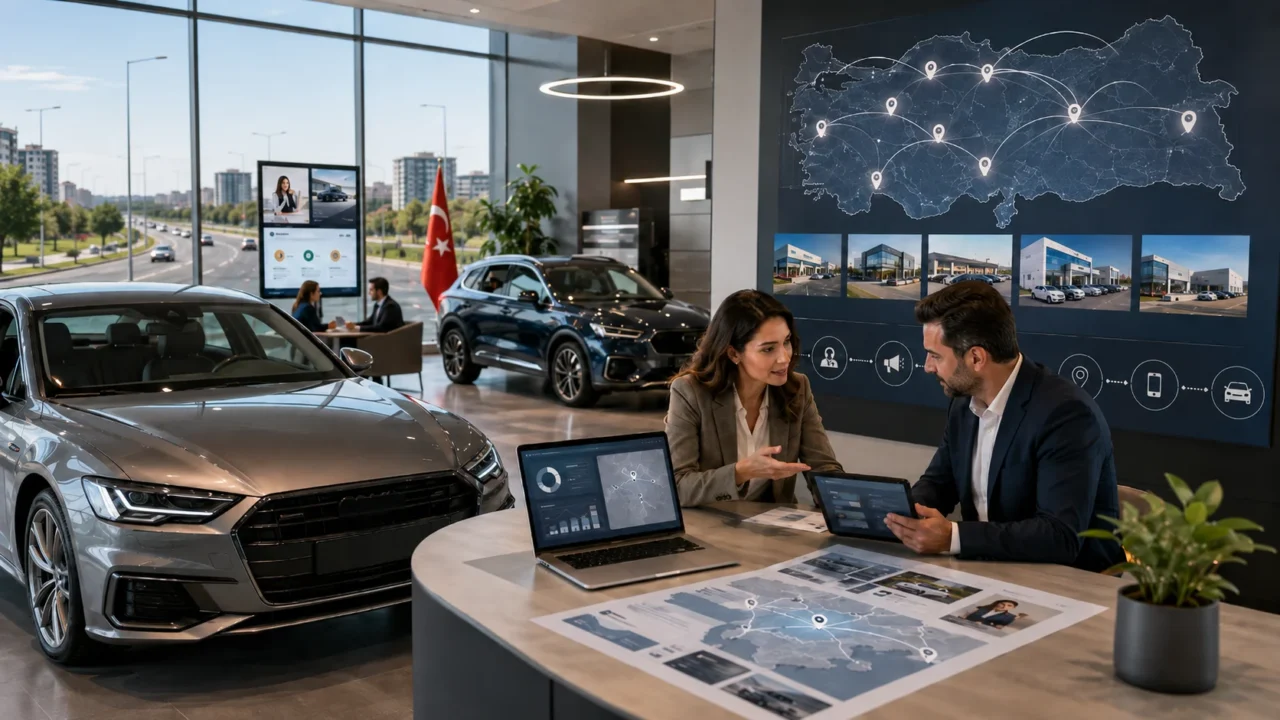
Automotive Industry Digital Marketing in Turkey
A foreign automotive brand entering Turkey faces a marketing problem that most other foreign brands don’t: the actual sale rarely happens on the brand’s own website or through a direct e-commerce transaction — it happens at a dealership, through a network of independent or franchised dealers who each have their own local marketing instincts, budgets, and sometimes competing priorities. Automotive digital marketing in Turkey has to solve for this dealer network dynamic alongside the more familiar considerations of a high-consideration, long-research-cycle purchase. This guide covers lead generation, dealer network coordination, channel strategy, and the specific factors that shape how automotive marketing should work in this market — from electric vehicle considerations and regional differences to fleet sales and owner community building.
Table of Contents
- The Dealer Network Coordination Problem
- The Turkish Car-Buying Research Journey
- Lead Generation and Dealer Routing
- Digital Channel Mix for Automotive
- Video and Content Strategy for Considered Purchases
- Pricing Transparency and Installment Financing
- National Brand Marketing vs. Local Dealer Marketing
- The Used Vehicle Marketplace Layer
- Electric and Hybrid Vehicle Marketing Considerations
- Regional Differences Across the Turkish Market
- Fleet and Corporate Sales Marketing
- Service and Retention Marketing After Purchase
- Online Configurators and Virtual Showroom Tools
- Social Proof, Reviews, and Owner Communities
- Measuring Automotive Marketing Performance
- Common Mistakes
- Conclusion
- FAQ
The Dealer Network Coordination Problem
Unlike most foreign brand marketing scenarios where a single national marketing team controls the entire customer journey from awareness through conversion, automotive marketing in Turkey typically hands off the final, most consequential stage — the actual sale — to a dealer network the national brand doesn’t fully control day to day. This creates a genuine coordination challenge: national brand marketing needs to build awareness and generate qualified interest, but that interest then needs to route cleanly to the right dealer, with consistent messaging and pricing information, without the lead going cold in the handoff or the dealer’s own local marketing contradicting the national brand positioning.
This coordination challenge intensifies for a foreign brand still establishing its dealer network in Turkey, since the network itself may be incomplete or uneven in quality during the early market entry period. A strong national marketing campaign that generates interest in a region without adequate dealer coverage produces frustrated, unconverted leads — which argues for closely coordinating marketing intensity with actual dealer network maturity by region, rather than running a uniform national campaign disconnected from the reality of where the brand can actually serve a resulting lead well.
The Turkish Car-Buying Research Journey
Vehicle purchases represent one of the longest, most research-intensive buying journeys in Turkish consumer behavior — buyers typically research extensively online across multiple sources (brand sites, independent review content, price comparison tools, and increasingly video content) over a period of weeks or months before ever visiting a dealership. This extended research phase means a brand’s digital presence needs to support genuine research depth — detailed specifications, transparent pricing information, and substantive comparison content — rather than a purely conversion-focused, shallow landing page experience better suited to a lower-consideration purchase.
Family and social input also plays a more visible role in Turkish vehicle purchase decisions than in some other categories — buyers frequently research and discuss vehicle options with family members whose opinions carry real weight in the final decision, which means marketing content occasionally needs to address a wider audience than the primary decision-maker alone, particularly for family-oriented vehicle categories.
Lead Generation and Dealer Routing
A well-designed automotive lead generation system captures interest (a test drive request, a pricing inquiry, a configurator submission) and routes it to the appropriate dealer — typically the geographically closest one, or one selected based on inventory availability — quickly enough that the lead is still warm when the dealer follows up. This routing infrastructure needs the same speed discipline that matters across every high-intent lead scenario in Turkey: a lead that sits unrouted or unanswered for hours, let alone days, has often already moved on to research a competing brand by the time contact happens. This connects to the broader lead response principles covered in our Paid Advertising in Turkey guide, applied to a purchase category where the stakes of a slow response are particularly high given how comparison-intensive vehicle research tends to be.
Digital Channel Mix for Automotive
- Search advertising captures high-intent research queries at exactly the moment a buyer is actively comparing options, making it a foundational channel for automotive lead generation in Turkey.
- YouTube and video content plays an outsized role in automotive research specifically, given how much buyers rely on video reviews and walkarounds before a purchase decision — this connects to the broader video advertising opportunity, which applies with particular force to a category where visual and experiential content genuinely influences the purchase decision.
- Social media supports awareness and brand positioning earlier in the funnel, following the same organic-plus-paid principles covered in our Social Media Marketing in Turkey guide, though it typically plays a smaller direct-conversion role than search or video for this specific category given the purchase’s length and complexity.
- Third-party automotive marketplaces and comparison sites represent a meaningful discovery channel parallel to a brand’s own digital presence, similar in function to how e-commerce marketplaces complement a brand’s owned site in other categories.
Video and Content Strategy for Considered Purchases
Given how central video is to automotive research specifically, investing in genuinely substantive video content — detailed walkarounds, honest feature explanations, real-world comparison content — tends to outperform purely promotional video advertising for this category. Buyers researching a vehicle purchase are looking for information that helps them make a confident decision, not just brand messaging, and content that genuinely serves that research need builds more trust than a traditional promotional approach, while still driving the same underlying brand consideration goal.
Pricing Transparency and Installment Financing
Given how central installment payment is to Turkish purchasing decisions across nearly every category, vehicle financing options deserve especially prominent, clear presentation in automotive marketing specifically — a vehicle purchase represents one of the largest single expenditures many Turkish consumers make, and financing terms often directly determine whether a specific model feels within reach. Clear, upfront presentation of financing options, rather than requiring a buyer to visit a dealership just to learn basic financing terms, reduces friction at exactly the research stage where a buyer is comparing options and deciding which brands merit an in-person visit at all.
National Brand Marketing vs. Local Dealer Marketing
Similar to the franchise and retail expansion dynamic that applies to physical retail more broadly, automotive brands need to balance centralized brand consistency with the reality that individual dealers often run their own local marketing and want some autonomy in how they promote their specific inventory and local offers. Providing dealers with a clear brand toolkit — approved creative templates, consistent messaging guidelines, co-op advertising fund structures — while allowing local execution flexibility, tends to produce more consistent results than either fully centralized control or fully independent dealer marketing with no brand oversight at all.
The Used Vehicle Marketplace Layer
Turkey’s used vehicle market operates substantially through dedicated marketplace platforms, and a foreign automotive brand’s marketing strategy should account for how these platforms influence buyer research even for new vehicle purchases — buyers frequently cross-reference new vehicle pricing against comparable used vehicle values as part of their decision process. Brands with certified pre-owned programs have a particular opportunity here, since a well-marketed certified pre-owned offering can capture buyers who might otherwise default entirely to the independent used market.
The used vehicle marketplace layer also shapes how buyers perceive resale value as part of the new-vehicle purchase decision — a model with strong, well-documented resale performance in the used marketplace becomes an easier sell in new vehicle marketing, since buyers factor total cost of ownership, including expected resale value, into their purchase calculation more explicitly than in many other markets. Brands that can point to strong resale data from established used marketplace platforms have a genuine, underused marketing asset in this regard.
Electric and Hybrid Vehicle Marketing Considerations
Electric and hybrid vehicle marketing in Turkey carries its own distinct set of buyer concerns that differ meaningfully from conventional vehicle marketing — charging infrastructure availability, government incentive programs, and total cost of ownership calculations that account for fuel savings over time all need to be addressed directly rather than assumed to be understood. A buyer considering an electric vehicle for the first time typically has genuine, specific questions about charging access in their daily routine that generic brand messaging doesn’t answer.
Given how new this category still is for many Turkish buyers, electric vehicle marketing content benefits from an especially educational approach — explaining charging infrastructure realistically, addressing range concerns honestly, and walking through the total cost comparison against a comparable conventional vehicle rather than only emphasizing the environmental or technology angle. Buyers who feel a brand has been straightforward about the practical realities of electric vehicle ownership tend to convert with more confidence than those who feel oversold on an idealized picture that doesn’t match daily reality.
Government incentive programs and any changes to them also need active monitoring and fast communication, since incentive structures can shift the practical economics of an electric vehicle purchase meaningfully, and marketing content referencing outdated incentive information creates a credibility problem right at the point a buyer is trying to finalize their financial comparison.
Regional Differences Across the Turkish Market
Vehicle purchasing patterns and priorities vary meaningfully across Turkey’s regions — Istanbul and other major metropolitan buyers often prioritize different vehicle attributes (compact size, fuel efficiency, technology features for urban driving and parking) than buyers in other parts of the country, where larger vehicles, different terrain considerations, or different price sensitivity may shape the decision differently. A national marketing campaign that doesn’t account for this regional variation risks generic messaging that resonates less strongly than regionally tailored content would.
Dealer network density also varies significantly by region, which connects directly back to the lead routing and dealer coordination challenge — a national campaign that generates strong interest in a region with limited dealer coverage produces a worse experience than the same campaign intensity in a region with strong dealer presence. Adjusting regional marketing investment to reflect actual dealer capacity to serve resulting leads well, rather than applying uniform national spend, tends to produce a more consistent buyer experience and better overall conversion efficiency.
Fleet and Corporate Sales Marketing
Corporate and fleet vehicle sales represent a distinct marketing motion from individual consumer sales, with a different buyer (often a procurement or fleet manager rather than an individual consumer), different decision criteria (total cost of ownership across a fleet, maintenance contract terms, bulk pricing structures), and typically a longer, more formal sales process involving direct account management rather than a purely digital-lead-driven journey.
Marketing to this segment benefits from dedicated content and channels distinct from consumer-facing automotive marketing — case studies demonstrating fleet cost savings, direct outreach to corporate procurement contacts, and a distinct inquiry pathway that routes fleet interest to a specialized sales team rather than the standard consumer dealer network. Treating fleet inquiries with the same consumer-oriented lead routing system often produces a mismatch, since fleet buyers expect a more consultative, relationship-driven engagement than an individual consumer typically does.
Service and Retention Marketing After Purchase
Automotive marketing doesn’t end at the sale — service department marketing, maintenance reminders, and loyalty programs for future vehicle purchases all represent meaningful ongoing revenue opportunity that’s easy to underinvest in when marketing focus concentrates entirely on new customer acquisition. A coordinated post-purchase marketing program, connecting the dealer’s service department with the brand’s broader customer relationship, helps ensure a vehicle owner’s next purchase consideration set still includes the brand rather than defaulting to whichever option is simply most convenient when the time comes.
Online Configurators and Virtual Showroom Tools
Interactive online vehicle configurators — letting a buyer explore trim levels, colors, and options combinations before ever visiting a dealership — have become an increasingly important research tool in automotive marketing generally, and this applies fully to the Turkish market. A well-built configurator does double duty: it serves the buyer’s genuine research need during the long consideration phase, and it generates a genuinely qualified lead signal for the dealer network, since a buyer who has spent meaningful time configuring a specific vehicle demonstrates far more concrete purchase intent than one who has simply browsed a general model page.
Social Proof, Reviews, and Owner Communities
Turkish buyers researching a vehicle purchase actively seek out owner reviews and community discussion, often on independent forums and social platforms rather than exclusively on brand-controlled channels, and this owner-generated content carries substantial weight in shaping purchase confidence. A brand that actively engages with and supports genuine owner communities — rather than treating them as outside the marketing strategy entirely — benefits from the organic credibility that owner-to-owner conversation provides in a way branded content alone cannot replicate.
Encouraging and surfacing genuine owner reviews, responding constructively to both positive and critical feedback, and supporting active owner community spaces (whether brand-hosted or simply engaged with respectfully on independent platforms) all contribute to the kind of social proof that meaningfully influences a buyer still in the comparison phase of their research. This is particularly valuable for a foreign brand still building trust and track record in the Turkish market, where established local reputation among existing owners can meaningfully offset the natural skepticism a newer market entrant faces.
Measuring Automotive Marketing Performance
Given the long research cycle and the dealer-network handoff, automotive marketing measurement needs a genuinely multi-touch attribution approach rather than last-click reporting, since a buyer’s eventual dealership visit is often the culmination of weeks of earlier digital research across multiple channels. Tracking lead-to-sale conversion by channel and by dealer, not just top-of-funnel lead volume, is necessary to understand which marketing investments actually translate into vehicles sold rather than just inquiries generated.
Common Mistakes
- Treating dealer lead routing as an afterthought rather than a core system requiring real investment. A slow or unreliable handoff undermines the value of even well-executed top-of-funnel marketing.
- Underinvesting in substantive video content in favor of purely promotional advertising. This category rewards genuinely informative content more than most.
- Burying financing and installment information behind a dealership visit requirement. This adds unnecessary friction at the research stage where buyers are actively comparing brands.
- Allowing dealer marketing to drift entirely inconsistent with national brand positioning. A clear toolkit and light oversight prevents brand dilution without eliminating local flexibility.
- Focusing marketing entirely on new customer acquisition while neglecting service and retention. This leaves meaningful ongoing revenue opportunity underdeveloped.
- Applying uniform national campaigns without accounting for regional dealer coverage or buyer priority differences. This produces inconsistent buyer experience and wasted spend in under-served regions.
- Ignoring owner communities and independent review platforms as part of the marketing strategy. Organic owner-generated social proof carries influence that branded content alone cannot replicate.
Conclusion
Eight points are worth carrying into a Turkey automotive marketing strategy:
- Dealer network coordination is a core marketing system requirement, not an operational afterthought.
- The Turkish car-buying research journey is long and research-intensive, rewarding substantive content over shallow promotional messaging.
- Video content plays an outsized role in automotive research specifically.
- Financing and installment transparency reduces friction at a critical research stage.
- National brand and local dealer marketing need active, ongoing coordination.
- Electric and hybrid vehicle marketing requires an especially educational approach given how new the category still is for many buyers.
- Regional differences in buyer priorities and dealer coverage should shape campaign intensity, not a uniform national approach.
- Post-purchase service, retention, and owner community engagement represent meaningful, often underinvested opportunity.
If you’re planning an automotive marketing strategy for Turkey, our Marketing in Turkey guide covers the broader channel coordination principles that apply across considered-purchase categories.
FAQ
How quickly should an automotive lead be routed to a dealer?
As quickly as technically possible — ideally within minutes rather than hours, since vehicle research is highly comparison-driven and a slow handoff risks losing the lead’s attention to a competing brand that responds faster.
Is video content really more important for automotive marketing than other categories?
Video plays an outsized role specifically in automotive research given how much buyers rely on walkarounds and visual comparison before a purchase decision, making it a higher relative priority than in many other product categories.
How much marketing autonomy should individual dealers have?
Most successful automotive brands provide a clear national toolkit and messaging guidelines while allowing dealers flexibility in local execution, rather than either fully centralizing control or leaving dealers entirely independent.
Does the used vehicle market really affect new vehicle marketing strategy?
Yes — buyers frequently cross-reference new vehicle pricing against comparable used vehicle values during their research, making the broader used vehicle marketplace landscape relevant context even for a brand focused purely on new vehicle sales.
How much marketing priority should service and retention receive relative to new customer acquisition?
This varies by brand maturity in the market, but service and retention marketing is frequently underinvested relative to its revenue potential, and even a modest, coordinated program often delivers strong return relative to its cost.
Does electric vehicle marketing need a genuinely different approach than conventional vehicle marketing?
Yes — buyers considering an EV for the first time typically have specific, practical concerns around charging infrastructure, range, and incentive programs that generic brand messaging doesn’t address. An educational approach that answers these questions honestly tends to build more purchase confidence than emphasizing only the environmental or technology angle.
Should automotive marketing campaigns be adjusted regionally within Turkey?
Generally yes — both buyer priorities and dealer network coverage vary meaningfully by region, and uniform national campaigns risk generating strong interest in areas where the dealer network can’t serve the resulting leads well.
Is an online vehicle configurator worth the investment for a foreign brand entering Turkey?
For most vehicle brands, yes — a configurator serves genuine buyer research needs during the long consideration phase and generates a stronger lead-quality signal than general browsing behavior, which helps dealers prioritize their follow-up effort more effectively.
Does fleet and corporate sales marketing require a different approach than consumer marketing?
Yes — fleet buyers typically make decisions based on total cost of ownership across a fleet and expect a more consultative, account-managed sales process rather than the standard consumer lead-routing system, so dedicated content and a distinct inquiry pathway tend to produce better results.