



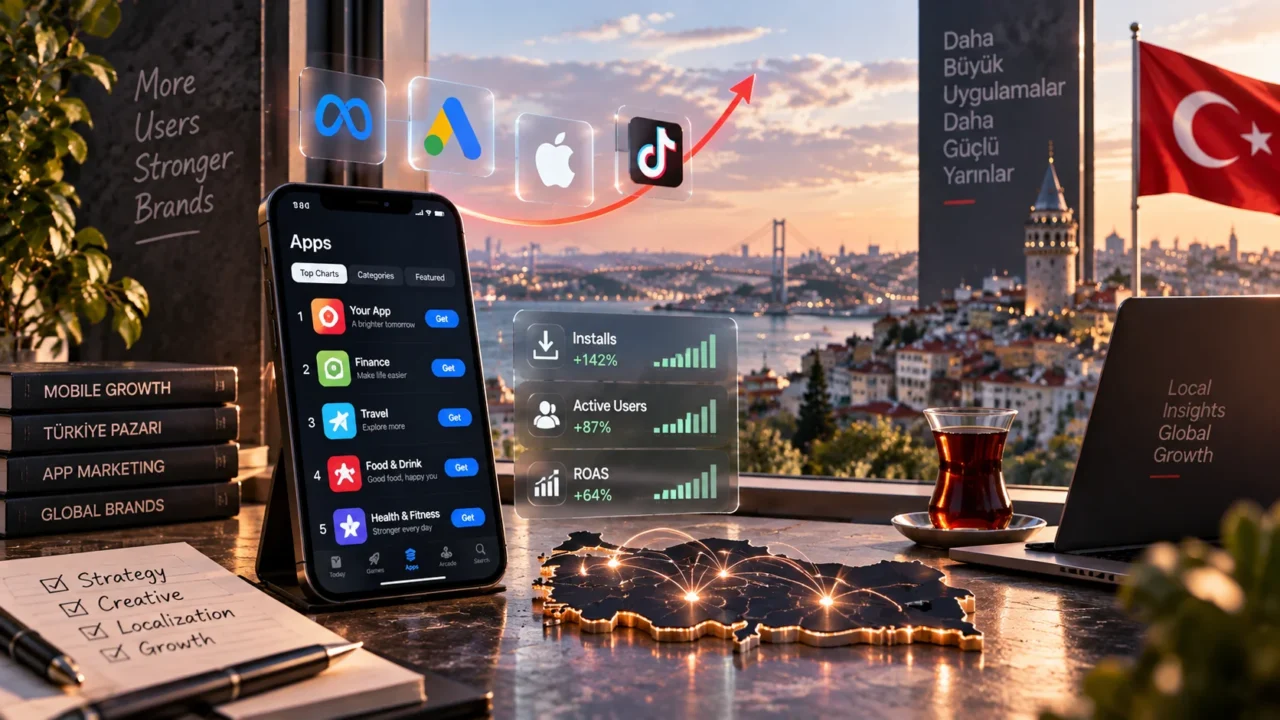
Mobile App User Acquisition in Turkey
Turkey is one of the world’s largest app markets by volume and one of the weakest by retention, and that combination is the single most important thing a foreign app team needs to understand before spending here.
The scale is real. According to Adjust’s Turkey app trends analysis, based on data from 5,000 partner apps collected between January 2023 and July 2025, Turkey ranked eighth globally in mobile app downloads by the end of 2024, with 3.66 billion downloads and 101.5 billion hours of total time spent in apps.
The retention picture is the problem. In the first half of 2025, Turkish retention rates for mobile games ran at 19 percent on day one, 5 percent on day seven, 3 percent on day fourteen and 1 percent on day thirty. Global benchmarks over the same period were 26 percent, 12 percent and 5 percent respectively.
Yet engagement per session is above average, not below it: Turkish average session length in the first half of 2025 was 32.8 minutes, ahead of both the MENAT regional average of 30.5 minutes and the global average of 29.9 minutes.
So Turkish users engage intensely and leave quickly. A user acquisition programme optimised to install volume will look excellent in month one and fall apart in the cohort report. This guide covers what that means for channel choice, bidding, attribution, monetisation and creative — and how to build a Turkish UA programme that survives contact with the retention curve.
Table of Contents
- The market in numbers
- The engagement paradox
- Why installs look cheap, and what that hides
- Channel mix for paid UA in Turkey
- Attribution in a post-IDFA market
- Monetisation and the lira problem
- Creative is the main lever
- How ASO and paid UA fit together
- The competitive set you are bidding against
- What to actually optimise to
- Common mistakes
- A 90-day plan
- Frequently asked questions
- Conclusion
The market in numbers
The headline figures, all from Adjust’s Turkey analysis unless stated:
- Eighth globally in downloads at the end of 2024, with 3.66 billion downloads.
- 101.5 billion hours of total time spent in apps.
- Mobile game installs grew 12 percent year on year in 2024, with sessions up 8 percent. In the first half of 2025 installs rose 4 percent year on year while sessions grew 12 percent — against global growth of 1 percent in installs and 2 percent in sessions, and MENAT regional growth of 9 percent across both.
- Turkish mobile game revenue was set to reach USD 427.5 million in 2025, close to half of the country’s total video game revenue.
- Seasonality is pronounced. Peak months were January, with installs up 23 percent and sessions up 9 percent, and March, at 12 percent and 10 percent respectively.
Two caveats before you plan against any of this. Much of the detailed install, session and retention data above relates specifically to mobile games, which behave differently from utility, commerce or subscription apps — do not assume it transfers to your category. And these are dated figures from a specific reporting period; check for a more recent edition before building a business case on them.
The engagement paradox
The retention and session data together describe something genuinely unusual, and it has direct commercial consequences.
| Metric (H1 2025, mobile games) | Turkey | Global |
|---|---|---|
| Day 1 retention | 19% | 26% |
| Day 7 retention | 5% | 12% |
| Day 30 retention | 1% | 5% |
| Average session length | 32.8 min | 29.9 min |
A day-thirty retention rate of 1 percent against a global 5 percent is not a rounding difference. It means the lifetime value model you built on another market is wrong by a factor that will not be recovered through bid optimisation.
Several plausible explanations circulate — high app-switching behaviour, a large hypercasual share of downloads, device and data-plan constraints, and the sheer volume of apps installed per user. Adjust’s data shows hypercasual at 28.6 percent of Turkish game downloads, which alone would depress aggregate retention since the genre is built around short lifecycles.
Rather than pick an explanation, the practical response is structural:
Model Turkey on its own retention curve, not a regional average. If your global LTV model assumes day-thirty retention in the mid single digits, Turkey will break it.
Judge campaigns on retained users, not installs. A cost per install that looks excellent against your other markets may produce a cost per retained user that is worse.
Treat early engagement as the asset. Long sessions mean the users who do stay are genuinely engaged. Monetisation and retention mechanics that act early — first-session onboarding, day-one and day-three hooks — matter more here than in markets where users drift back on their own.
Why installs look cheap, and what that hides
Turkey has a reputation among UA teams as a low-CPI market. The reputation is broadly deserved and frequently misused.
Install costs are lower than in Western Europe or North America for structural reasons — a large mobile audience, high download volume, and advertiser competition concentrated in particular verticals rather than across the board. That makes Turkey attractive for volume, for creative testing at low cost, and for apps whose monetisation does not depend on high per-user revenue.
What it hides is the rest of the equation. Cheaper installs paired with weaker retention and lower per-user revenue can produce a worse unit economic outcome than an expensive market with strong retention. The mistake is not buying Turkish installs; it is buying them on the assumption that cheap acquisition is the same as efficient acquisition.
On specific CPI figures, be sceptical of everything you read. There is no reliable, current, publicly available Turkey CPI benchmark by category, and the figures circulating on agency blogs are usually stale, unsourced, or global averages relabelled. Since lira costs also move with inflation and exchange rates, a benchmark from eighteen months ago is not comparable to today’s. Run a deliberate test and build your own baseline. The same discipline applies across Turkish channels, as set out in our budget guide to digital marketing costs in Turkey.
Channel mix for paid UA in Turkey
The channels available are the global ones. What differs is their relative weight.
Google App Campaigns remain the volume backbone for Android in Turkey, which matters more here than in markets with higher iOS share. Android’s dominance in the Turkish smartphone base means Google Play is where most of your addressable installs sit.
Meta delivers scale and the strongest creative iteration loop. Instagram’s penetration in Turkey makes it a reliable install source across most categories.
TikTok is disproportionately effective in Turkey relative to many markets, particularly for games, entertainment and younger-skewing utilities. Creative built natively for the platform substantially outperforms adapted video — the dynamics are covered in our guide to TikTok marketing in Turkey.
Apple Search Ads is efficient for intent capture on iOS but constrained by the smaller iOS base. It works best as a defence and capture layer alongside ASO rather than as a volume driver.
YouTube delivers reach for apps that need explanation or demonstration — see our guide to YouTube advertising in Turkey.
Ad networks and programmatic can add incremental volume, particularly for games, but require closer fraud monitoring. Our guide to programmatic advertising in Turkey covers the supply-side considerations.
Creators are an underused UA channel in Turkey specifically. Turkish creator audiences convert well to app installs, and for categories where trust is a barrier — finance, health, marketplaces — a creator recommendation does work a video ad cannot.
The broader paid picture for Turkey sits in our guide to Google Ads and Meta Ads in Turkey.
Attribution in a post-IDFA market
Attribution is where foreign teams most often carry over assumptions that no longer hold anywhere, Turkey included.
iOS measurement runs through Apple’s privacy-preserving frameworks — SKAdNetwork and its successor AdAttributionKit — which report aggregated, delayed and partially obscured conversion data rather than user-level attribution. On Android, Google’s Privacy Sandbox is moving in a similar direction. Neither is Turkey-specific, but both shape what you can learn from a Turkish campaign.
The Android weighting works in your favour here. Because Turkey skews Android, a larger share of your measurement remains conventional than in iOS-heavy markets. That is a genuine planning advantage worth exploiting: your Turkish learnings about creative and audience may be more legible than your US ones.
A mobile measurement partner is effectively mandatory. Adjust, AppsFlyer and similar MMPs are the standard infrastructure, and the Turkish market is well served by them. Without one you cannot compare channel performance, detect fraud, or build the cohort analysis that the retention data above makes essential.
Fraud deserves real attention. Markets with cheap inventory and high volume attract install fraud. Budget for MMP fraud prevention and read your rejected-install reports rather than only your attributed ones.
KVKK applies to your app. Turkish data protection obligations attach to the processing of personal data of users in Turkey, including SDK data collection, consent handling and cross-border transfers. This is a separate exercise from your global privacy compliance, covered in our guide to KVKK compliance for foreign brands.
Monetisation and the lira problem
An install is only worth acquiring if the user can and will pay, and Turkey complicates both halves.
Pricing has to be set locally. Converting your home-market price into lira produces a price point that reads as expensive to a Turkish user and moves with the exchange rate. Both app stores allow territory-specific pricing, and using it is not optional for a serious Turkish business.
Prices need revisiting. In an inflationary environment, a lira price set twelve months ago is a different real price today. Build a review cadence rather than treating pricing as a launch decision.
Subscription conversion behaves differently. Turkish users are accustomed to installment-based payment for larger purchases, and monthly subscription pricing in lira can face resistance that annual plans, local payment methods or ad-supported tiers mitigate. Test the model, not just the price.
Ad-supported monetisation is often the realistic path. Given the retention curve and price sensitivity, many apps in Turkey monetise better through advertising than through in-app purchase — which changes what a good user looks like, and therefore what you should be bidding for.
This is the point where UA strategy stops being a media question and becomes a product and pricing question. For foreign apps, the work of adapting the product experience, pricing and onboarding for the Turkish user sits alongside the media plan rather than after it — the kind of combined mobile application and marketing work that agencies with both capabilities, Medyae among them, are set up to handle.
Creative is the main lever
With bidding largely automated, creative is where most of the controllable performance difference sits — and it is where translated assets fail most visibly.
Turkish voiceover and on-screen text, written not translated. App UA creative is short and idiomatic. A translated script reads as foreign in the first two seconds, which is where the decision happens.
Local casting and settings. Users recognise whether the person on screen and the environment around them belong to their market.
Localised store assets to match. Paid traffic lands on your store listing, so screenshots and preview video in Turkish are part of the UA funnel, not a separate ASO task.
Volume over polish. Turkish CPMs support broader creative testing than expensive markets do. Use that: the cheap market is most valuable as a creative learning environment, and winning concepts often transfer to markets where testing costs more.
Production considerations for the Turkish market are covered in our guide to video marketing and content production in Turkey.
How ASO and paid UA fit together
Paid UA and app store optimisation are not alternatives; they compound.
Paid installs drive download velocity, which influences store ranking, which produces organic installs. Store listing conversion rate determines how many of your paid clicks become installs — meaning a poor Turkish listing raises your effective CPI on every channel simultaneously.
The practical sequence for a foreign app entering Turkey is to get the store listing genuinely Turkish before opening the media budget, not after. Keyword research for the Turkish stores, localised screenshots and a Turkish preview video are prerequisites rather than optimisations. Our guide to App Store Optimization in Turkey covers that work in detail; this article assumes it is done.
The competitive set you are bidding against
A foreign app entering Turkey is not bidding against a thin field.
Turkey has a substantial domestic mobile industry. Adjust notes that games from Turkish studios attract over 30 million local players and hundreds of millions worldwide, with Dream Games among the most prominent developers. Turkish consumer apps in commerce, delivery and fintech have built large local user bases and market aggressively.
Three implications:
- Local competitors understand the market better than you do. Their creative, seasonal timing and monetisation are tuned to Turkish behaviour.
- Auction pressure is category-specific. Gaming, delivery, fintech and commerce are contested; niche utilities may face far less competition.
- Category leadership may already be settled. Assess whether you are entering a category with an entrenched local incumbent before committing UA budget.
What to actually optimise to
Given everything above, the measurement plan matters more than the media plan.
Define a Turkey-specific target event. Not install, and usually not registration. Pick the earliest event that correlates with retention in your app, and optimise campaigns to it.
Build cohort reporting from week one. Given the retention curve, a campaign judged at seven days will mislead you in both directions. Set the evaluation window to your actual payback period.
Separate Turkey from regional groupings. A campaign spanning MENA or EMEA will allocate away from Turkey or toward it for reasons that have nothing to do with Turkish performance. Separate budgets are how Turkey gets a fair read.
Track cost per retained user, not cost per install. This single change fixes most of the misjudgements foreign teams make in this market.
Instrument properly before spending. Analytics configuration errors are a common and expensive failure point — see our GA4 and marketing analytics setup guide for Turkey.
Common mistakes
Optimising to install volume. Turkey will give you volume cheaply and it will not retain.
Importing an LTV model from another market. Day-thirty retention at 1 percent against a global 5 percent invalidates the assumptions.
Converting prices rather than setting them. Exchange-rate-derived pricing reads as expensive and drifts with the currency.
Running Turkey inside a regional campaign. You lose both control and readability.
Launching UA before the store listing is Turkish. A weak listing raises effective CPI across every channel at once.
Treating games benchmarks as universal. Much of the published Turkish retention and session data is games-specific.
Skipping fraud monitoring. High-volume, low-cost inventory attracts it.
Assuming a low CPI means efficient acquisition. Cheap installs with poor retention can cost more per retained user than expensive ones.
A 90-day plan
Before launch. Localise the store listing fully. Set territory-specific pricing rather than converted pricing. Implement your MMP with Turkish event tracking and fraud prevention. Review KVKK obligations for your SDK stack and consent flow. Define the target event you will optimise to.
Weeks 1–4. Launch on two channels rather than five, with Turkish-origin creative in several variants. Keep Turkey in its own campaign structure and budget. Resist judging anything before you have cohort data.
Weeks 5–8. Read day-one, day-seven and day-thirty retention by channel and by creative. Identify which sources deliver users who return, not which deliver the cheapest installs. Begin testing monetisation model variants if retention is tracking below your model.
Weeks 9–12. Establish your own Turkish CPI and cost-per-retained-user benchmarks. Scale the channels that survived cohort analysis. Decide whether the unit economics support continued investment — and be willing to conclude that they do not, which is a legitimate outcome rather than a failure of execution.
Frequently asked questions
How big is Turkey’s mobile app market?
According to Adjust’s Turkey app trends analysis, Turkey ranked eighth globally in mobile app downloads by the end of 2024 with 3.66 billion downloads, alongside 101.5 billion hours of total time spent in apps. Turkish mobile game revenue was set to reach USD 427.5 million in 2025.
Is app user acquisition cheap in Turkey?
Install costs are generally lower than in Western markets, but that does not make acquisition efficient. Turkish retention runs below global benchmarks, so a low cost per install can still produce a high cost per retained user. There is no reliable public Turkey CPI benchmark by category, so build your own through a deliberate test rather than planning against figures found online.
Why is app retention lower in Turkey?
Adjust’s data for the first half of 2025 showed Turkish mobile game retention at 19 percent on day one, 5 percent on day seven and 1 percent on day thirty, against global benchmarks of 26, 12 and 5 percent. A high hypercasual share of downloads — 28.6 percent — is one contributing factor, since that genre is built around short lifecycles. Notably, session length in Turkey exceeds the global average, so the issue is return rate rather than engagement.
Which channels work best for app installs in Turkey?
Google App Campaigns provide volume, weighted by Turkey’s Android-heavy device base. Meta delivers scale and creative iteration. TikTok performs strongly for games and younger-skewing categories. Apple Search Ads captures iOS intent but is limited by the smaller iOS base. Creator partnerships are underused and work well where trust is a barrier.
Do I need a mobile measurement partner for Turkey?
In practice, yes. Given privacy-driven changes to iOS and Android attribution and the importance of cohort analysis in a low-retention market, an MMP is the only way to compare channels reliably, run cohort reporting and detect install fraud.
Should I price my app differently in Turkey?
Yes. Converting your home-market price into lira produces a price point that reads as expensive locally and shifts with the exchange rate. Use territory-specific pricing in both stores, review it on a defined cadence given inflation, and test the monetisation model itself — ad-supported or annual plans often outperform monthly subscriptions here.
Conclusion
Turkey offers a foreign app team something genuinely valuable: enormous install volume at costs well below Western markets, with an audience that engages longer per session than the global average. It also offers a retention curve that will destroy an unadapted lifetime value model.
The teams that succeed here do three things differently. They localise the store listing and the pricing before they open the media budget. They optimise to a retention-correlated event rather than to installs. And they judge Turkey on its own cohort data rather than against a regional benchmark that does not describe it.
Do that, and Turkey works as both a growth market and a cheap creative testing ground whose learnings transfer elsewhere. Skip it, and you will buy a great deal of volume, report an excellent cost per install, and wonder six months later where all the users went.