



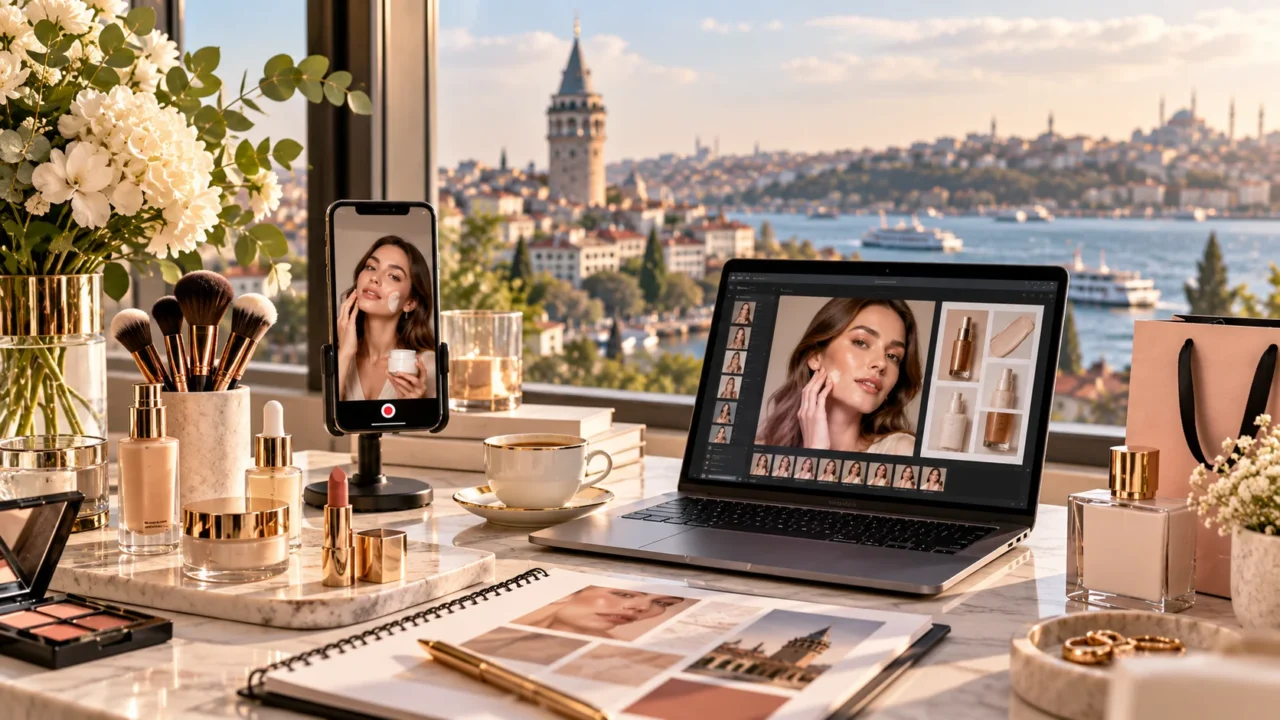
Beauty and Cosmetics Marketing in Turkey: What Foreign Brands Need to Know
Two things decide whether a foreign beauty brand works in Turkey, and neither is media budget. The first is whether you can legally place the product on the market at all — which requires a responsible person established in Turkey and notification through the Ministry of Health’s product tracking system before first sale. The second is whether the claims your global campaign is built on survive translation into a regulatory environment that treats cosmetic claims as a supervised category, with two separate authorities able to act on them.
Get those right and the channel work is comparatively familiar: Turkey is a creator-driven, marketplace-heavy, mobile-first beauty market where discovery happens on social platforms and conversion often happens somewhere you do not control.
Get them wrong and you will either be unable to sell, or you will run a campaign whose central claim cannot be made here. This guide covers the regulatory gate, where global beauty copy typically breaks, how the channel mix actually works, and what changes about creator marketing when the category is cosmetics.
Table of Contents
- The market, and which numbers to distrust
- The regulatory gate before any marketing
- Product claims: where global copy breaks
- Borderline products
- Two regulators, not one
- Where Turkish beauty discovery actually happens
- Marketplaces and retail distribution
- Creator marketing in a regulated category
- Creative and localization
- Consumer trust, reviews and counterfeits
- Common mistakes
- A realistic first 90 days
- Frequently asked questions
- Conclusion
The market, and which numbers to distrust
Turkey is a significant cosmetics economy in both directions, and the trade data is the part worth trusting.
According to the İstanbul Chemicals and Chemical Products Exporters’ Association (İKMİB), drawing on Trade Map data, Turkey’s cosmetics exports reached USD 2.3 billion in 2024, representing 1.2 percent of world exports, while imports stood at around USD 2.1 billion, or 1.1 percent of world imports. In the first half of 2025, cosmetics exports rose to approximately USD 1.08 billion, up around 14 percent on the same period of 2024.
The import figure is the one foreign brands should note. Turkey imports nearly as much cosmetics value as it exports, which tells you two things: there is real domestic demand for international product, and you will be competing against both global brands already established here and a genuinely capable local manufacturing sector.
The numbers to treat carefully are domestic market size figures quoted in Turkish lira. Published estimates vary widely between sources and years, they cover different category scopes, and lira figures are distorted by inflation in ways that make year-on-year comparison meaningless without adjustment. If a proposal justifies your Turkish investment with a lira market-size figure and a growth percentage, ask what scope it covers, what year it is from, and whether it is adjusted. This article does not quote one, for those reasons.
For the broader market-entry picture, see our guide to marketing in Turkey for foreign brands.
The regulatory gate before any marketing
Cosmetics in Turkey are regulated under Law No. 5324 on Cosmetics and the Cosmetic Products Regulation published in the Official Gazette of 8 May 2023 (No. 32184, repeating issue), administered by TİTCK — the Turkish Medicines and Medical Devices Agency, under the Ministry of Health.
Three requirements shape the timeline for a foreign brand.
A responsible person established in Turkey is mandatory. Under Article 6 of the Regulation, the responsible person is the natural or legal person obliged to ensure that products placed on the market comply with the applicable obligations. For imported cosmetic products, the importer is the responsible person by default for each product it places on the market. The importer may, by written agreement, designate another natural or legal person established in Turkey as the responsible person, and that person must accept the designation in writing.
A distributor is not automatically an available candidate for the role. Under the Regulation a distributor becomes the responsible person only in defined circumstances — where it is designated as such in writing, where it places the product on the market under its own name or trademark, or where it modifies a product already on the market in a way that could affect compliance with the applicable requirements. Translating a label for the market it is placed on does not, by itself, count as that kind of modification.
This is a structural decision that carries real liability, so it is not a box to tick casually, and “our distributor handles it” is not an answer until you can point to the written designation.
Notification before first placing on the market. Under Law No. 5324, notification must be made before a cosmetic product is placed on the market for the first time, and subsequent changes to the product or the manufacturer must also be notified. Notification runs through TİTCK’s Product Tracking System (ÜTS), where the responsible person submits the original label, a Turkish label where the original does not carry Turkish information, and packaging visuals, along with barcode, brand and product names, nominal quantity, function code, origin details, responsible person and contact details, and the formulation expressed as ranges.
Notification is not approval — and you cannot advertise it as one. TİTCK states plainly that no letter or document is issued confirming that a notification has been recorded, and that all responsibilities under Laws No. 5324 and 7223 rest with the responsible person. That has a direct marketing consequence: claiming or implying that a product is “TİTCK approved” or “ÜTS approved” misrepresents what notification is.
There are also ongoing obligations that touch marketing indirectly. The responsible person must operate a cosmetovigilance system and record product-related data, and under Article 26 of the Regulation both the responsible person and the distributor must notify TİTCK immediately of serious undesirable effects. If your Turkish launch generates consumer complaints about reactions, that is a regulated reporting process with no comfortable delay built into it, not only a customer service issue.
Product claims: where global copy breaks
This is where most foreign beauty campaigns run into trouble, and it is worth being precise about how the rules work rather than generalising.
TİTCK publishes a Guideline on Cosmetic Product Claims (Kozmetik Ürünlerin İddialarına İlişkin Kılavuz) among its cosmetics guidance documents, alongside guidance on borderline products, safety assessment, product information files and labelling. The claims guideline sets the framework within which cosmetic claims must be substantiated and presented, and it has been revised — the “free-from” claim criteria in its annex were updated in 2024, for example.
Because the specific permissible wording depends on the claim, the product, the evidence behind it and the current version of the guideline, this article does not attempt to list what you can and cannot say. Any brand bringing global claims into Turkey should have them reviewed against the current guideline text by someone qualified, before the campaign is produced rather than after.
What is worth stating is the pattern of where foreign brands get caught:
- Claims that drift toward treatment. Global beauty copy frequently borrows therapeutic language. A cosmetic is defined by its function, and a claim that positions the product as treating a condition is a different regulatory category.
- Substantiation held in another market’s format. Evidence assembled for a different regulatory regime may not map onto what is expected here. The substantiation file matters as much as the wording.
- “Free-from” and negative claims. These are specifically addressed in the claims guideline’s annex and have been revised, which is exactly the kind of detail a translated global asset will not have accounted for.
- Before-and-after imagery and percentage results. Any quantified result in an advertisement invites the question of what evidence supports it — and in Turkey that question can come from a regulator rather than a consumer.
- Influencer language outrunning the approved claim. A creator describing your product in stronger terms than your own copy does is a claim being made in your advertising. More on this below.
Borderline products
TİTCK maintains a specific guideline on products that constitute a borderline with cosmetics, which exists because the boundary is genuinely contested in modern beauty categories.
The categories where foreign brands most often discover they are not selling what they assumed include products positioned around active dermatological outcomes, certain device-adjacent items, oral or ingestible “beauty” products, and anything marketed around a physiological mechanism rather than a cosmetic effect. The classification determines which regime applies, which authority supervises it, and what you may say about it.
Get the classification confirmed before building positioning on top of it. A brand that discovers mid-launch that its hero product is not regulated as a cosmetic in Turkey loses both the campaign and the timeline. Where a product does sit closer to health territory, the channel and regulatory picture differs substantially — that terrain is covered in our guide to healthcare and wellness marketing in Turkey.
Two regulators, not one
A point foreign teams routinely miss: product compliance and advertising compliance are supervised separately.
TİTCK regulates the product — its safety, notification, labelling and the claims attached to it as a cosmetic. The Advertising Board (Reklam Kurulu), operating under the Ministry of Trade within the consumer protection framework, supervises commercial advertising and unfair commercial practices, and can order advertising stopped, require corrections and impose administrative fines. Cosmetics advertising has been an area of Advertising Board activity, including against large international advertisers.
The practical implication is that a claim can be defensible as a cosmetic claim and still be challenged as misleading advertising, or vice versa. A single legal review scoped to product registration will not cover the advertising exposure. Scope both.
Where Turkish beauty discovery actually happens
Beauty in Turkey is a creator-led, video-first category. That is not a Turkey-specific observation in itself, but two local characteristics shape how it plays out.
The discovery-to-purchase path usually crosses platforms. A Turkish consumer typically encounters a product through a creator on Instagram or TikTok and completes the purchase on a marketplace or in a chain retailer — not on the brand’s own site. Attribution models built on last-click on your own domain will systematically understate creator performance and overstate branded search.
Video does the explanatory work. Application technique, texture, shade matching and results are visual problems, and static imagery built for a European e-commerce grid underperforms here. What performs in Turkish social video is covered in our guide to video marketing and content production in Turkey, and the platform-level picture in social media marketing in Turkey.
For channel specifics, our guides to TikTok marketing in Turkey and Instagram and Meta Shopping for e-commerce in Turkey cover the mechanics. What is category-specific for beauty is that the creator layer is not a campaign tactic here — it is the primary discovery infrastructure, and budgeting it as a quarterly activation rather than an always-on channel tends to produce disappointing results.
Marketplaces and retail distribution
Beauty is one of the most marketplace-dependent categories in Turkish e-commerce, which creates a specific problem for foreign brands: your products are often already being sold in Turkey before you enter.
Parallel importers, grey-market sellers and small distributors list international beauty products on Turkish marketplaces routinely. Before planning a launch, audit what is already listed under your brand — who is selling it, at what price, with what product information, and with what reviews. That existing footprint sets the price expectation and the review baseline you will inherit, and it may include product that was never notified through the proper channel.
Three consequences for planning:
- Price positioning may already be set for you by existing listings, and undercutting or repricing is a commercial negotiation rather than a marketing decision.
- Review history attaches to the product, not to you. A poor review base accumulated by a grey-market seller shipping old stock becomes your starting position.
- Marketplace advertising is downstream of listing control. There is little value advertising a listing you do not control.
The wider marketplace and platform picture is covered in our guides to e-commerce in Turkey and Hepsiburada and Amazon Turkey advertising. Alongside marketplaces, Turkey has a developed specialist beauty retail channel and a strong pharmacy channel for dermocosmetics, and which of those your category belongs in should be settled before the media plan, because it determines whether you are running a retail-support programme or a direct-to-consumer one.
Creator marketing in a regulated category
Beauty is the most creator-dependent category in Turkish marketing, and also one where creator content carries the most regulatory risk. Both facts need to sit in the same plan.
On the commercial side, our guides to influencer marketing in Turkey and influencer marketing costs in Turkey cover selection, rates and structure. What is specific to beauty:
Creator claims are your claims. A creator saying your serum “fixes” something, or attributing a result your substantiation does not support, is a claim appearing in your advertising. Briefing creators on what may and may not be said about the product is a compliance control, not a brand-tone preference, and it should be part of the contract rather than a conversation.
Disclosure obligations are prescriptive in Turkey. Turkish rules on social media influencer advertising are more specific than in many markets, including on which words must appear and where they must be visible. Beauty is a high-volume gifting category, and in-kind benefit triggers disclosure obligations just as payment does. Build label verification into content approval.
Micro-creator volume raises the control problem. Beauty programmes often run dozens or hundreds of creators. That scale is exactly where claim discipline and disclosure compliance break down, because nobody reviews the hundredth post. Decide how you will actually check, before you scale the programme.
Authenticity is commercially load-bearing here. Turkish beauty audiences are practised at identifying creator content that reads as scripted, and the backlash is visible in comments rather than silent. Content that acknowledges limitations tends to outperform content that does not.
Creative and localization
Beauty creative transfers worse across markets than almost any other category, because so much of it is embedded in local standards, routines and vocabulary.
Shade and tone representation. Turkey’s consumer base spans a wide range of skin tones and hair types. Global asset libraries built for a single regional market frequently fail to show a relevant reference point, and in a category where the customer is asking “will this look right on me,” that is a conversion problem rather than a diversity checkbox.
Routine and ritual differ. Steps, sequences and product categories in a routine are culturally specific. Creative built around an assumed routine that Turkish consumers do not follow asks them to translate the proposition themselves.
Ingredient vocabulary is genuinely mixed. Turkish beauty conversation uses a blend of Turkish and English ingredient and category terms, and which dominates varies term by term. This has to be checked against how Turkish consumers and Turkish retailers actually write, not decided by a translator — the same principle set out in our guide to website localization for Turkey.
Seasonality and cultural moments. Turkey’s calendar has its own peaks for gifting and self-care categories that do not map onto a Western retail calendar.
Production is where this usually resolves. Localised beauty creative generally means originating content in Turkey with Turkish talent rather than adapting a global shoot — which is the kind of work agencies with local production capability, Medyae among them, are set up to handle alongside the social and creator side. That is a practical point about where the work happens, not a substitute for the regulatory review described above.
Consumer trust, reviews and counterfeits
Trust is a sharper issue in beauty than in most categories, because counterfeit risk is real and consumers know it.
International beauty brands are common counterfeit targets, and Turkish consumers are correspondingly attentive to whether a seller is authorised. Authorised-seller signalling, clear authenticity information and a visible official channel are commercially useful here rather than merely defensive.
Reviews carry unusual weight in the category, and Turkish rules on how consumer reviews may be collected and displayed are specific — including that reviews should come from consumers who actually purchased the product, and that positive and negative reviews should not be treated differently. If your review infrastructure was configured for another market, that configuration is worth checking.
Complaint platforms also play a visible role in Turkish consumer discourse, and beauty brands attract reaction volume around reactions, authenticity and delivery. Having a response process before you need one matters — see our guide to reputation and crisis management on social media in Turkey.
Common mistakes
Planning the campaign before confirming the responsible person and notification. The regulatory path sets the launch date, not the media plan.
Assuming global claims transfer. They need review against the current Turkish claims guideline, before production.
Describing notification as approval. TİTCK issues no confirmation document, and notification is not an endorsement.
Scoping only product registration for legal review. Advertising is supervised separately by the Advertising Board.
Launching without auditing existing marketplace listings. Your price and review baseline may already exist.
Treating creators as a campaign line item. In Turkish beauty, the creator layer is the discovery channel.
Letting creator claims run ahead of substantiated copy. Their words become your advertising.
Judging creator performance on last-click to your own site. Purchase frequently completes on a marketplace.
A realistic first 90 days
Before launch. Settle the responsible person structure. Confirm product classification, including anything near a borderline. Complete notification. Have global claims reviewed against the current Turkish guideline, and rebuild the substantiation file where needed. Audit existing marketplace listings under your brand.
Weeks 1–4. Establish listing control where you can. Produce Turkish-originated creative for your hero products rather than adapting global assets. Brief an initial creator group with explicit claim and disclosure requirements written into the contract.
Weeks 5–8. Read performance at category and marketplace level rather than last-click to your own site. Expand the creator group only once your approval process has been tested at small scale. Build out review infrastructure in line with Turkish requirements.
Weeks 9–12. Assess whether your category belongs in a marketplace-first, specialist retail or pharmacy-channel model, and reallocate accordingly. Establish your own Turkish benchmarks rather than importing regional ones.
Frequently asked questions
Does a foreign cosmetics brand need a legal entity in Turkey?
You need a responsible person established in Turkey. For imported products the importer is the responsible person by default, though it may designate another person established in Turkey in writing, with that person accepting in writing. A distributor takes on the role only in defined circumstances — written designation, placing the product under its own name or trademark, or modifying a product already on the market in a way that could affect compliance. The role carries compliance obligations and should be settled deliberately rather than assumed.
Do cosmetic products need approval before sale in Turkey?
Notification, not approval. Under Law No. 5324, notification must be made before a product is first placed on the market, through TİTCK’s Product Tracking System. TİTCK states that no document is issued confirming a notification has been recorded, and responsibility rests with the responsible person — so a product cannot be marketed as “TİTCK approved.”
Can I use my global product claims in Turkey?
Not without review. TİTCK publishes a guideline on cosmetic product claims that sets how claims must be substantiated and presented, and it is revised over time. Because permissible wording depends on the claim, product and evidence, global copy should be reviewed against the current guideline before production rather than after.
Who regulates cosmetics advertising in Turkey?
Two authorities are relevant. TİTCK regulates the product, its notification, labelling and cosmetic claims. The Advertising Board under the Ministry of Trade supervises commercial advertising and unfair commercial practices and can stop advertising, require corrections and impose fines. A legal review covering only product registration leaves the advertising exposure unassessed.
Are influencers essential for beauty marketing in Turkey?
For most consumer beauty categories, creator content is the primary discovery channel rather than a supplementary one. The trade-off is that creator claims form part of your advertising, and Turkish disclosure rules are prescriptive, so scale needs a real approval process behind it.
Where do Turkish consumers actually buy beauty products?
Frequently on marketplaces, alongside specialist beauty retail and, for dermocosmetics, pharmacies. Discovery and purchase commonly happen on different platforms, which means measurement based on last-click to your own site will misread channel performance.
Conclusion
Beauty is one of the more attractive categories for foreign brands entering Turkey — real import demand, a young and engaged consumer base, and a creator ecosystem that can build awareness quickly. It is also one of the few categories where the regulatory work genuinely gates the marketing work, rather than running alongside it.
The sequence that works is unglamorous: settle the responsible person, confirm classification, complete notification, get your claims reviewed against the current Turkish guideline, audit what is already being sold under your name, and only then build the campaign. Brands that run it in that order launch on schedule. Brands that start with the media plan tend to discover, somewhere around week six, that their hero claim cannot be made here and their bestseller has been on a marketplace for two years with a two-star average.
This article is general information based on published legislation and official guidance as at the date shown. It is not legal or regulatory advice. Cosmetic regulation, guidance documents and advertising rules change, and the treatment of any specific product or claim depends on its facts. Confirm your position with qualified Turkish regulatory and legal advisors before acting.