



Reputation and Crisis Management on Social Media in Turkey
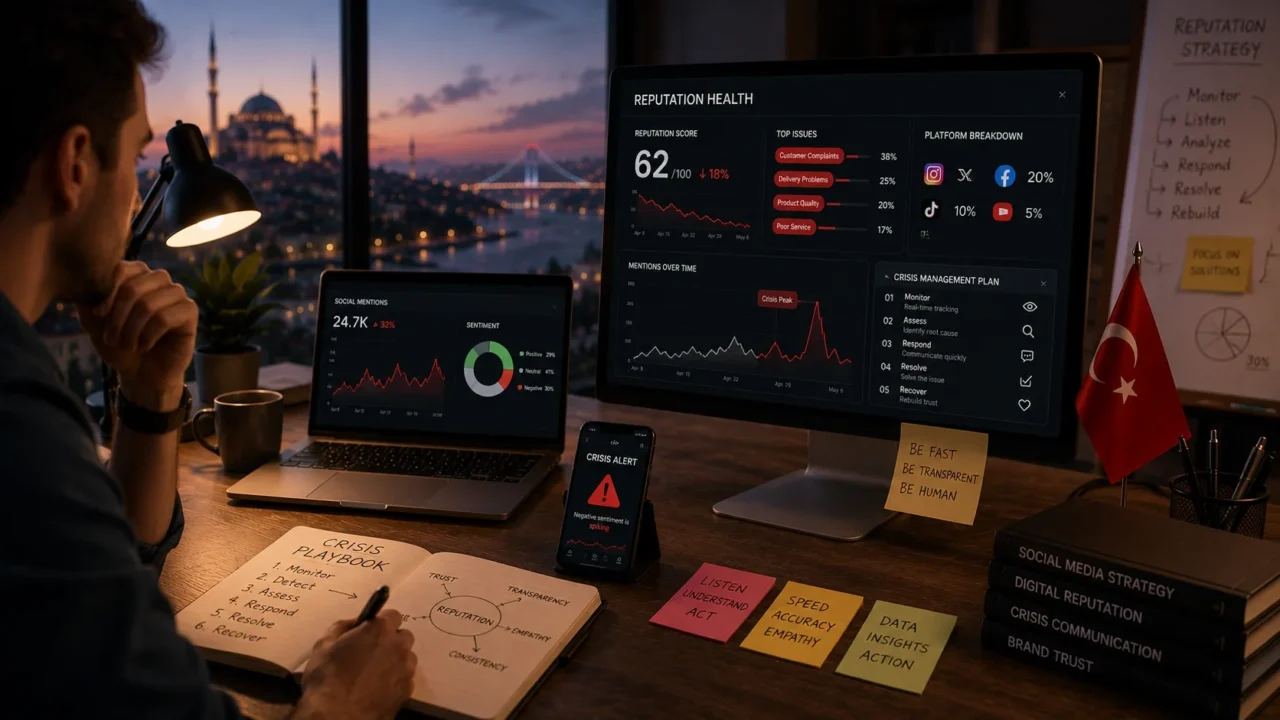
A single customer service complaint on Instagram, left unanswered for a day, rarely stays a single complaint in a market where Turkish social media users are quick to amplify a shared grievance. Reputation and crisis management in Turkey requires the same fundamentals as anywhere else — monitoring, fast response, honest communication — but the speed at which local sentiment can shift, and the specific cultural expectations around how a brand responds, make a generic global playbook insufficient on its own. This guide covers monitoring setup, early warning signs, response principles, language and tone considerations, escalation protocols, post-crisis recovery, and how a foreign brand should build genuine crisis readiness rather than improvising a response after a situation has already started to escalate.
Table of Contents
- Why Crisis Dynamics Differ in Turkey
- Setting Up Reputation Monitoring
- Early Warning Signs Worth Watching
- Categorizing Severity: Complaint vs. Crisis
- Response Principles That Work Locally
- Language and Tone in a Crisis Response
- Building an Escalation Protocol
- Who Should Respond: Local Team vs. Global Headquarters
- Post-Crisis Recovery
- Building Crisis Readiness Before You Need It
- How Crisis Dynamics Differ by Platform
- Measuring Reputation Impact After an Incident
- Common Mistakes
- Conclusion
- FAQ
Why Crisis Dynamics Differ in Turkey
Turkish social media users tend to be highly active in amplifying shared complaints, and a grievance that resonates — a delivery failure, a perceived pricing unfairness, a tone-deaf piece of content — can move from a single comment to widespread visibility faster than in less socially active markets. This isn’t unique to any one platform; it shows up across Instagram, X, and TikTok alike, and it means the response window a brand has before a minor issue becomes a visible reputation problem is often shorter than teams accustomed to slower-moving markets expect.
Part of what accelerates this amplification is the density and interconnectedness of Turkish social media communities relative to the population size — a complaint that resonates with a shared cultural frustration (a sense of being treated differently as a foreign brand’s customer than customers in the brand’s home market, for instance) can spread through overlapping community networks unusually quickly. Foreign brands sometimes underestimate this because their home-market experience with a similar-sized complaint didn’t produce the same velocity, not realizing that market-specific amplification dynamics, not the complaint’s objective severity, are what’s actually different.
Foreign brands specifically face an additional layer of scrutiny that domestic Turkish brands don’t always encounter to the same degree: any perceived inconsistency between how a brand treats customers in its home market versus in Turkey becomes its own point of grievance, separate from whatever the original complaint was about. A shipping delay handled with a generous, well-publicized goodwill gesture in one market and a purely procedural response in Turkey can trigger a secondary wave of criticism about double standards, layered on top of the original issue — which is a dynamic worth being genuinely aware of when comparing how customer service policy and tone should be calibrated across markets.
Setting Up Reputation Monitoring
- Social listening tools should be configured for Turkish-language keywords and phrasing, not just brand name mentions in English — a complaint written entirely in Turkish slang or informal phrasing can easily slip past a monitoring setup calibrated for a different language pattern.
- Monitor beyond the brand’s own channels. Complaints and discussion frequently happen in comments on other accounts, in Twitter/X threads, and in community groups rather than only on the brand’s own posts — the same broad monitoring principle applies to data handling during any resulting customer interaction.
- Assign clear ownership for monitoring during off-hours. A complaint posted in the evening or over a weekend that goes unanswered until the next business day has already had significant time to gain visibility — a staffing decision that connects to the broader agency versus in-house tradeoff many brands face.
- Set up keyword variants and common misspellings. Turkish users frequently write brand names with different capitalization, spacing, or informal abbreviations, and a monitoring setup that only catches the exact official brand name spelling misses a meaningful share of relevant conversation.
Early Warning Signs Worth Watching
- A sudden spike in comment volume on a single post, especially with a shift in sentiment, is often the first visible sign that something is escalating beyond a normal individual complaint.
- The same complaint appearing across multiple, previously unconnected accounts suggests organic amplification is underway, which typically accelerates faster than a single-source complaint would.
- Mentions migrating from comments into direct posts or stories signal that frustrated customers are actively trying to increase visibility rather than simply venting in a reply.
- A noticeable shift in the tone of routine customer service inquiries — more sarcasm, more references to “everyone is saying” — can indicate that a specific issue has already started circulating in group chats or community spaces the brand’s monitoring tools don’t directly cover.
- An uptick in unfollows or negative reviews on third-party platforms occurring in parallel with social media activity often indicates the issue has moved beyond a vocal minority into broader, quieter dissatisfaction that’s less visible in comment threads alone.
Categorizing Severity: Complaint vs. Crisis
Not every negative comment warrants a crisis-level response, and treating every complaint with the same intensity both exhausts a social media team and can actually draw more attention to minor issues than they’d otherwise receive. A useful framework distinguishes between routine complaints (individual customer service issues handled through standard response protocols), emerging concerns (a pattern of similar complaints suggesting a systemic issue worth investigating), and genuine crises (rapid, widespread amplification with real potential brand damage). Having this framework defined and agreed upon before a real situation arises — rather than debating severity classification in the middle of an actual incident — allows the team to move faster when speed genuinely matters.
Response Principles That Work Locally
- Acknowledge quickly, even before a full resolution is ready. A visible, timely “we’re looking into this” response does real work in slowing escalation, even when the actual fix takes longer to deliver.
- Take detailed resolution out of public comments and into direct messages, but only after a public acknowledgment — resolving entirely in private without any public visibility can read as avoidance to onlookers following the thread.
- Avoid defensive or dismissive language, even when a complaint feels unfair or based on a misunderstanding; a tone that reads as dismissive tends to escalate a situation further rather than de-escalate it.
- Own genuine mistakes directly rather than deflecting to policy or process. A response that leans too heavily on “this is our standard policy” language, when a customer clearly feels wronged, often reads as more concerned with liability than with the customer’s actual experience.
- Match the response format to the platform where the complaint originated. A thoughtful written response works well on Instagram or X, but a complaint that’s gained significant traction through video content (a TikTok or Reel highlighting the issue) sometimes benefits from a video response as well, since it demonstrates the brand engaging on the same terms the criticism was raised in.
Language and Tone in a Crisis Response
A crisis response drafted in English and translated, or written in an overly corporate register, reads as impersonal at exactly the moment a more human tone is needed most. Native Turkish response drafting — not just accurate translation, but genuinely natural phrasing and appropriate register — matters as much here as it does in the rest of a brand’s social media presence, and arguably more, since a crisis response is scrutinized far more closely than routine content.
Register matters specifically here too — a response that’s too formal can read as cold and corporate, while one that’s too casual can seem to trivialize a genuine grievance. The right register generally sits closer to how a thoughtful, empathetic customer service representative would speak in person than either extreme, and this is a genuinely difficult balance to strike correctly without native fluency and cultural familiarity, which is part of why crisis response drafting is one of the areas where local expertise matters most.
Building an Escalation Protocol
A clear, pre-agreed escalation protocol removes the need to improvise decision-making authority during an actual crisis, when speed matters most. This should define who has authority to post an initial public acknowledgment without waiting for full executive sign-off, at what severity level the situation gets escalated to senior leadership or legal review, and how quickly different levels of the organization need to be looped in. A protocol that requires multiple rounds of headquarters approval before any public response can be posted often means the brand’s first visible reaction comes hours after a situation has already gained significant traction — by which point the initial silence has itself become part of the story.
Who Should Respond: Local Team vs. Global Headquarters
For most day-to-day reputation management and even moderate-severity incidents, response authority should sit with the local Turkish team, who understand the cultural context and can respond in native language without translation delay. Global headquarters involvement makes sense for higher-severity situations with potential legal, financial, or global brand implications, but even then, the actual public-facing communication should be drafted or at minimum closely reviewed by someone with genuine local fluency — a response drafted entirely at headquarters and simply translated for local posting carries the same tone and register risks as any other translated crisis communication.
Post-Crisis Recovery
- A clear, public follow-up once an issue is resolved closes the loop for anyone who saw the original complaint but not necessarily the resolution, and demonstrates accountability beyond the initial response.
- Internal review of what triggered the issue should feed back into operational or communication changes, not just the immediate response — recurring versions of the same complaint suggest an unaddressed root cause rather than a one-off incident.
- Rebuilding trust takes sustained, consistent behavior rather than a single well-handled response; one good crisis response doesn’t undo a pattern of poor communication if the underlying issue recurs.
- A brief internal post-mortem, even for a relatively minor incident, helps refine the escalation protocol and response playbook for next time, turning each incident into an opportunity to improve institutional readiness rather than treating every crisis as an isolated, one-off event with no lasting organizational learning.
Building Crisis Readiness Before You Need It
The strongest crisis responses are almost always built on preparation done well before any actual incident. This includes having pre-approved response templates for common issue categories (delivery delays, product defects, customer service complaints) that can be quickly adapted rather than drafted from scratch under time pressure, a clearly documented escalation chain with named individuals and their availability, and a designated native-Turkish-speaking spokesperson or response owner who’s already familiar with the brand’s voice and values before ever needing to apply that familiarity in a live crisis. Brands that treat crisis preparedness as a one-time onboarding task, rather than something revisited and rehearsed periodically, often find their actual protocol has quietly gone stale — team members change roles, escalation contacts become outdated, and templates no longer reflect current product or policy realities.
Running a periodic tabletop exercise — walking through a hypothetical but realistic crisis scenario with the actual response team, without it being a real live situation — is a practical way to stress-test the protocol and surface gaps before they matter. Brands that have never actually rehearsed their crisis process often discover, in the middle of a real incident, that key contact information is outdated or that no one is quite sure who has final sign-off authority — problems a fifteen-minute tabletop exercise would have caught in advance.
How Crisis Dynamics Differ by Platform
A crisis doesn’t unfold identically across every platform, and a response strategy built around one platform’s dynamics without accounting for how the others behave differently tends to leave a brand reacting a step behind on whichever platform wasn’t the primary focus.
Instagram and X tend to be where a complaint first surfaces and where a brand’s public acknowledgment carries the most immediate weight, since these platforms reward quick, visible engagement and penalize silence. TikTok crisis dynamics move differently — a single video highlighting an issue can accumulate views and shares at a pace that outstrips a brand’s ability to respond through the same medium in real time, which is part of why having a video response option prepared in advance, not just a written statement template, matters specifically for TikTok-originated situations. WhatsApp and closed group chats present a distinct challenge: sentiment can build in spaces a brand’s monitoring tools simply can’t see directly, meaning the first visible sign of trouble sometimes arrives already partway escalated, with the earlier private discussion invisible to the brand until it surfaces publicly.
This platform variation argues for a crisis protocol that names specific platform-appropriate response formats in advance, rather than a single generic response plan assumed to translate equally well everywhere. A team that’s only ever prepared a written statement template will find itself improvising if the actual crisis is unfolding primarily through short-form video.
Measuring Reputation Impact After an Incident
After a crisis is resolved, it’s worth deliberately assessing what actually happened rather than simply moving on once the visible noise dies down. Sentiment tracking before, during, and after the incident gives a clearer picture of genuine reputational impact than impression alone — a brand’s own sense of how badly a situation went doesn’t always match what the underlying sentiment data shows, in either direction.
Beyond sentiment, tracking whether the incident produced any measurable change in follower growth rate, engagement rate on subsequent posts, or direct customer inquiries referencing the incident helps quantify impact in terms a broader business audience, not just the social media team, can act on. This data also becomes valuable input for the post-mortem process, giving the next protocol revision something more concrete to work from than general impressions of how the response went.
Common Mistakes
- Monitoring only for English-language or exact brand-name mentions. This misses a significant share of Turkish-language discussion happening in more informal phrasing.
- Slow off-hours response. Given how quickly local amplification can move, a delayed weekend or evening response often means responding after visibility has already grown substantially.
- Translating a crisis response rather than drafting it natively. This reads as impersonal at the exact moment a human tone matters most.
- Resolving privately with no public acknowledgment at all. This can look like avoidance to anyone following the public thread, even if the private resolution itself was handled well.
- Requiring excessive headquarters approval before any public response. This delays the brand’s first visible reaction past the point where it can meaningfully slow escalation.
- Treating every complaint with crisis-level intensity. This exhausts the response team and can draw more attention to minor issues than they’d otherwise receive.
- Ignoring platform-specific crisis dynamics. A written-only response plan leaves a brand improvising when a crisis unfolds primarily through video content, particularly on TikTok.
- Skipping post-incident measurement. Without tracking sentiment and engagement before and after, a brand has no reliable way to know whether a response actually worked or simply felt like it did internally.
Conclusion
Eight points are worth carrying into a Turkey reputation management strategy:
- Local amplification can move faster than in less socially active markets, shrinking the effective response window.
- Monitoring needs to be configured for Turkish-language, informal phrasing, not just direct brand mentions.
- A quick public acknowledgment, even before full resolution, does real work in slowing escalation.
- Native Turkish response drafting matters more in a crisis than in routine content, given the closer scrutiny a crisis response receives.
- A clear, pre-agreed escalation protocol removes costly decision-making delay during an actual incident.
- Crisis readiness built and rehearsed in advance consistently outperforms improvised response.
- Different platforms demand different response formats, and a written-only plan leaves gaps for video-driven platforms like TikTok.
- Post-incident measurement turns each crisis into institutional learning rather than an isolated event with no lasting benefit to future readiness.
If you’re building a social media presence for Turkey and want reputation monitoring built into the strategy from the start, our Social Media Marketing in Turkey guide covers the broader content and community management approach.
FAQ
How quickly should a brand respond to a complaint in Turkey?
As quickly as possible, ideally within hours rather than the next business day — given how fast local amplification can move, a delayed response often means responding after a complaint has already gained meaningful visibility.
Do we need 24/7 monitoring, or is business-hours coverage enough?
Business-hours-only monitoring leaves a real gap, since complaints posted in the evening or over a weekend can gain significant visibility before anyone responds. At minimum, a clear escalation path for after-hours monitoring is worth having, even if full 24/7 staffing isn’t feasible.
Should complaints be handled entirely in private messages?
A brief public acknowledgment before moving detailed resolution to private messages tends to work better than resolving entirely out of public view, since onlookers following the thread see the brand actively engaging rather than going silent.
Does KVKK affect how we handle customer complaint data during a crisis response?
Yes — any personal data collected or processed while resolving a complaint, including in direct messages, falls under the same KVKK obligations as any other customer data handling, which is worth building into crisis response protocols rather than treating as a separate concern.
Who should decide whether a situation is a routine complaint or an emerging crisis?
This should be defined in advance through a clear severity framework rather than debated in the moment. Giving the local social media team authority to make an initial severity call, with defined triggers for escalating to senior leadership, allows faster response than requiring every judgment call to go up the chain first.
Is it worth preparing response templates before an actual crisis happens?
Yes — pre-approved templates for common issue categories, ready to be quickly adapted rather than drafted from scratch under time pressure, meaningfully speed up initial response time and reduce the risk of an improvised response containing an inconsistent or poorly considered message.